SID Washington Annual Conference: John Podesta Reframes MDGs for 2030

Washington, DC – PITAPOLICY, a new member to the Society for International Development, attended SID’s annual conference on Thursday, June 6th, 2013.  We were pleased to see how the conference covered politics, institutions, economics, and technology (our key themes in looking at development in the ‘pita-consuming’ region) and we have grouped the highlights across the PITAPOLICY themes for pita-consumers to comment further! The big question was: what do mean by “fragile” countries–what qualifies? As Joseph Hewitt of USAID explained, “Not absence of or , but absence of legitimacy & effectiveness.”

Our analysis: Policy, Institutions, Development, & Economic points, or PIDE POINTS, are identified! Our favorite theme revisited the age old question asked by childhood story character, Lorax, from Dr. Seuss’s “The Lorax”.  The Lorax asks how will societies respond to social conscience…

**Note: Our points are italicized.  Direct quotes will be shared in quotes, unless otherwise stated.

Politics in Development:

  • We tend to correlate democrtization processes as described in “How Development Confronts Politics?”
  • It’s a given that aid from political institutions IS political.

Interests in Development:

  • As companies expand into emerging markets, they c that they need to assume development actor role.~Dan Rundy

  • If private sector takes on more of a role while expanding in2 , is it or something else?


  • Need to encourage more American presence in field to engage on in states. -Tiff

  •  

    Mismatch problem: A fragile state problem must consider how local leaders focus on humanitarian assistance to maintain political career survival, while many donors focus on #sustdev. #mismatch


Technology in Development:

  • U.S. Department of State is supporting opposition via 1) a database of over 500 Syrians on ground to connect 2) mass media dissemination- Ast Secrty

Analysis in Development:

  • In 1991 identified a gamechanger: found that political is central to socio-economic Carothers  
  •  Since 2011, what we’ve seen from the is the impact of growing urbanization.
  • Perhaps, investments in education AND urban environments are needed two create resilience.  Think slum areas concentrated near huge hubs of unemployment.

Society for International Development

Welcome and Introduction: Rodney Bent, SID-Washington 2013 Conference Chair

Opening Keynote Address: John Podesta, Chair, Center for American Progress and the Center for American Progress Action Fund: John Podesta Reframes MDGs for 2030
  • “Progress towards Millennium Development Goals (MDGs) were not evenly achieved”
  • “Our report to for next set of recognized global move away from North-South dichotomy.”
  • Many MDGs implemented in “silos”
  • “Face of Poverty has changed since 2003, when MDGs first drafted”
  • More than 40 percent of global population lives in post-conflict, “fragile” states.
  • There may be a tension between the aspirations of not leaving people behind versus the practicality of achieving new MDGs for 2013.
  • PIDE POINT: Podesta recognizes that the MDGs must move away from ‘North-South’ dichotomy –esepecially  within regions (eg. MENA).  For example, partnerships would need to develop from within countries, like Egypt, that are reviewing its economic and social programs.
Concurrent Breakout Sessions (We focused on the Fragile Countries session since we spoke with one of the speakers after the presentation concluded.)
 
Panel 1: Building a Resilient City in Emerging Economies: Sustainable Development Interventions for Climate, Health, and Energy

 
Cities have become humankind’s permanent and irreversible home— 50% of humans now live in cities, 60% will do so in 2030, and perhaps 85% in 2100. Nearly every country in Africa, Asia, and Latin America has already become majority urban, or is in the process of doing so. This urbanization trend includes the world’s poor, the majority of whom will live in cities within two decades. While cities give the urban poor new opportunities, they
also create problems: one billion people live in slums without basic services such as clean water, and many suffer
from widespread hunger, violence, hazard exposure, and infectious diseases. This panel will bring together public,
private, and NGO experts to discuss the greatest development challenge of the 21st century — how to alleviate
conditions for the urban poor. Questions will include:
 
o How does urbanization change the development equation? How are cities different from rural
areas?
o What are the greatest challenges and opportunities presented by mass urbanization?
o What are rapidly-growing cities’ most pressing needs when it comes to development and
 poverty alleviation?
o What are best practices for managing transportation, job creation, health, sanitation , energy, and water demands?
Moderator:Peter Engelke, Senior Fellow, Strategic Foresight Initiative, The Atlantic Council
 
Speakers: Farley R. Cleghorn, Senior Vice President and Chief Technical Officer, Futures Group International
Joseph P. Danko, Senior Vice President and Managing Director of Urban Programs, CH2M Hill Dr. René Hohmann, Urban Specialist, Cities AllianceDr.
Christine Sow, Vice President, International Programs, Plan International USA
  • World Bank Spring Meetings released a specific report on the growing urban-rural dynamic. 
  • PIDE POINT: Given the growth of urbanization, note how the revolutions in Tunisia and Egypt emerged in the more urbanized parts of the country.

Panel 2: A Productive New Direction for the US Food Assistance Program–or a Proposal that is (Again) “Dead on Arrival”?

The Obama Administration has included in its FY 2014 budget submission a proposal that would reduce the
volume of in-kind commodity assistance shipped from the U.S. on U.S.-flagged vessels and increase the volume
purchased in local or regional markets, mostly in Africa and Asia. This is not a new proposal, as the Bush Administration requested something similar, but it may be the first not be marked “dead on arrival” in the U.S. Congressional in-box.
o What has changed?
o What has not changed?
Moderator: Connie Veillette,Senior Fellow, Lugar Center
Speakers:
Bill O’Keefe, Vice President for Government Relations and Advocacy, Catholic Relief Services
Lucas Koach, Policy Director, Food for the Hungry
Gawain Kripke, Director of Policy, Food Security and Hunger, Agriculture, & Trade, Oxfam America
Beth Tritter, Managing Director, Glover Park Group
  • This panel reviewed issues from several perspectives given the largely controversial book “Dead Aid” by Dambisa Moyo as well as in the debate “dead on arrival.”
  • PITAPOLICY Founder, Mehrunisa Qayyum, commented on the controversy in a March article: http://www.vancouverobserver.com/news/world/canada-reworking-dead-aid-model-foreign-policy
Panel 3: Fragile States: Why We Should Care
In geopolitics, how much we “care” is measured by the level of funding and political capital spent, both of which
are finite resources. Iraq and Afghanistan have received massive amounts as Tier 1 priority foreign policy issues,
whereas Somalia, Congo, Haiti, and even Sudan (among others)–all fragile states–receive only token resources
and no-cost diplomatic platitudes.
 o What are the costs and benefits of the United States providing resources in an attempt to reverse or remedy fragile states? How do we weigh     potentially competing security and humanitarian needs?
 o What is the track record for the success and failure of US and international engagements with failed or failing states? What are the fundamental ingredients that are required for progress toward stability and recovery?
 o What are the “bright spots” for intervention in these difficult areas?
 
Moderator: Melanie Greenberg, President and CEO,Alliance for Peacebuilding
Speakers:
Joseph Hewitt, Technical Team Leader, Office of Conflict Management and Mitigation, U.S. Agency for International Development (USAID)
Ambassador William Garvelink, Senior Advisor for Global Strategy, International Medical Corps
Haruyuki Shimada, Advisor, South Asia Department, Japanese International Cooperation Agency (JICA)
J. Randall Tift, Senior Policy Advisor, World Vision
  • “Linear solutions can make the problem worse in “~Greenberg
  • Fragility is not the “absence of democracy or economic systems”. RATHER it is “absence of legitimacy and effectiveness” in interactions between state and society — whereas legitimacy is the fairness of the system, and effectiveness in outcomes.
  • Make investments in ‘learning agenda’
  • “Partnerships are incumbent for civil society to organize”~Hewitt
  • Tift highlighted 10 World Vision lessons learned on fragile countries, such as “1) Fragile states are not helpless, 2) Fragile states are not passive, just disempowered; 3) Do not limit American staff from participating in field programs, among a few others.
  • PIDE POINT: Sometimes we aggregate data so much that we miss local area developments.
  • PIDE POINT: Disagree somewhat with Tift’s recommendation “Must blend security with counter-terrorism goals with the humanitarian goals” because private sector and NGOs will become even more dependent on outside assistance for security, which creates more tension.

Panel 4: Contracting Procurement Reform

USAID Forward is reforming the way America’s largest foreign aid agency does business. Other aid organizations
are also in the midst of implementing reforms that involve new strategies such as funding developing country
governments, businesses and NGOs directly. This panel will look at key policy issues, streamlining of timing for
procurement, outsourcing, and the role of small business.
 
o Do procurement reforms diminish the United States’ unique “whole of nation” approach to
international development?
 o What about other aid organizations? With AusAID potentially doubling its aid by 2016, how
can we measure progress to determine the total impact?
 o What about quality? Have USAID, AusAID and others surveyed their host nation partners to
see if their programs are effective?
 o Regarding contracting reform localization, does it have to be “either/or” with respect to local
and international contractors? Or are there ways to find synergies between these groups?
 
Moderator: Jim Kunder, Senior Fellow, German MarshallFund of the United States
Speakers:
Gregory Adams, Director of Aid Effectiveness, Oxfam America
Kathleen Flanagan, President and CEO, Abt Associates
Chris Tinning, Minister- Counsellor, Washington, Aus tralian Agency for International Development (Aus AID)
Eric Postel, Assistant Administrator for Bureau of Economic Growth, Education and
Environment, U.S. Agency for International Development (USAID)
 
  • PIDE POINT: Outsourcing security to private sector security was not discussed.
  • More discussion of the procurements challenges in latter keynote speeches.
 
Presentation of 2013Andrew E. Rice Award for Leadership and Innovation by a Young Professional in International
Development
  • Awarded to two from the Middle East & North Africa region working in Washington, DC: Morocco and Syria
  • Amazing how Abdallah’s work collaborated with civil society organizations on the ground in Syria to obtain over 200,000 documents to illustrate human rights violations, which we argue in our Huff Post Blog is the key driver for holding war criminals accountable in fragile countries, like Syria. Source: http://www.huffingtonpost.com/mehrunisa-qayyum/development-diplomacy_b_2878685.html


Luncheon Keynote Address Henrietta H. Fore Chairman and CEO, Holsman International, former
Administrator of the U.S. Agency for International Development (USAID)
 
 
  • Dual contradiction of USAID versus the private sector dollars.
  • PIDE POINT: “In “de-risking environments” we need to incentivize foreign direct investment, decrease “rent-seeking” and balance state and private donorship.”
Thomas Carothers, Vice-President for Studies, Carnegie Endowment
for International Peace, co-author ofDevelopment Aid Confronts Politics: The Almost Revolution


  • Development aid confronts politics–there’s no such thing as “nonpoliticized aid” because we are taking into accounts how our actions and aid giving will be perceived politically.  “We are thinking and acting political”.
  • “Almost” inserted into the title of book and talk because there is a potential of bringing in socio-economic reasons to engage.
  • We’ve shifted from the 60s and 70s model of “apolitical roots in providing only technical assistance” and towards the 90s trend where every significant US donor follows USAID in reviewing political development indicators.  These include governance, corruption, and rule of law.
  • Two impulses are driving the “Lorax” in Development: 1) End of the Cold War, less suspicious about donor activism; and 2) historic shift towards democritization with the language of human rights appealing to societies that are not as attracted political ideology discussions. 
  • But at least they converge on four words: accountability, participation, transparency, and INCLUSION.  World Bank, DFID, and others refer to these as “Demand-Side Reforms” as they realized that resistance to change comes from those power-holders in fragile countries.
  • INCLUSION received, and is receiving more attention, in the Social Safety Networks (SSN) discussions and recent World Bank Report for the MENA region.
Ambassador Rick Barton, Assistant Secretary for the Bureau of Conflict and Stabilization, U.S. Department of State
  • “How to give government an ear when international development community is busy giving everyone a voice!”
 
Plenary Session: Governance: The Diverse Demand Side
 
 
Conflicting pressures for progressive change from both the bottom up and top down can cause problems for
everyone involved in governance. How can all parties come together to work towards governance transformation? From the demand side, we will look at private equity, natural resource management, and telecommunications and their requirements for and impact on governance. This panel will address questions such as:
oWhat do those in private equity need to see before they will invest? What does the “Lorax” who speaks for the people whose lives will inevitably change feel is needed in governance?
o How does the most powerful game changer in recent times –social media and other telecommunications advances –affect governance?
o And what about from the top down? What is the point of view of the government leaders?
 
Moderator: Larry Garber, Deputy Assistant Administrator, U.S. Agency for International Development
(USAID)
 Speakers:
Teresa Barger, CEO and CIO, Cartica Capital
Charles Benjamin, President, Near East Foundation
Deborah Kimble, Practice Area Director for Governance and Civil Society, Creative Associates
Harris Khalique, AAWAZ Team Leader, DAI
  • “Securities laws are fine, but problem is with enforcement” ~Barger
  • Foreign Direct Investment (FDI) climate needs 1) laws, 2) enforcement, and 3) feedback loops to ensure accountability. ~Garber
  • “Rural communities have a remarkable capacity for self-governance regarding natural resources.” Benjamin
  • PIDE POINT: Rural communities need a sapce for self-governance, so consider different ways of codifying customary law when it comes to water rights.  Note Egypt, Sudan, and Ethiopia’s current water disputes.
Closing Keynote Address: Donald Steinberg, Deputy Administrator, U.S. Agency for International Development
  • “Private sector has to be involved with taking things to scale”
  • Inclusivity means groups need to be reflected in improved housing, employment, etc…in other words “where all the groups are included as planners”.  There’s not “About them without them”.
  • PIDE POINT: Inclusivity and donor assistance was linked towards US strategic interests when Steinberg commented that our fastest growing trade countries are those  that received U.S. aid. This has implications for other types of budgetary discussions as U.S. assistance funding has decreased in the last decade.
  • For questions on points above, feel free to tweet us @PITAPOLICY or email queries to qayyum@pitapolicyconsulting.com. Thanks!


Leave a Comment

Filed under Analysis, PIDE (Policy, International Development & Economics)

Qusair: A microcosm of @UN politics at the Expense of 30,000 Besieged Inhabitants

PITAPOLICY believes that Qusair/Qusayr represents the standstill of politicking at the United Nations…below we have broken down the besieged Qusair into Politics, Impact, Technology, and Analysis that have developed since Senator John McCain’s visit to Syria.  

Politics

AP reports highest U.S. ranking official’s visit to Syria: Sen. John McCain says Syrian rebels battling the forces of President Bashar Assad need ammunition and heavy weapons to counter the regime’s tanks and aircraft.

McCain spoke Friday, the day after he returned from an unannounced trip to Syria. McCain says the rebels need some kind of capability to reverse a battlefield situation that currently favors Assad’s forces.

Gen. Salim Idris is chief of the Supreme Military Council of the Free Syrian Army. He was with McCain on Monday as the lawmaker traveled inside Syria. McCain was the first U.S. senator to travel to Syria since the civil war began more than two years ago.

In a telephone interview, McCain said he met with 19 battalion commanders. He says lethal aid could be provided to them. More here and here:

Where Does the Syria Opposition in Syria Stand?


Impact

Al Jazeera Reports: UN wants safe corridor for Syrian citizens.  Government troops backed by Lebanese Hezbollah fighters pound Qusayr, as UN calls for residents to be allowed to flee.

Speaking to Al Jazeera, Rupert Colville, Pillay’s spokesman, said the humanitarian corridor could only be created if both sides agreed.

“Some of those wounded will clearly die if they don’t get medical treatment,” Colville said.

“There should be a ceasefire at least and they let the civilians and the wounded get out and also let some aid in as well. Civilians who stay behind will need food and water.

“International law does require fighting forces to allow aid to civilians in this sort of situation.”


BBC Reports on Qusair/Qusayr ‘s Humanitarian Crisis: The Red Cross has expressed alarm over the situation in the besieged Syrian town of Qusair, and has appealed for immediate access to deliver aid.

Thousands of civilians are believed to be trapped as pro-government forces battle rebels, with medical supplies, food and water scarce.

Technology

Reuters reports: Sophisticated technology from Russia and Iran has given Syrian government troops new advantages in tracking and destroying their foes, helping them solidify battlefield gains against rebels, according to Middle Eastern intelligence officials and analysts.

The technology includes increased numbers of Iranian-made surveillance drones and, in some areas, anti-mortar systems similar to those used by U.S. forces to trace the source of mortar fire, the officials and experts said. Syrian military units also are making greater use of monitoring equipment to gather intelligence about rebel

Analysis: Russia…Cutting off Nose to Spite Its Face

NPR: A City of Assad Supporters in War-Ravaged Syria listen here.

  1. Russia blocks “Declaration of Alarm” DESPITE that the International Red Cross has called for immediate access to besieged ht
  2. Russia blocks draft text because the  had “failed to speak out when was seized by rebels” MT


Leave a Comment

Filed under Analysis, Interests, PIDE (Policy, International Development & Economics), Politics, Technology

Live-Blog: “Democratic Transitions in the Arab World” #CSID14

PITAPOLICY is live-blogging the 14th Annual Conference “Democratic Transitions in the Arab World: Two Years After the Arab Spring”, hosted by the Center for the Study of Islam and Democracy in the International Trade Center in Washington, DC.  Speakers review Islamic interpretations of governance, democracy, and how to ensure “civil political culture”. (PITAPOLICY had to put civil political culture in quotes because the presenter on this subject, from the UK, was toooooo judgemental and narrow about his application of civil, civilized, and civic-minded.  In our view, these are all different traits.  A people are not a monolith in their attitude and behavior towards systems and citizenship.) 

Keynote:

Rached Ghannounchi, President of the Nahdha Movement in Tunisia Visions for a New Tunisia: How Islam & Democracy Can Support Each Other

Hady Amr of US Agency for International Development in the Middle East (@USAIDMIDDLEEAST)

  • “Responded to Arab Spring by establishing a mission b/c we can be a partner, as highlighted by Secretary John Kerry.
  • We have two goals:

1) Supporting economic empowerment & Inclusive Economic Growth

~Economic growth by spurring small business growth…and building a 21st century workforce.

~Working in the Education space: in process of launching Egypt Education initiative, which will invite hundreds of Egyptians to study in the U.S.

2) Strengthening Participatory democracy via transparency and accountability

~Great example in Yemen w/r/t electoral systems and constitutions.

~Regarding Syria: half of $250 Million gone to refugees in surrounding countries; working with programs in Turkey and Jordan.

Questions:

  • How will Tunisia deal with its corruption–even the charges post- Ben Ali?
  • How to implement transitional justice–especially as a model to fellow Arab Transition countries?
  • What is Ennahda’s Islamic identity? asked by Human Rights First
  • What do you plan to do to ensure that the blasphemy law does not spiral out of control? (it’s not in the Constitution, though).
  • Are you concerned about the breakdown of dialogue with certain groups, like the peaceful Salafis? asked by Tunisian journalist based in Tunis
  • What about transparency for lower-level officials? (Reminiscent of a recent incident of another Tunisian setting himself on fire.)

Ghannouchi: WE will not export the revolution to others…just the model.

  •  No revolution can be claimed by 1 leader. It’s the success and gift of our young people.
  • On transitional justice and reconciliation: We don’t want revenge…we have no grievances.  We encourage our brothers to forgive.
  • We must reeducate police and train them.  The police must work within the law.
  • If we’ve described what our goals are, what is left of our Islamic identity? Some people understand Islam as a sort of punishment. The main goal of government is not to punish, but to give services. So people conclude that we should get rid of Islam.
  • Salafis are not a monolith; similar to what I said about Islamists.
  • Democracy is not only a rule or system of government…it’s also a system of education.

Social & Economic Challenges

  • Economic Challenge: Employment still stuck as Tourism slowly recovering, e.g. Number of tourists=6 Million in 2012
  • Security Challenge: Revolution has weakened the state and the authority, which has given opportunity for some groups to cross the law. Extremists on both sides of the Right and the Left have tried to impose their views.
  • Salafi challenge is the “fruit of the Ben Ali regime” that needs to be resolved. (he’s being sarcastic)  Need to push Salafists, like the violent ones, to work w/in the law.

First country to be both Democratic and Muslim

  • And we feel the burden of responsiblity. Our revolution isn’t for experts, but for our people
  • We could’ve formed a government that was purely secular, but we want to reflect the wide political spectrum
  1. Doesn’t mean we exclude secularists either, just b/c they didnt win majority in election.
  2. Also, State’s role isn’t supposed to impose a type of life, but a security and services to the people so that they may make their own choices regarding how they live their daily life.
  3. Constitution: establishes citizenship and responsibilities. Refers  to “Saheefa” of the first Islamic state, which established citizenship. (PITAPOLICY: What are the responsibilities of citizenship, aside from tax payments?)
  • Organized through a process of consultation with political parties and NGOs on human rights — which lasted 5 weeks.  We decided not to include Shari’ah (Islamic law) in the Constitution. We compromised between a mixed system of Parliamentarian and Presidential.
  • Some people in our party accused of becoming the party of “compromise”, but we say we have the responsibility to include in order to move forward.

Questions:

  1. What is Islamism? Answer by Panelist: “Islamism might not have any weight as a monolithic ideological project. It doesn’t have any distinctiveness anymore.” ( We think Mandeville responded.)
  2. What do they have in common?
  3. “How did Syria uprising turn violent?” (We would’ve phrased it differently: What did the Assad regime do to facilitate a violent revolution in Syria?)

Panel 4 (happening in Parallel): What the USCan Do to Support Democratic Tansition in the middl East, Chaired by Michael Miklaucic
Radwan Ziadah “The Obligation of the International Community Towards the Syrian People”

  • People are seeing their sons and daughters being killed for nothing… there is no forced gap stop as systematic killings continue.  Arab League, and UN sent Observers, but the killing continues.
  • Describes the ongoing massacres which amount to more deaths than chemical weapons incidences reported. (What more to do than focus on chemical weapons…the U.S. is stuck on this point while we can’t move forward with addressing illegitimacy of Assad regime.)

Peter Mandaville “The Evolution of US Policy Towards Islamists”

  • People are going to start counting beards 2C how many Muslim Brotherhood or other groups fill up Ministerial positions.
  • (Is this a fair measure of pluralism…or represents the US evolution in noting Islamists?)

Marc Lynch, George Washington University “The Challenge of Islmaists in Power to US Democracy Promotion”

  • Arab Spring is not over…just started
  • Bahraini regime is in trouble, Kuwait in its biggest political crisis in its modern history; Saudi Arabia is not as comfortable as we think

Marina Ottaway, Woodrow Wilson Center “Problems of Transition: Lessons from Other Countries”

  • We continuously move from short term to short term strategy. We aren’t, but need to, reconsider a change in our policy towards Saudi Arabia, for example.
  • We cry that there are too many political parties in Egypt and Tunisia…so what? Those not working will dissolve
  • Clash of experience: e.g. Islamist groups…of course, this is normal in a transition b/c we’ve had parties that monopolized power and experience for SOOOO long. This is where the U.S. may play a positive role. Here’s where I’ve thought of some good suggestions. e.g. bring people over to the U.S. to study practical things.
  • Study: for example, we had someone from Morocco interning in a Congressman’s office, now he’s leading a Moroccan ministry. (Ummm…this may be more controversial for both Americans and Moroccans ;))
  • Legitimacy and Legality do not coincide…if it had, there would not have been an Arab Spring. Now we have to work to get them to coincide, which will bring about stability. “Legitimacy is in the eye of the beholder”

Panel 3: Democratic Transition in the Region Challenges and Opportunities Chaired by Robert Schadler
Daniel Brumberg, U.S. Institute for Peace “The Legacies of Protection Racket Politics: Egypt and Tunisia in Comparative Perspective”

Abdelhamid Abdeljabar “Social Media and the Arab Spring- The Vehicle that Made the Revolution Possible”

Three stages of news

  • Uncensored reporting, where Pres. AlGannouchi first seen by Tunisians on Al Jazeera television.
  • More satellite channels emerged: Al Arabiya from Saudi Arabia; Arab News Network from London; Sky News Arabia; US established Al Hurra
  • Digital Wave, which gives way to Citizen media, basically used by youth–educated mostly: social media and internet…which is shifting communication into dialogue all at the same time
  • Tunisia in 2010: 10% internet users were on . In 2011- jumped to 17%. 15% blogs talking abt  ~Prof. Abdeljabar
  • Egypt’s famous website “We’re all Khaled Said” gained 70K online supporters w/in a few days
  • Social media used to share symbols and mass proliferate throughout coffeehouses and through Youtube.

Maria Holt “Women and the ‘Arab Spring’: A Case Study of Yemen”

  • Although Tawakol Karman protested elections and quota systems are still not implemented, there are some positive developments…e.g. the background of activism continues to make up Yemen’s social fabric regardless of scholarship’s hesitancy to dig deep on Yemen in the general Gulf area.
  • Iconic Symbols of Empowerment: Women in Islamist organizations are in a unique position to activate voice, e.g. Islah Party….”when they speak, they speak w/confidence” attest some of her Yemeni women interviewees
  • Paradox: Concerns the role of Islam how it both “constrains and restrains women” during revolution and aftermath in Yemen.
  • Considers the Amnesty International Report not adequate to characterize the role of women in Yemen, despite their observations of discrimination b/c women assumed a strong role during Yemen revolution in 2011–even in 1967 regarding women’s rights. Considered more progressive. e.g. Boys and Girls studied together; minimum age for marriage.
  • Notes Tawakol Karman, the Nobel Peace Prize Winner hailed from Yemen –
  • During Revolution, fathers, brothers and husbands encouraged their sisters, wives to participate — however, in San’aa, some Islamist factions encouraged segregation

Note: Daniel Brumberg, US Institute for Peace had to excuse himself from panel.

Lunch Remarks via @PITAPOLICY Tweets

Questions from Audience:

  • What are best practices for managing elections?
  • Wouldn’t removing blasphemy laws still divide the society?
  • Marina Ottaway: Shouldn’t liberals also be more tolerant?

Panel 2: Can Tunisia Succeed as a Model?

Note: “Tunisia’s draft constitution must be revised to comply w/int. treaty obligations, argues Human Rights Watch

Source: http://ow.ly/lw7IM

“Electoral Formula and the Tunisian Constiutent Assembly”
John Carey, Dartmouth College

  • Note:Tunisia held the first post-ARab Spring election, for 217 members of its Constituent Assembly, by closed-list proportional representation
  • Used an electoral formula “Hare Quaote” where largest party was awarded less than a majority of seats and pushed them to negotiate with other groups in drafting a constitution.
  • Review of how Hare Quota operated as an Electoral Formula: Carey’s paper uses district level data to demonstrate that , had the other most commonly used electoral forumla been employed, the largest party would have been awarded a super-majority in the Assembly and been in a position to impose a consittution. Goving forward, the invcentives for party system fragmentation generated by the Hare Quota system could impede the development of Tunisian democracy, and reformers in taht country should consider replacing that formula with a divisor system.
  • 3 Things Right for Constituent Assembly: Single Tier Vote as opposed to Egypt, so level of transparency was high
  1. Selected Proportional Representation: meaning
  2. Magnitude: Governates that have higher populations, were divided up into Electoral districts
  3. Transparency: Voters should be able to know what their choice is getting them


  • Systematic: Know how their votes translates into number of seats…
  • Majority: How majoritarain governments form during narrow margins
  • Opportunities for Individual Accountability: How can voters “punish” parliamentarians through votes when not legislating constructively

Joelle Fiss Human Rights First FissJ@humanrightsfirst.org “Blasphemy, Freedom of Speech and Democratic Transition: The Case of Tunisia”

  • 200 cases of blasphemy laws violating #humanrights after 2011 – 5 in #Tunisia and growing problem #CSID14
  • Rec to Tunisia: happy that it’s not introduced into Tunisia constitution. hope that in post-constitutional phase that crimininalization is narrowly defined. violence response is absolutely unacceptable…even if one is deemed offended.
  • Call on Tunisians to protect those who have been accused or speak out against blasphemy laws – including parliamentarians.
  • Suffocates #civilsociety as mobs convene.Tunisia Sept 2012 where led to violence and poses citizen against citizen, forced govt authorities to take sides, lose-lose situation  incitement is different from blasphemy…look at intent.  the more you are offended, the more one feels entitled to more extreme responses… blasphemy becomes politicized

Alexander Martin, 1st Year Phd “Building common ground for democratiziation in Tunisia through the development of civil society and civil political culture”

  • Civility is the tolerance, or mutual accommodation in day to day dealings.
  • Civil society needs 2 things: state to protect the civil society and civil society to be protected from State.
  • Quoted some Orientalist works about how “Arabs lack civility within society”

Radwan Masmoudi, Center for Study of Islam & Democracy: “Building a Stable democracy in Tunisia What will it take?”

  • Transitional Justice is a big topic: related to accountability w/o turning it into a dictatorship.
  • Cleaning up the system: as in those who served Ben Ali. How to replace those who were corrupt…pace of reforms.
  • Reforming Media, Judges, and Judicial system.
  • Civil society is striving…it takes only a couple of days for NGOs to register. Reason optimistic  that Tunisia is going to make it.


  • Prblm w/dictatorship: They reject reforms. That’s why revolutions start. Prblm w/Rev: Happen suddenly & must destroy state. This is costly…almost becomes an anarchy.
  • The question in Tunisia: has to do w/pace. Haven’t had an opportunity to discuss them b/c focusing on Constitution.  Some people think we’re going too fast, whereas some feel that we’re going too slow. e.g. Constitution is behind schedule-it’s at one year in development–but it’s not about getting 10 experts to write it. The challenge is building consensus among people and the parties…that’s what takes time.
  • It’s easier 2 agree when discussing theory, harder 2 agree in practice
  • Why focus on Tunisia? B/c if building democracy doesn’t succeed in Tunisia, won’t succeed anywhere in other Arab transition countries.


Questions from Audience:

  • Can we ever point to a time that Islam had an ideally democratic phase in history?
  • Did Islam ever develop an economic theory outside of Zakat (Islamic require?


Panel 1: How a Proper Undersandinf of Islam Can Help Democracy? Chaired by Tamara Sonn
Abdulaziz Sachedina: “Can Islam of the Islamic parties in the Arab Sprng lead to democracy? Text and Textualism”

Nader Hashemi nader.hashemi@du.edu“Why Islam (properly understood) is the Solution: Reflections on the Role fo Religion in Tunisia’s Democratic Transition”

Abdulkarim Soroush, Scholar-in-Residence at Yale University:  “Lessons learned from the iranian Revolution”

  • The core of democracy is the judiciary. We overlooked this in Iran, where it’s weakest now.
  • My humble rec to Tunisia is to focus on the judiciary. ~Abdulkarim Soroush
  • Iran produced a “Theory-less” revolution….meaning that EVEN after 34 years, we still don’t have a theory about Islamic economics. Weakness of #Iranrevolution.
  • Neither the Shah or Khomeini offered a positive solution or theory.

Asfaque Syed: “Universal Dimensions of theQur’an and Historic Specificity of Islam’s Theological Sciences”

  • Islam and shariah law are not the same. Multiplicty of ways, broad moral laws of Islam.
  • Opinion=Ray’ and Islamic law is fallible
  • Supposed to protect minorities in politics and civic life Chapter 39, Verse 14
  • Argues for confidential voting
  • 10 Golden Rules
  1. any attempt must not be done w/in vaccuum, consider historial moral legacy w/some level of scrutiny, dismiss slavish imitation
  2. Establish process of redress and separation of power Chapter 9 and verse 122
  3. Allow for pluralism Ch 2, v 142
  4. Provide a space for people to discharge their duties


Leave a Comment

Filed under Interests, Politics

World Economic Forum Covers Energy, Employment, #SSN, #Syria…What did the #WEF not cover?

  • PITAPOLICY was quoted Al Jazeera’s show, “The Stream”, storify page!!!

#IranElection questions and comments

Members of The Stream discuss the #IranElection. Is Iran going offline ahead of the June 14 elections? See which responses make it on air, watch the live stream of our show Thursday, May 23, at 19:30 GMT: stream.aljazeera.com Click here for full story!


  1. .@AJStream Bigger than during the Green Rev in that more watchdog groups will be monitoring internet blackouts #IranElections #FilterNet


The Kuwaiti Fund for Arab Economic Development will supply the amount in annual installments over a 10-year period.

Kuwait has granted fellow Gulf Arab state Oman $2.5 billion to fund development projects as part of a regional programme initiated in 2011 after protests, Oman’s state news agency reported on Monday.

  1. epeat of RT “there is a severe need for substantial subsidy reform” Aljarwan
  2. Intra-trade? MT New Vision 4 Arab Employment Requires Regional Renaissance

     
  3.  
  4. Syria: As we’re talking peace, people are actually preparing for more war – via

  5.  
  6. Postponing elections in gives fake sense of stability.if politicians fight like on electoral law how will they solve harder issues?

  7. vested interests need . #Syria#biz RT Assad’s Key to Survival: Loyal Businessmen

  8. 90% of ‘s exports & imports travel thru 2 ports, Haifa & Ashdod via

  9. There are 50 trln cubic feet of shale gas in some Arab countries: , Jordan, ~F. Gergab, NOC Libya MT

  10. 17 IMF programs were implemented in Turkey between 1961-2002, non of them were successful.

  11. Turkey has a taxing system that favorites investment & production & export but penalize consumption heavily

  12. Over 60% of visits to Youtube in Saudi Arabia are from mobile device – 47% in MENA & only 15% globally.

  13. Isn’t it ironic that throughout the Arab unrest, education debate has received so little air time? –

  14. “The more educated you are – the more likely it is that you cant get a job in this region” John K Defterios

  15. Ellen Kullman @ : Science, by its nature, changes markets and behaviors.

  16. Business leaders believe development plan can cut Palestinian unemployment from 21% to 8% – Kerry

  17. The 2 other winners are of and @mazenmkhalil from

  18. Concur on . eg RT ‏ “subsidies are useless as they only serve the rich” Kabariti

  19. Then do st abt it! Get to take responsibility! We focus on region, so that’s how we R adrsing it.

  20. India’s climate is not as dry, arid as Libya’s. there’s still time for u to address ur water stress, not issues.

  21. ‘evidence pouring in has lost almost all of – “Assad is winning” narrative is being exposed as bullshit’ h/t

  22. what %age used by ? RT ‏ spends around 20% of its GDP on importing

  23. aside, was going to need medical anyways- regime has history of targeting even its OWN docs

  24. Most of the aid we deliver in Syria goes into government-controlled areas – Aleinikoff

  25. .: We have found torture devices in , used to stretch people to death and get false confessions –

  26. UN rules: aid can’t enter rebel areas w/out Syria’s permission. Sec. Council could change that – Aleinikoff

  27. Even if Syria violence were to stop today, the impact, the displacement will be felt for years – Aleinikoff

  28. MENA energy subsidies as a proportion of government expenditure are highest in the world with 25.49%

  29. As delegates to meet, need to ask selves:1 what the central challenges to region are, & 2 what those gathered can do about them

  30. What is being done to revert back to Net exporter? RT ‏ “Today, the is a net importer” Aljarwan

  31. Virtual will be needed RT : In Aleppo, student attendance dropped to 6%

  32. “RT Syria: As we’re talking peace, people are actually preparing for more war –

  33. We’re looking to mobilise $4 bln in investment to help develop Palestinian – Kerry via

  34. Israel is not intervening in the crisis. We are silent, but not indifferent – Israel’s Peres

  35. . As usual, Saida: u have ur pov, we have ours, has theirs, and ppl of theirs-which trumps any1 we’ve MT’d.

  36. Our friends who have volunteered as physicians/surgeons for are risking their lives each day while using 19th cnty tools

  37. “political solution urgently needed to stop country’s dangerous fragmentation and resolve refugee crisis” King Abdullah

  38. Yossi: Mr. Schwab and acted as a facilitator to hold secretive meetings between us so we would be able to reach this initiative

  39. May we ask which Israeli and Palestinian companies and support the 2 states proposed by ?

  40. We need to settle the refugees issue. We can’t remove it from negotiations – Mahmoud Abbas

  41. : We want a modern, democratic Palestinian state that would preserve women’s rights, rule of law – Mahmoud Abbas

  42. We need two states, Israel, Palestine, living side by side in peace, dignity and freedom – Israel’s Peres

  43. “Blood vessels blocked with hairpins”~Surgeon as Regime Specifically Attacks Hospitals

  44. All kind of violence is betrayal to all religions

  45. on vocational : invest in apprenticeship systems, show that becoming an expert gets better pay

  46. CER is the new CSR (corporate entrepreneurship responsiblity)

  47. Watch Shimon Peres, Mahmoud Abbas, John Kerry and King Abdullah live together now at

  48. – “now’s a great time to be an enlightened monarch in the middle east” as a model for big bang, zero hour radical reform

  49. “In the past 90 years, Turkey had three springs before we finally saw summer,” says Hasan Cuneyd Zapsu, Turkish businessman at


Richer Gulf Arab oil exporters pledged in March 2011 to extend $10 billion over 10 years to Bahrain and Oman to support economic development.

Leave a Comment

Filed under Analysis, Interests, PIDE (Policy, International Development & Economics), Politics

Libya in 3D: TEDx, Finance, & Legislation

Libya is more than just a country where the Benghazi Terror attacks claimed four American lives.  It is a country where women lead NGOs, the Libyan Diaspora participate, and the legislation is fluid.  This week we are highlighting “Libya in 3-D”: three dimensions of a country in transition. 
  • First, we have long time PITAPOLICY fan, Danya Bashir Hobba, representing the social dimension of Libya in her TEDx talk “Creating Opportunities for Success”.  Danya Bashir Hobba is a Libyan, author, activist, the Executive Director for the Middle East and North Africa, NGO: Social Media for Change and works with the Dubai School of Government on the Arab Social Media Report.  She is a two-time winner of the UAE Young Entrepreneurship Competition.
  • Second, we have a column from Hafed Al-Ghwell, who is among the Libyan Diaspora in Washington, DC.
  • Third, we have a quick translation of some changing legislation.
TEDx Talk
Message from Danya Bashir:
“My name is Danya Bashir, I am 22 and from Libya. I have been a fan of your page for quite some time, which is why I wanted to share my Tedx talk with you and the page… my talk focuses on how people, and youth in particular can create their own opportunities, regardless of their environment as well as break the stereotype that anyone who wears a veil is uneducated or oppressed, because we are not, we have hopes, dreams just like everyone else…”
Follow Danya on Twitter: @ceoDanya
My 2 Cents: Libya’s Financial Sector
By Hafed Al-Ghwell.
Originally Published in the Libya Herald
Washington DC, 13 May 2013:
One of the undisputed features of the oil-based Libyan economy over the past half a century or so, is the dominance of the State in all aspects of economic life. Oil dependency, and the resulting supremacy of State in the management and distribution of wealth, is, of course, unlikely to change any time soon. Economic diversification and allowing for a more private led economy however are now among the key goals of the new authorities and the public at large. In this context, improving access to inclusive financial services should certainly constitute one of the most important building blocks of such an economic strategy.
Despite a series of structural “reforms” attempted by the Central Bank of Libya (CBL) since 2005 and aiming at modernizing and liberalizing the financial sector, it remains far from being so, and the sector is still not in any position to contribute to a strong private sector-led economic growth, which is in turn is a key to creating the jobs that are desperately needed by Libya’s majority youth population and achieving the desired diversification of the economy.
Until now, the many wealth distribution programs that have been attempted by the previous regime and pursued by the interim governments since 2011, have maintained a relatively low poverty rate. However, this policy has, on the other hand, ended up stunting the financial sector, yielding a banking sector whose role is more geared toward salary distribution and short-term low risk trade finance activities, rather than allocating resources toward the most productive projects and sectors. It also undermined the Central Bank of Libya’s (CBL) ability to conduct any real monetary policy.
Libya, however, is now in an ideal position to establish the foundations of a world-class financial infrastructure, and peruse a comprehensive review of its regulatory framework, aligning it to best international practices. The political transition that Libya is going through at the moment can provide an ideal opportunity to achieve a clean break from the past and recognize all financial losses still embedded in the balance sheets of its financial institutions.
The Libyan Government should as a priority, therefore, revisit, not necessarily its wealth distribution policies, but the channels that are used to implement them. In particular, the roles of the Specialized Credit and lending Institutions and the wealth management funds have to be overhauled in order to restore a level playing field in the banking sector. In the medium to long term, the Government may consider how to finance public investments through sovereign and/or project bonds. Although more costly than a direct budget financing from oil receipts, a sovereign security market would pave the way for private sector bond financing (long-term financing) while allowing a real, efficient monetary policy.
In the short run, the monetary and financial authorities should continue their modernization effort by focusing on key enabling environment factors. In particular, there are some major roadblocks that remain to be lifted, including:
  • To avoid conflict of interest and contribute to a level playing field, the CBL should divest from the public banks by transferring its share to the private sector or to a Government fund demonstrating strong corporate governance practices;
  • Since the court system offers very little recovery prospects to creditors, lenders remain excessively risk averse at the expense of borrowers that have insufficient collateral, especially considering the thorny property rights due to the previous regime’s nationalization of all private rights, and which is yet to be addressed by the new authorities, Libya needs to develop a strong and fair insolvency and creditor’s right regime;
  • Regulatory and supervisory standards: By raising the standards in banking, capital markets, insurance, and accounting and auditing, the regulatory agencies would spread best practices within the banking and the non-banking institutions and improve both financial efficiency and financial stability;
  • Governance and risk management: Fundamental to any modernization of the financial sector will be improving sector-wide corporate governance. The recently issued circular on corporate governance was a needed first step, but the CBL must lead a more strategic governance transformation plan that reflects desired sector progress, for example, a clarification of roles for the state-owned or specialized banks. These new governance structures will drive successful financial sector transformation while at the same time representing Libya’s improved and more democratic political climate. These new governance structures will also support the growing role of the private sector and greater competition and so must be set up within appropriate risk management frameworks to ensure continued financial stability and a level playing field.
The new political dynamic in Libya also creates a great opportunity for encouraging the growth of Islamic financial products and services. Howeveras the CBL develops a framework for Islamic finance and micro-finance, there is still a need to address some of the missing pieces and the need to do this in a way that avoids further financial sector distortions, and ensuring that it is integrated with emerging global Islamic finance standards, and respects the diverse needs of the Libyan population. In addition to this, there seems also to be significant market development prospects for micro-finance in Libya. A specific regulatory and supervisory framework would help the micro-finance industry to emerge.
Given the nature and the number of the challenges facing the monetary and financial authorities, including low capacity levels and technical expertise, a comprehensive Financial Sector Development Plan should be considered, including monetary policy management issues (such as establishment of a money market, issuance of sovereign bonds, etc.).
In any event, since there is no entity in Libya with clear responsibility for reform of the overall financial sector as of now, the establishment of a National Steering Committee composed of the main financial sector stakeholders would seem to be appropriate to coordinate technical cooperation and to keep reform efforts on track and serve as a catalyst for rebuilding a sound national financial architecture, with the help of specialized global financial institutions, that can help lay the foundation for a long term economic growth and prosperity on the bases of the best  international standards without having to reinvent the wheel or repeat mistakes that have been learned from around the world.
Hafed Al-Ghwell is an Advisor to the Dean of the Board of Executive Directors of the World Bank Group in Washington DC. Follow Al-Ghwell on  Twitter @HafedAlGhwell.
Legislation No.13 of 2013 of the Political and Administrative Isolation
Source: Libya Herald
Article 1
The standard requirements for holding any public positions, refers to the restrictions that must be applied in the cases of those assuming any of the public positions stipulated in these legislations from the 1st Sept 1969 to the Liberation date of 23rd  Oct 2011 and includes the following;
The First Category:  Anyone held one of the following positions during the period, from 1st September 1969 and the country’s liberation announcement date of 23 October 2011;
1)      Members of what used to be known as the “Revolution Command Council” of the 1969 Coup, members of used to be known as the “Liberated Officers” and all members of used to be known as “Gaddafi’s Comrades Association”.
2)      Organizers of social people’s masses on municipality or national levels.
3)      Chairman, Deputy Chairman and members of the Generals People’s Congress or held the position of a chairman of any municipality or province.
4)      Chairpersons and heads of sectors, institutions, organizations, companies or councils affiliated with the Prime Ministry, the Revolution Command Council or what used to be known as the General Peoples’ Committee or the General People’s Congress.
5)      Anyone held the position of a Prime Minister or Chairman of the General Peoples’ Congress’, deputy chairman of such position, minister or the secretary or the deputy of the General People’s Committee for any specific sector, the public notary of the General Peoples’ Congress or any particular General People’s Committee, or held the position of a Secretary of any Popular Committee of a municipality or province or a secretary of any Sector’s Popular Committee within the province.
6)      Anyone served as an ambassador, secretary at any Public Office, held the position of a permanent representative of Libya at any International or Regional organization of any types, held the position of charge de affairs or consul.
7)      Anyone who held the position of a chancellor or deputy chancellor at a University or was a chairman of a People’s Committee of a university or served as the general registrar of a university.
8)      Any one who served as the head of the interior and exterior security agencies, military intelligence,  security brigades, or served as the head of department of any of these institutions, or served as the head of any of the quarter security offices or the head of any political office at one of the military or security institutes.
9)      Heads of student unions in and outside the country affiliated with the General Union of Libyan Students.
10)  Anyone who held a leading position of any institute connected with any of Gaddafi’s family members or was a partner with them in any type of business.
11)  Members and employees of the Revolutionary Committee Liaison Office, Coordinator of  any Revolutionary Office,  a member of any Revolutionary work team or Revolutionary Convoys or a member of the Special Courts or prosecution offices, members of the so called “Revolutionary Nuns”, Heads and members of the Revolutionary Guards,  Heads and members of the Eliminating/Assassins Committees, Public Guard leaders of main headquarters and branches and anyone who participated in the revolution administration forums.
12)  Anyone who held the position of a director, general manager or researcher at any of what used to be known as “the Green Book Research and Study Centers”, Green Stadium lecturers or held a leading role in one of the media institutes.
13)  Anyone that held a command position at an army base, or was a commander of a defensive zone, or held the position of a president or a commander of a military establishment, body, or institute.
14)  Anyone who belonged to an international organization that posed a threat to the territorial integrity of Libya and adopted violence as a strategy.
The Second Category:  Relates to the Political and Administrative isolation for this category and the behavior that lead to the corruption of political, economic and administrative life in the country during the period referred to in the previous article as stated in the following behavior patterns:
1)      Civilians who collaborated with Gaddafi’s security agencies and their collaboration proven to have lead to human right violations.
2)      Anyone known for his/her constant praise and glorification of Gaddafi, his regime and his green book, whether through media or through the delivering public talks.
3)      Anyone who took a hostile position towards the 17 February revolution by action, incitement, collaboration or provision of any kind of support.
4)      Anyone who committed or helped in any way to kill, imprison or torture Libyan citizens, home or abroad, on behalf of the previous regime.
5)      Anyone who unlawfully seized or caused damage to any public or private property during the previous regime for political reasons.
6)      Anyone involved in stealing the Libyan people’s wealth or became rich on Libyan people’s account or gained wealth, funds, benefits unlawfully inside or outside of Libya.
7)      Anyone involved in scientific, artistic, intellectual, religious, cultural or social activity which aimed at glorifying Gaddafi, his regime or propagated the so called reform project known as, “Libya Alghad” Tomorrow’s Libya.
8)      Anyone who used religion to support or give credibility to Gaddafi’s regime or Gaddafi’s actions, or considered openly, the 17February revolution as being in disobedience to an official ruler.
Article 2
Persons included in Article 1 of these legislations are not allowed to hold the following positions and employment:
1)     Leadership and membership of legislative, regulatory or foundation bodies on any national or international levels.
2)      Leading state positions.
3)      Executive positions ranging between the head of state or the head of government and including the position of a general director on national and international level.
4)      Chairmanship and membership of boards of directors, executive, administrative and regulatory functions, such as, the position of Director and above in management bodies, institutions, banks and public and investment companies, that are solely or partly owned by the Libyan state or by one of its institutions, inside or outside the country.
5)     Membership of any judicial bodies.
6)      Leading positions at security and military establishments.
7)      Ambassadors, consulates, delegates to international and regional organisations as well as other diplomatic functions and technical attachés.
8)      Chairmanship and membership of governing bodies of political parties, entities, institutions and Commissions of a political nature.
9)      Presidency of universities, academies, colleges and higher education institutions.
10)  Finance Auditor.
11)  Leadership positions in various media and publishing institutes.
Article 3:
A committee should be formed under the provisions of these legislations under the name, ‘the supreme commission of applying the required standards for holding public positions’. The commission shall be independent and shall independently financed and will be based in Tripoli. The commission may open branches or offices in other cities.
Article 4:
The chairman and members of the commission are those whose names were mentioned in the NTC decision, No. 16 of 2012 relating to the naming of the chairman and members of such commission. The Supreme Judiciary Council must undertake the task of applying the standards stipulated in article one and article five of these legislations, the Supreme Judiciary Council must also nominate those whose membership had expired and which must first get the approval by of the GNC.
Article 5:
Persons chosen for the membership of this commission must meet the following conditions:
1)      Must be a Libyan national.
2)      Must be known for integrity.
3)      Must not be under 35 years of age.
4)      Must not be convicted in any criminal offence or felony relating to honour.
5)      Must not have been dismissed from any position except for political reasons.
6)      Must not be affiliated with any political entity or party.
7)      Must have an academic Degree in Law and above.
Article 6:
The chairman and members of the commission must make the oath before the GNC prior to resuming their duties in a manner determined by the GNC.
Article 7:
Commission members shall appoint, from among them, during their first convened meeting a Chairman and a deputy Chairman for the commission as well as official spokesman from among themselves, the commission shall issue the decisions and regulations of the administrative and financial system, the commission shall also prepare a budget which then needs to be approved by the GNC on recommendation of the commission’s chairman.
Article 8:
Should the commission’s chairman position become vacant, the commission’s deputy replaces him and assumes all his duties according to provisions of the law until such time when a new chairman is appointed.
Article 9:
The chairman and members of the commission must abide by the same laws governing members of the judicial authorities in accordance with law No. 6 of 2006 relating to the judicial system and its amendments, in respect of disciplinary, investigation and the filing of criminal law suits. They will also have the same immunity similar to that given to the judicial members hence it is not permissible to file a criminal suit or interrogate any of them, accept by a GNC decision, giving authority of that effect, in case of any commission member having a final decree or judgment made against him/her or vacated his position, the Supreme Judiciary Council then nominates a replacement who then gets a final approval of the GNC.
Article 10:
The commission is entitled to investigate any candidate applying for a position, and to seek information on that person as it deems necessary. The commission has the right to summon the relevant individual/s in question and hear their testimony. They can also cross-examine his verbal or written submitted report. The commission has the right to use all necessary means and methods to verify the authenticity of the given information and testimonies referred to in Article 10 and has the right also to use the help of whom ever the commission deems appropriate to help it accomplish its duties.
Article 11:
The commission referred to in Article 3, is under obligation to implement the standards stipulated in Article 1 against those assuming or nominated for positions in accordance with these legislations, the commission decisions may be issued by half of its members plus one , indicating the applicability or non-applicability of standards within a maximum period of 21 days from the date the commission receives the financial testimony clearance and the person’s Curriculum Vita, making sure all needed documents and information are provided.
Article 12:
Those concerned may lodge an appeal against the decisions made by the Commission at the of Administrative Justice Department of the Appeal Court, where the position or employment, the decision’s subject matter, is located within ten days from the date of announcement by the entity they belong to.
The Administrative judiciary circle must make a final decision on the lodged appeal within 21 days from the date of lodging the appeal without the need to go through the preparation procedures.  The administrative judiciary circle must collect all information and evidence on which the first decision was based before making a final decision of the appeal.
The defendants have the right to appeal the decision made by the Administrative judiciary circle in front of a high court within 10 days of the judiciary decision. The high court is under obligation to make a decision of the appeal within 1 month of the date of first lodging the appeal, defendants must provide their statements within the time period allocated above.
Article 13:
The commission must make its decisions relating to the applications of standards of assuming public positions in accordance with the rules and regulations provide within its adopted work charter and which should be approved by the GNC.
Article 14:
It is forbidden for the commission’s chairman, members and workers to disclose any classified information or data received by them or their commission as part of their duties; however the commission is under an obligation to make all its decisions and reasons for making such decisions public without disclosing classified information and he who violates that will be sacked.
Article15:
The candidate or institute making a nomination for a position must fill in the special application prepared by the commission. The nomination must be submitted along with the candidate’s personal data as well as the candidate’s financial clarification and an undertaking to accept full legal responsibilities for the authenticity of the supplied information sealed with his signature and finger prints.
Article 16:
With exception to what is stipulated in article three, the Supreme Judiciary Council undertakes the task of applying the standards provided for in Article one in respect of Judicial members.
Article 17:
Without prejudice to any other severe penalty provided by law, anyone who declines, neglects or give incorrect information in the submitted questionnaire requested by the commission shall be imprisoned for a period of no less than one year. The same penalty shall be applied in the case of any employee or person who declines to provide the commission or refuses access to any evidence or documents under his disposal or refuses to provide help in that matter or destroys evidence.
The same punishment shall also be applicable to those who carry on in their position after a decision of a non-compatibility of standards was issued against them as stipulated in the provisions this law.
Article 18:
This legislation will be in force for ten years from the date of issue.
Article 19:
Legislation No.20 of 2012 relating to the Supreme Integrity Commission and its amendments shall herewith be rendered null and void from the date these legislations take effect.
Article 20:
This legislation shall come into effect, thirty days from the date of issue and all other legislation contrary to this shall be made void. This legislation should be published in the official gazette.
The General National Congress (GNC)
Tripoli, 5 May 2012
This is not a legal translation of the law. Readers should seek a legal translation for total accuracy.

Leave a Comment

Filed under Interests, PIDE (Policy, International Development & Economics), Politics

Mother’s Day: Nine Month Return on Investment=Immeasurable.

Dear Mothers of PITA-Consumers,

Thank you for serving as THE MOST influential socio-political-economic factor in each of our lives.   This mother from #Syria fed her family by selling all her jewelry http://ow.ly/kVQYj  v @WFP @UN_Women #MothersDay #Unconditional #Relief

Why we are thankful year round…

Regardless of shortcomings related by The World Economic Forum, which  compiles the Global Gender Gap Index, and The United Nations’ Millennium Development Goals, which track the Gender Parity Index, nothing can track the true impact of motherhood on each of our individual human development.  In some cases, mothers impact our professional development. No matter what indices we use, the nine-month return on investment is immeasurable. 

I first learned about the concept and depth of ‘Human Development‘ from a young, caring physician–who just happened to be a mom.  The Human Development Index triggered a series of mother-daughter lessons about “What does it mean for well-being of a person and for the larger society?”  Is there a way to get past the cultural-relativism that often dismisses the universal needs for all human beings–regardless of cultural barriers?  

The experiences shared by this woman, and the effort to show this particular “pita-consumer” at a young age what villages and other societies undergo to raise their young into productive citizens will never be forgotten.  PITAPOLICY will continuously explore the linkages between infant mortality rates  to mothers’ care to adult productivity.  Moreover, I will try my best to remember how privileged and blessed I have been to have received so much education, time, dedication and love from one of her best “investors”. 

Mentors have come and gone in my life.  They have enriched me with their “social capital”.    Yet, my mom continues to remind me that I’m more than an aggregate measure of health, education, and current standard of living.   In the eyes of social justice and government responsibility: My well-being is no more important than the well-being of a “munchkin” in Ethiopia, Mexico, Afghanistan, or Egypt–wherever.    That’s why we have mothers: to ensure that our well-being receives an “extra boost” through our moms because governments and society do not have the resources to recognize us as individuals.

The article below will highlight one measure of how society tracks the appreciation for motherhood.  Middle East & North African (MENA) countries (PITA-consuming countries) did not make it into the examples because of their governmental policies’ lackluster support for maternity leave and other supportive measures.  Thankfully, the people within PITA-consuming countries are defined by other aspects of societal norms and cultural practices. By no means does PITAPOLICY give a free pass to MENA governments’ absent recognition for motherhood in the workplace.  PITAPOLICY PITA-consumers: please join PITAPOLIYC and demand that Mothers Day acknowledge the three-dimensional role that mothers lead in the most basic unit of measurement: households.   And hug your mom.  Again.

Sincerely Yours,

PITAPOLICY & Its Contributors

Leave a Comment

Filed under Interests, PIDE (Policy, International Development & Economics), Uncategorized

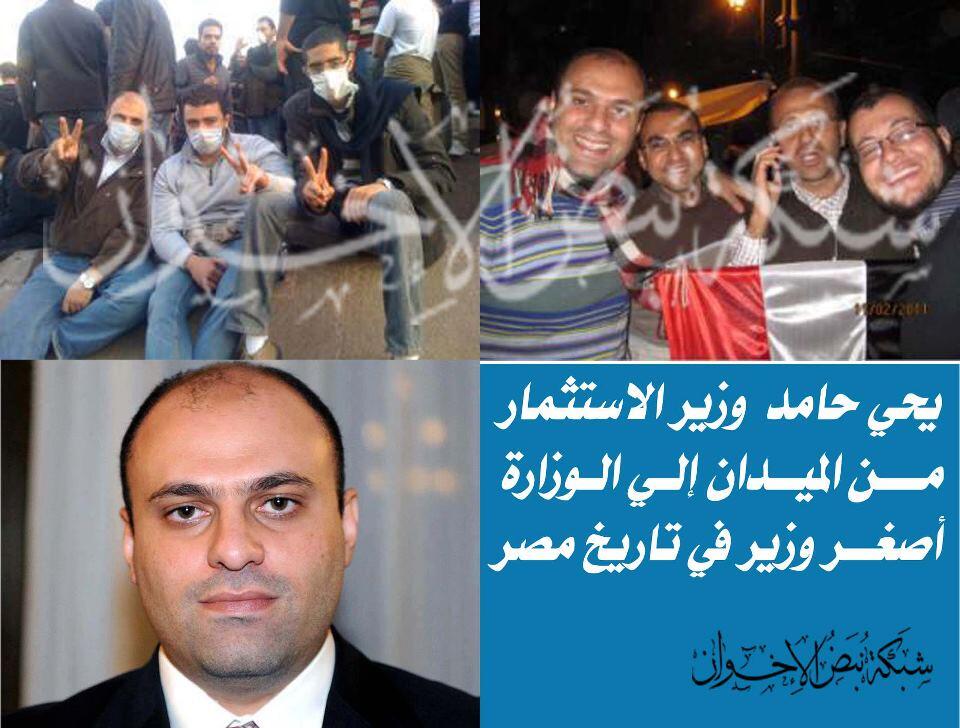
New Arab Minister: Vote for Experience or New Point-of-View? #Egypt

Photo Credit: via @Truthcaller سامح الخطاري 7 May

في الصورة ابن #التحرير في الثورة وابن #الإخوان المسلمون – وزير الاستثمار #يحيى_حامد اصغر وزير بتاريخ #مصر 35 عام pic.twitter.com/Cd8JD0yFv6

Egypt appointed a new Minister of Investment: Yehia Hamed, age 35, from the Muslim Brotherhood party. Hamed is the youngest Minister in the country’s modern history at 35. 

It’s important to note that Hamed participated in Egypt’s January 2011 revolution, and represents an age demographic that voiced strong opposition to the status quo regarding civic and political life.  PITAPOLICY found  some great opinions over Twitter on whether this appointment represented a positive development, overly optimistic, or uncertain.  For example, Yasser El-Shimy who tweets as@Underreported,  is more wary of this appointment–and not because of Hamed’s political party affiliation. 

But the question of experience needs more clarity.  Experience can mean many things…professional experience, political experience, or life experience.  El-Shimy, like many other Egyptians, raises a valid concern about inexperience.  Having a less experienced appointee in a sensitive position literally translates into concern about Egypt’s present investment climate. and  Also, given that Egypt’s economy is struggling with unemployment, inflation, falling investment, currency reserves, and the recent IMF loan negotiations fallout, Egypt’s younger demographic must still worry about Egypt’s future in attracting foreign direct investment.   Perhaps, it IS more fitting to have an appointee from the generation that MUST be more engaged on investment issues because his “thirty-something” generation represents the biggest stakeholder in Egypt’s investment future.  Plus: it is not like Hamed’s predecessors solved the investment problems in Egypt with their advantages of cronyism–errrr we mean “years of experience” and professional networks of advisers.  

  • Background

Nine new ministers announced in Egypt cabinet reshuffle

Egyptian cabinet spokesperson Alaa El-Hadidy announced on Tuesday the nine new ministers as follows:

  1. Judge Mohamed Ahmed Soliman was appointed Minister of Justice to replace Ahmed Mekki who resigned on 21 April.
  2. Judge Hatem Abdallah Bagato was named Minister of Parliamentary Affairs to replace Omar Salem.
  3. Sherif Hassan Ramadan Hadarra was appointed Minister of Petroleum to replace Osama Kamal.
  4. Ahmed Eissa was appointed Minister of Antiquities to replace Mohamed Saied.
  5. Ahmed Mahmoud Ali El-Gizawi was appointed Minister of Agriculture to replace Salah Abdel-Moemen.
  6. Fayad Abdel-Moneim Hassanein Ibrahim was appointed Minister of Finance to replace El-Morsi El-Sayed Hegazi.
  7. Ahmed Mohamed Amr Darrag was appointed Minister of Planning and International Cooperation to replace Ashraf El-Arabi.
  8. Alaa Abdel-Aziz El-Sayed Abdel-Fattah was appointed Minister of Culture to replace Mohamed Arab.
  9. Yehia Hamed Abdel-Samie Hamed was appointed Minister of Investment to replace Osama Saleh.

Source: Al Ahram

A cabinet reshuffle was announced on Tuesday morning after days of expectations, although it is not expected to appease opposition demands.

The new reshuffle included nine ministers, at least three of which are prominent Muslim Brotherhood figures, namely the ministers of agriculture, investment and planning and international Cooperation.

Key ministers involved in Egypt’s ongoing loan negotiations with the International Monetary Fund were replaced, including all economy ministers and the minister of petroleum.

Negotiations between Egypt and the IMF over a $4.8 billion loan have been stalling for several months, with the international lender requesting more rigorous expenditure cutting measures in the economic reform programme proposed by the government.

The IMF was reportedly doubtful of the government’s ability to reform a costly fuel subsidy regime. New Minister of Petroleum Sherif Hadarra is reportedly very close to the Muslim Brotherhood.

Other economic files, including the Ministry of Planning and International Cooperation and the Ministry of Investment were given to influential Brotherhood members Amr Darrag and Yehia Hamed respectively. Hamed was one of the spokesmen for President’s Mohamed Morsi’s 2012 electoral campaign.

[Click here for full story.]

Leave a Comment

Filed under Analysis, Politics, Uncategorized

Shared Prosperity–Join our Workshop May 5th!

Dear Pitaconsumers!

This coming Sunday marks our 4th “Mind Your Body; Mind Your Stress” workshop in the networking series combining yoga with social media tips.  We are now offering a special student discount of $5 off to participate!

What Does Shared Prosperity Take? #DoGood #ConsciousCapitalism

Two weeks ago, the World Bank convened its annual civil society organizations meetings to discuss “Shared Prosperity” and what it takes.  We ask again: What does it take for shared prosperity? We respond: “Doing Good” plus “Conscious capitalism”. 

Because it is the week of Washington, DC’s “Do Good Summit”, which organizes workshops for local DC businesses looking to do good, we would like to repost a piece about civil societies in the Middle East and North Africa region. In mid-April, over 551 Civil Society Organizations visited DC to participate in the Annual World Bank-IMF Spring meetings.  The following are PITAPOLICY Founder’s thoughts…

Shared Prosperity Needs More Face to Face Engagement, Not Just Online

By: Mehrunisa Qayyum

“It takes civil society to engage on solutions,” shared Lotfi Maktouf, who founded Al Madanya, which is a Tunisian-based nonprofit that helps address the number one challenge in Tunisia, youth unemployment. Through Al Madanya’s simple intervention, subsidizing driver’s license training, youth obtain the means to earn a driver’s license which can lead to a job — or at least provide the identity card they need for other types of employment. I could not help but think that this year’s World Bank theme for “Shared Prosperity” had to be somewhat inspired from the analysis and reports coming from the Middle East and North Africa division that focused on inclusiveness for development. Current World Bank President, Dr. Jim Yong Kim, repeatedly cushioned each recommendation to support “Shared Prosperity” as the end-goal. Shared prosperity also served as a way to include civil society across all regions regarding extreme poverty, education, and climate change.

#ItTakes Civil Society Organizations

Combined with the 2013 meeting’s “hashtag”, which is the term for a social media meme, #ItTakes, it was easy to enlist civil society organizations among the online audience to comment. For social media followers, there was certainly much online discussion the Annual World Bank-International Monetary Fund (IMF) Spring Meetings that primarily focused on the Tunisian and Egyptian IMF loan decisions, rather than the other widely used hashtag “#educationfirst” throughout the week-long online/offline discussions.

During the meetings, 551 representatives from Civil Society Organizations arrived in Washington, D.C. to participate in about sixty CSO sessions that engage on better program management to partnering with the United Nations for Millennium Development Goal projects, like sanitation and education. Traveling to Washington, D.C., let alone, the U.S. is expensive. So it is understandable that over 20 percent of the CSO representatives come from the U.S. However, even if one were to subtract 100 of those American CSO reps from the total, only 23 of 451 representatives came from the Middle East & North Africa region itself.

Among MENA countries, those represented, came from some countries going through economic and political transition, like Tunisia, Yemen, and Egypt. Civil society institutions who were unable to attend, observed and questioned from Tunisia, like Twitter user, Saida Manoubia who asked over Twitter as @khaffousa: “if there could be growth without development, and how did #tunisia achieve the growth he is talking about?”

Yet, no civil society [Click here to continue…]

Leave a Comment

Filed under Analysis, PIDE (Policy, International Development & Economics)

PITAPOLICY Focus on MENA~World Bank-IMF Spring Meetings: April 20th

****Note: All PITAPOLICY comments are in italics

Follow hashtags: #ittakes #wblive #FiscalMonitor

Event: From the Arab Revolutions to Global Austerity Trends

Sponsors: Third World Network (TWN) and the Arab NGO Network for Development

Panelists: Mahinour El Badrawi (Egyptian Center for Economic and Social Rights / ECESR, Cairo, Egypt), Isabel Ortiz (Initiative for Policy Dialogue, Columbia University, New York), Kinda Mohamadieh (Arab NGO Network for Development / ANND, Beirut, Lebanon), IMF Representative (TBC), CHAIR: Bhumika Muchhala (TWN).


  1. Some key questions that this panel will try to address are:
    Are the fiscal, monetary, tax and investment policies being considered by governments facilitating, or hindering countries in the Arab and other regions in building an inclusive economy and supporting socio-economic recovery?
  2. Will public expenditure for the strengthening of education, health, and other social sectors be safeguarded or slashed?
  3. How is chronic and high unemployment and high food and fuel prices being addressed?

Muchala: The world has been shaken by outbreaks of civil unrest in response to the combined and lingering effects of high unemployment, worsening living conditions, and eroding confidence in governments. In the aftermath of the Arab revolutions, many countries in the region are facing serious balance of payments problems, mounting external debt, and countries such as Egypt are facing record-low foreign exchange reserves and entering into agreements with the IMF.  Contrary to public perception, austerity measures are not limited to Europe; in fact, many adjustment measures feature most prominently in developing countries. According to IMF data, 119 countries will be adjusting public expenditures in 2013, increasing to 131 countries in 2014 and the trend will continue at least until 2016.

Directing public expenditure and #investment: How can #civilsociety facilitate economic sovereignty?

  • Montez: Choiceless Democracies is the title I chose for my presentation based on South Africa. What kind of political transition will bring about positive economic programs…as we have all these external donors with all their geo-political interests.
  • What the Arab Spring countries are facing is an old banking system. Let’s talk about this word Austerity.  Unlike developed countries, where austerity is part of social psychology, in developing countries, austerity isn’t done for its own sake.
  • Look at removing fuel subsidies: IMF based on “backward calculation” which looks at repayment assuming how much domestic growth may be expected.  Alternative: look how many factories are idle.  After determining this, can look at domestic savings.
  • Arab Spring countries could look at monetary easing…Cyprus can’t do it b/c they don’t have their own currency, unlike Arab countries.
  • Change of regime argument is another alternative.  Arab countries need a new economic model. One can only grow faster if one accepts greater inequality.
  • PP: Alternative already underway in Tunisia, Egypt, Libya…Yemen with bloody results…and Morocco under “guided monarchy power”.  Accepting greater inequality was already rejected in Tunisia…and “under debate” in Bahrain 😉
  • Ortiz w/Cummins: Excessive public expenditure contractions looked at 181 countries.
  • PP: Looks like Iraq, Yemen, Sudan and Jordan appeared at the bottom of the graph shown on screen with the MOST change in public expenditure
  • Ortiz: Aside from political risk, let’s look at removing food subsidies despite high food prices between Jan . 2007-2012 looking at FAO data. Local food prices still remained high in Iraq, for example.
  • Overall, policymakers should consider, that in times of crisis, it is important to scale up social safety net investments instead of scaling down.
  • There is a concern for leakages, as we saw in the Moldova case. Poor received least coverage. Try to look for a social protection floor: children, elderly, and people with disabilities.
  • Labor Flexibiation Reforms: avaialbe evidence suggests that labor market flex will not generat decent jobs. On the contrasry, in a context of econ contrasction, it tis likely to generate labor market “precarization”…Crisis of Social Support.
  • PP: We need a better definition of “Labor flexibablization” based on the author’s terms…as well as WHAT is “precarization”!
  • El Badrawi: Argues that homegrown plans are not really homegrown in Egypt.
    How do we explain national economic plan (Pres. Nov. 2012) mirrors the same #IMF plan proposed to Mubarak?
  • Qatar, and other loan providing countries convened in October 2012 to recommend to Arab Transition countries: Tunisia, Egypt, Yemen…not quite in transition but kings are scared pantless for regime succession: Jordan, Morocco
    October 2012: recommendations for those 5 countries. Egypt “cutting untargeted and inefficient energy subsidies, transition to modern value added tax system; allow fluctuation for currency.
  • Discusses alternatives: Tax reform:  Progressive taxation currently in place hurts the poorest: 30k Egyptian pounds to 40K taxed at 10%. If you make 1 million Egyptian pounds, then the tax rate is 25%.
  • …still needs reform in a different way, including corporate tax reform


  • Mohamadieh: Want to discuss implications and contradictions between the advice on macro-economic balance of payments objectives.  Looking at last 2 to 3 decades in Arab countries, we see decline in manufacturing capacities, like in Egypt, as well as depression of wages among citizens.
  • Investment rights and investment zones: In 2013, IMF called for dismantling tariffs and holding back minimum capital requirements.
  • Trend of irresponsible policy advice example: 2009 IMF report: 1990s, interventionist approach there was an uneven role, and no clear mandate by board nor clear criteria, which led to ineffective ability for staff to assess macro-economic or note all risks associated.
  • PP: Speakers need to present more slowly when reading from their paper…it’s hard to follow along when no numbers or data provided!
  • PP: Morocco reporter takes issue w/Mohamedieh’s presentation. Reporter talks about World Bank issues building a dam in Morocco and not being consistent…specifies nepotism. 
  • What’s going on w/fuel subsidies regarding substitutions, like wood?


Leave a Comment

Filed under Analysis, Interests, PIDE (Policy, International Development & Economics)

PITAPOLICY Focus on MENA~World Bank-IMF Spring 2013 Meetings: April 19th

***IMF Update***Tunisia and #IMF reach agreement on $1.78 bln loan: govt official, according to Al-Ahram Online #fiscalmonitor http://ow.ly/keVHW

***Note: PITAPOLICY comments are in italics. ****
Event: Inclusion and Resilience:
The Way Forward for Social Safety Nets in the Middle East and North Africa

Inclusion and Resilience: The Way Forward for Social Safety Nets in MENA brings together new evidence, newly collected data, country-specific analysis, and international experience.  It aims to spur the debate among policy makers and civil society representatives about the existing challenges and feasible policy options on how to make social safety nets more effective and sustainable.  

DATE:               April 19, 2013

TIME:               12:30p.m.–2:00p.m.

PLACE:           World Bank Headquarters, Main Complex Building

Keynote Panelist:    Sri Mulyani Indrawati, Managing Director, World Bank
Chair & Moderator:   Inger Andersen, Vice President, MENA, World Bank
Presenter:        Steen Jorgensen, Sector Director, Human Development, MENA, World Bank
Panelists:         Nizar Baraka, Minister of Economy and Finance, Morocco
          Susana Gamez, International Consultant, Social Protection & Subsidy Reform        

Omneia Helmy, Acting Executive Director, Egyptian Center for Economic Studies           
Adriana Kugler, Professor, Public Policy, Georgetown University
PP: Today is the second part of the social safety net discussion, which was initiated in Tokyo. We will hear a perspective from a former MENA Director at the World Bank. She relates the Indonesian experience.
  • Andersen: Targeted subsidies only hits one-third of MENA region’s poor. Indrawati, former MENA Director at Bank, will share Indonesia’s experience as an economist and academic.
  • Indrawati: Who should receive targeted subsidy? When the baby of subsidies are delivered, the result is worthwhile.
  • Spending political capital to get through the technocratic and academic exercises.
  • Pain cannot be alleviated totally, but it can be lessened.
  • Jorgensen: Universal subisidies r inefficient and pro-rich benefit significantly from fuel subsidies, but many people among the poor do as well.
  • We need to do categorical targeting of subsidies towards widows…or known as poverty targeting.
  • Note the polling we did: Jordan and Tunisia had more confidence in their governments in dealing with social safety net issues than those in Lebanon and Egypt.
  • My 3 Takeaway Points: 1) MENA countries spend too much on universal subsidies 2) Social Safety Nets have low coverage of the poor and leakages to the non-poor and 3) social can be reinforced to achieve better impact at low cost.

PP: Is cash better than in-kind subsidies…many of the people WB polled said yes!

PP: Helmy gives Egypt as a case study on subsidies and social safety net challenges:

  • Helmy: Country experience regarding barriers:
  • 1) citizens have a low level of confidence in government to address social safety net problem
  • 2) Formal safety nets: we have many INFORMAL social safety nets…pools of large amounts of cash…if there is good governance and accountability, then they could supplement the government  officially.
  • 3) Ineffective implementation of laws and regulations
  • 4) Labor law: 5 percent are employed are supposed to be w/disabilities
  • 5) high technical and administrative costs.
  • Kugler (Professor of Public Policy at Georgetown University): Redistributive, Role of providing insureance…but does not serve poor b/c poor are priced out of those markest.
  • A couple of problems that emerge w/targeting subsidies problem: 1) Moral Hazard and 2) Stigmitization
  1. Problem 1: Moral Hazard: encouraging more of the behavior government is trying to prevent
  2. Example 1: Refers to US program w/TANF, which indirectly encouraged, or provided incentives for women to have children out of wedlock
  3. Example 2: Encouraging for people to claim unemployment.
  4. Problem 2: Stigmatization
  5. Example of children getting free lunches and it being a public shame.


  • Andersen: How can we at the World Bankbest assist you based on your observations and research?
  • Benchekroun (Morocco: Chief of Mission to the Head of Government, Ministry of General Affairs & Governance): It’s not a simple task because these are not just market and social pressures. It’s a political challenge as well. Any price increase would have a fallout with the poor. Cash transfer solutions were tried in Morocco. We also had an education among the poorest program.
  • We have a lot of questions in the government that we don’t have answers for yet…and we traveled to Latin America and Indonesia to gain lessons learned. So we appreciate the World Bank support.

PP: Morocco is trying a variety of programs…and Benchekroun argues that unifying the programs into a single registration system is best. So, is she asking the World Bank to help them with data consolidation via technology software and measurement expertise?

PP: FINALLY, a representative from Arab Civil Society organization speaks! A representative from Tunisia asks how a civil society organization positively engaged with government and a religious organization.

  • Jorgenson: Notes smuggling fuel smuggling between Libya and Tunisia due to different prices in neighboring companies.
  • Calls on them to collaborate/coordinate prices. Egypt is looking at how they can exempt farmers from subsidies.


*****************************************************************************************************************************

Event: Global Voices on Poverty: A Discussion on Ending Poverty with World Bank Group President Jim Yong Kim and United Nations Secretary General Ban Ki-moon
World Bank Group President Jim Yong Kim and UN Secretary General Ban Ki-moon will discuss what the two organizations and their partners must do to turn the goal of ending extreme poverty into a reality and engage global citizens around this topic.
MODERATOR:       Tumi Makgabo, Former Producer/Host, CNN Inside Africa
FEATURING:          Trevor Manuel, Minister of the Presidency in charge of the National Planning Commission, former Minister of Finance, South Africa.
                                Muhammad Yunus, Nobel Laureate and Founder, Grameen Bank
                                Gunilla Carlsson, Minister of International Development, Sweden
                                Maria Kiwanuka, Minister of Finance, Uganda
Venue:                   World Bank Main Complex, Preston Auditorium
Time:                      Friday, April 19, 2013, 11:00 AM
  • Kim: Difficult, but still aiming to end extreme poverty by 2030. Excited that UN Secretary General has brought multi-lateral institutions to address our targets: people living under 1.25 USD a day is a “stain on our consciousness”
PP: Spending tons on aid, but no impact…
  • Kim: In the middle of AIDS epidemic, we still grew over 5% in Africa…despite the economic crisis, developing countries have managed to grow…so the World Bank has been doing a lot of things right.
  • Trevor Manuel: We’re preoccupied with measuring GDP. It’s not a sufficient measure for ending #poverty.
Let’s look at poverty alleviation examples…
  • Yunus: Banking institutions that are inclusive is still a fundamental issue.  Since the founding of Grameen Bank, we still need our banking institutions to become inclusive.
  • We need Technology to address education…where the children of poorest family can receive education like the richest.  You don’t need a school, or a physical teacher, we need a mobile application.  Everyone has a mobile.
Regarding MENA, we’re talking about applying Yunus’ criticism to Yemen, Afghanistan, rural areas in Egypt, Morocco…and Palestine.
PP: Is there enough political will to effectively deal with these issues?
  • ki-Moon: I’ve said that we’ve need your political will and political leadership. There is no such country that has an abundance of resources; now political will is what really matters.  That’s why I’m here: to meet with the Finance Ministers to request that they allocate the proper resources.
  • When they all come to General Assembly, they agree…but by the time they arrive at the JFK airport, they completely forget!

PP: Love how UN Secretary General called out leadership…without naming names.  But maybe he should have in the name of transparency…

  • Kim:We need the data to eradicate poverty. It’s not just political correctness to say to put women in the center of the solution.
  • If there’s anything we’ve learned from the Arab Spring, it’s that growth without inclusion is not going to work.
  • Need to have zero tolerance on corruption…that’s why we debarred a group for 10 yrs for corruption issues regarding building a bridge.
  • ki-Moon: Need to have accountability…and countries need to keep their promises. so we’ve included measures on accountabilty…established an Accountability Commission.
  • It’s not that we’re lacking in food. It’s about prices and distribution…b/c of that we are suffering from food crisis.

Is this a cynical assessment…don’t think so…just realistic.  Strategic bribery: what’s the reality on the ground when informal networks might work better than policy?  #ittakes #wblive #MiddleEast

  • Carlsson: What about active citizenry.  Without empowerment…we’ll repeat the mistakes. We need to move beyond governments.

Sure, so are we giving up on expectations of government…or are we talking about citizen groups who feel that they can use media or NGOs to overturn bad government policies?


Leave a Comment

Filed under Analysis, Interests, PIDE (Policy, International Development & Economics), Politics