Playing Poker in Syria

Dear Pita-consumers~

The United States’ Intelligence officials say that they are in the process of showing all their cards in a high-stakes poker game.  It’s high-stakes not because over 100,000 Syrians have been killed…but because a smaller number have been killed with Sarin gas….a chemical weapon.

Today the U.S. Senate passed the authorization bill for limited U.S. strikes in Syria to respond to, what the U.S. intelligence reports believe, chemical weapons use by the Assad regime.  However, the U.S. House will need to also debate and review the bill before its implementation–which cannot happen until September 9th, at the earliest.  Already, U.S. Speaker of the House, John Boehner, stated, “This is something the as a country needs to do. I’m going to support the president’s call for action.”  On the academic side, former White House official, and Dean at Johns Hopkins, Vali Nasr, argues in the New York Times that, “It’s in America’s strategic interest to take decisive action to mortally wound the Assad regime.”  We’ve heard of ‘surgical strikes‘ and even the possible “Plan Assassinate Assad” in other media.

Earlier, Saturday August 31st, the UN investigation team evacuated Syria to deliver its four-day report back to the UN.  Kuwait sent planes to evacuate their residents from Lebanon, according to UN weapons inspectors pull out of ahead of schedule .  (Meanwhile, Asma Al-Assad has dealt with her husband’s role in the deteriorating Syria situation via ‘Retail Therapy‘.  Wealthy Syrians live ‘normally’ as US raises pressure )  It is worth noting that the UK debate on the subject has gone a full 180 degrees on its stance to opt for military intervention without more evidence of Assad regime use of chemical weapons.  Germany remains in abstention, while Russia and China will veto any motion to launch strikes on Syria–unless they say otherwise.

Since the chemical weapons reports resulting in 1,400+ deaths, humanitarian and Syria activists have made strong arguments both for and against military intervention, which would involve British, French, and US resources. U.S. Secretary of State, John Kerry (@JohnKerry) noted the vehement anti-military intervention protestors in the Syria Hearing.  As he explained, that’s why he, Secretary of Defense Hagel, and General Dempsey “are especially sensitive to faulty intelligence… thats why we’ve declassified info

It’s Complicated:

  1. Just because one is Anti-Regime does not imply that one is Pro-Intervention: Opposition Has Mixed Feelings About US Plan
  2. Must examine risks in taking no action
  3. Although we have support, why don’t we have MORE participation by those in this military option? Senator Cardin raised a salient point, that, if the the military intervention has so many other country supporters, what resources will they commit to finance this operation…or even participate…

Activists who are Anti-Strike argue:

  1. So, the US will intervene because of weapons use not because of other ? in response to Secretary Kerry’s argument: “Need to send message that when the US says ‘Never Again’, we mean ‘Never Again!'”
  2. “The US has no interest in Democracy in .Look at Hafez who joined against . Israel, & Stability.”~

Activists who are Pro-Strike argue:

  1. is haemorrhaging women, children.” Numbers displaced by escalating conflict reaches 6.2 million.
  2. : the regime cannot gas or shoot his way out of his predicament. What is the message? He’s been granted impunity!”
  3. “Any strikes will be claimed by the regime to have killed innocents or the wrong people.”
  4. Use every buzzword possible, eg:  : I want to continue “building capacity of vetted, moderate opposition” such that strikes would, hopefully, empower opposition.

In particular, Peace & Conflict Resolution activist, Ramah Kudaimi, reviewed the debate festering within the activist community on Syria.  Here is an excerpt of Kudaimi’s op-ed:

With Syria back in the news due to the horrific chemical weapons attack last week that killed hundreds and threats from the US to engage in military strikes, below are some do’s and don’ts for progressive/radical anti-war organizations/activists in the US as you figure out a proper response.

1. DON’T in any way say or imply both sides are wrong and it’s not clear who we would be supporting if we get involved militarily. This is an insult to every Syrian who has and continues to go out in the streets and protest both the regime and those forces who are looking to use this time of war to assert their own power over others. It is a shame how many progressive groups in the US just jump on the “both sides are bad” wagon so we shouldn’t get involved. There are one million children who are refugees and that is the fault of the regime. It is the regime who is bombing cities with jets; it is the regime that has ruled the country with brutal force for decades. Any statement that doesn’t acknowledge this is again an insult to those who have sacrificed so much.

2. DON’T over conflate Iraq and Syria. Just as ludicrous those who look to Kosovo as an example of military intervention to support it in Syria are, it is quite pathetic when so many progressives and leftists are just obsessed with supposedly false chemical weapons claims. There are 100,000 Syrians dead, majority killed by conventional weapons. So there are a million and one excuses for the US to intervene and faking chemical weapons attacks is not needed. There is also no basis I believe in claiming al Qaeda has access and uses such weapons. Al Qaeda fought the US for a decade in Iraq and not once deployed such weapons. But all of a sudden they’re using them in Syria? And if the rebels had these weapons, the regime would’ve fallen a long time ago.

3. DON’T obsess over al-Qaeda, Islamist extremists, jihadists, etc. Since 9/11 progressives have rightly shunned the use of all these labels when it comes to the US War on Terror, yet we now use them freely when it comes to Syria and actually believe it. The overwhelming majority of Syrians, both those who have taken arms and those who continue to resist through nonviolent means, have nothing to do with the extremist groups and are rising up against all forces who are destroying their country, whether they be regime or supposed “opposition” groups. It is also important to understand that the Free Syria Army is not a central command army with orders given from the top. It is a loosely affiliated group of different battalions and anyone can claim to be part of it.

4. DO point out all the US failures toward Syria and how dropping bombs on the country is not what is needed. I personally don’t believe that US is going to get militarily involved. They promised weapons to the rebels and have yet to deliver. No way is the US getting in because as has been pointed out by Gen. Martin Dempsey and in a NYT opinion piece, it is so much for useful for US “interests” for Syrians to kill each other. I think taking a position of the US should not get involved through a military intervention is fine. DON’T put it as “Hands off Syria” implying this is some kind of American conspiracy. DON’T argue this is about US not having a right to taking sides in a civil war. DON’T make it all about money for home since we do want more humanitarian aid. DO frame it as what will help bring the suffering of Syrians to an end.

5. DO point out US hypocrisy as it judges Russia for sending weapons to the regime. Just last week a story came out that the US is sending $640 million worth of cluster bombs to Saudi. Weapons continue to flow to Egypt, Bahrain, and Israel despite massive human rights violations. DO call for an end to all sales of weapons to all regimes in the region. Continue reading excerpt of Kudaimi’s op-ed

As such, here are some PITAPOLICY responses to the military option conversation:

  •  : US intervention is a nat’l security inerst & to show we haven’t abandoned them
  • Why does boil down to Israel?
  • How has diplomacy failed? For example, the US has MISSED opportunities to engage: eg Pentagon bought helicopters from Russia 4 Afghanistan war
  • The most disappointing observation of all pro-military intervention proponents: Senator McCain sat in the Syria hearing playing Poker on his phone.  We don’t know if we are more surprised that he picked this particular game subconsciously, or that he was even aware that he could operate his phone to play games.
 

Leave a Comment

Filed under Analysis, PIDE (Policy, International Development & Economics), Politics

Social Media Activist’s Guide to Influencing Mainstream Media #DCPFAF


Greetings Pitaconsumers!

PITAPOLICY is buusssy this week–and in a good way!  We are focusing on the experience of a social media activist’s guide to influencing mainstream media.  First off, PITAPOLICY is sponsoring its THIRD Tweetup.  This time we  will support the DC Palestine Film & Arts Festival by sponsoring their first tweetup.  Join us Thursday, August 30th, where the #DCPFAF tweetup will happen at Busboys & Poets at 6pm!  Second, on August 30th, PITAPOLICY Founder, Mehrunisa Qayyum will moderate a social media panel for DC activists.

DC Palestine Film Festival & Arts Tweetup: Listed on DC LinkTank
Do you enjoy film, art, or tweeting your witty points on cultural events? This is the MEETUP for you!

#DCPFAF TWEETUP
Get ready to chat, view, and TWEET about the 3rd Annual DC Palestine Film and Arts Festival beginning September 28th!

@DCPFAF invites you to participate in this FREE event for a preview of what we have to in store for the Fall. To get psyched about our active film and arts community: let’s encourage our film fans, blogger buddies and Arab arts fans to attend. You don’t have to have a Twitter account to attend!

Connect With Us!
All we ask is for you to bring a friend and attend. For those that tweet, please join our community online on Tumblr or follow the hashtag #DCPFAF.  Visit the DCPFAF Website: http://dcpfaf.org/.  Follow @DCPFAF on Twitter and join us tomorrow!

Background
In2011, a group of three dedicated young women founded the DC Palestinian Film and Arts Festival (DC-PFAF). The vision was thatthe Festival would create a platform to display the artistic creativity of Palestinians primarily through film, but also through visual art,music and other mediums. After a successful 2-day teaser festival in May 2011 to test the waters, we officially launched DC-PFAF in September 2011. Securing an exciting range of high profile and experimental films, while attracting a wide variety of audiences from young professionals, to students, to artists, as well as the Arab communities of DC, gave us the validation to push forward and institutethe Festival as an annual event. 

50th Annual Convention of Islamic Society of North America

Washington, DC~We are excited that the 50th Annual Convention for the Islamic Society of North America is happening this Labor Day weekend, from August 30th to September 2nd in the U.S. Capitol of Washington, DC.  Each year, PITAPOLICY revisits the issue of islamic banking and investment, among philanthropy causes in the MENA region at the ISNA forum.  

This year, we are REALLY excited that PITAPOLICY Founder, Mehrunisa Qayyum, will moderating another ISNA panel: “The Social Media Activist’s Guide to Influencing Mainstream Media”.  Expert panelists include Malika Bilal, co-host of the popular show The Stream on Al Jazeera America; Ahmed Bedier, Muslim American civil rights activist, who has appeared on numerous programs; and Zeba Khan, a Muslim American writer and founder of Muslims for Obama and fellow Common Ground News Contributor.  Bilal, Bedier, and Khan will highlight how various social media tools equip the activist to positively engage media…and synergize their message to produced a positive impact. 

Join us at 4:45pm for this lively discussion at the DC Convention Center in Washington, DC Room 140AB.  If you are unable to attend, don’t worry, this wouldn’t be a social media discussion without your online comments.  Follow the discussion on Twitter at #50ISNADC.   Qayyum will be live-tweeting as @PITAPOLICY, so jump in with your questions and comments!

  • Which combo of social media tools work best for different audiences?
  • What is hashtag highjacking?
  • #MyJihad is one example that pushed mainstream media to note Twitter power, but critics sometimes focus on how Twitter is for the more “elite user”… what are your thoughts are on such criticism?
  • Or maybe criticism unjustified?
  • #MuslimRage: serves as another example of Muslim American activist response.

The Social Media Activist’s Guide to Influencing Mainstream Media

The mainstream media has seemed to be a one-way conversation for decades. With the advent of social media, in particular Twitter, the landscape has changed. Learn how to harness the power of Twitter and other social media to influence the mainstream media in positive ways.
Speakers: Ahmed Bedier, Zeba Khan, Malika Bilal

Moderator: Mehrunisa Qayyam


Leave a Comment

Filed under Interests, Politics

Will New Redline Include Number of UN investigators or Relief Workers Killed?

Greetings Pitaconsumers:

On August 23rd, we crossed the 1 millionth child mark regarding the Syria crisis.  The ‘We’ implies that we acknowledge that we  still participate in the international community even though 3 of the Arab League state members, Russia, China, and others dismiss the Syria crisis, and responsibility for children’s .  Last week, we discussed the economic downside within Syria.

Overall in the U.S. public opinion, 25% of Americans support U.S. intervention in Syria reports How different is this response from the U.S. reticence and hesitancy over U.S.- Kosovar intervention?  In 1999, Kosovar symbolized the “humanitarian intervention” crisis as NATO moved forward with military action because the U.N. lacked a mandate.  Poll Reveals Americans Largely Against Intervention The redline in 2012 was chemical weapons…then shifted.  But the redline sidestepped the one millionth refugee child mark.  Will the new redline be redrawn to include a critical mass of UN investigators or medical relief personnel who are killed?

Earlier today, the UN convoy transporting the truce observers and chemical weapons inspectors was hit by a sniper.  Immediately after, Bashar Al Assad appeared in a Russian media interview to deny the Assad regime involvement in the UN convoy attack.  Nonetheless, the attack on the UN convoy reminds us of another pitfall of the Syria crisis.  (Yes, the civilian death toll still remains a primary concern. But we cannot forget that emergency relief, development, and medical staff in Syria, are those that report and treat the civilians (and soldiers).  Without them, the death toll would not only be higher, BUT the United Nations Security Council, news agencies, and foreign NGOS would have NO idea or INSIGHT regarding

  1. Statistics on death/injuries,
  2. Conditions for women and children, nor
  3. Supplies needed to stave off famine.

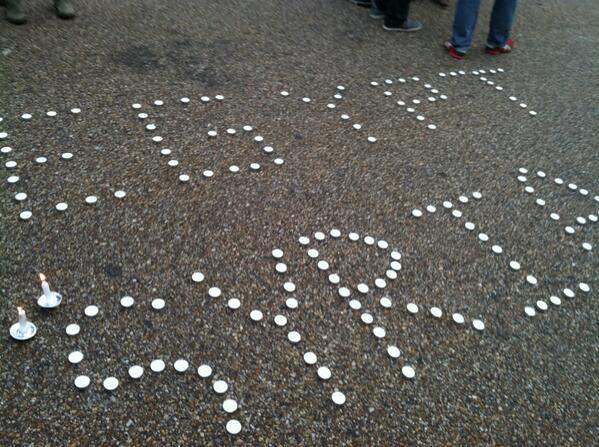
For example, Doctors Without Borders documented that 3,600 Syrians showed ‘neurotoxic symptoms,’ 355 deadOn August 23rd, 2013, immediately following the East Ghuta area photos depicting the 1,300+ victims of a chemical weapons attack, we attended a vigil honoring the victims of Egypt’s Rabaa Massacre and Syria’s civilians killed in the Syria Crisis outside the White House.


Politics: UK may act w/o backing; Russia not 2B outangered says “Deeply Concerned” abt intervention

  • Aside from the U.S. hesitancy to intervene militarily, France and the UK express stronger rhetoric, which may lead to further action–and inevitably, draw upon the support of the United States.  Specifically, French Foreign Minister, Laurent Fabius said that the govt was responsible for ‘a chemical massacre’ near .
  • Colin Powell urges U.S. to back away from conflict Is Powell’s warning from an Iraqi and Libyan experience where the U.S. is not prepared for capacity building in a post-conflict Syria?
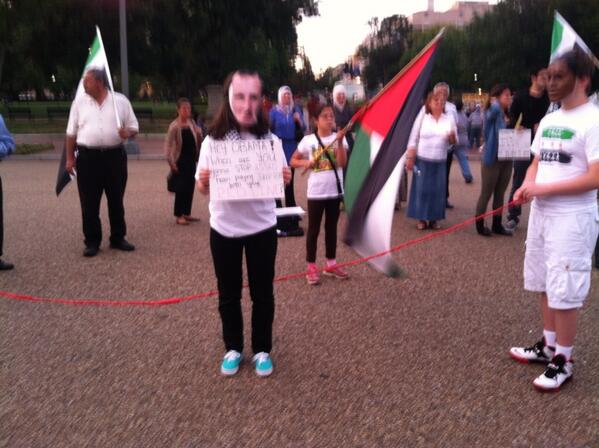
  • Protestors outside of the U.S. White House crafted a charged message by playing a children’s game of skipping a red jump rope while asking out loud, “Hey ! When are you gonna stop from playing jump rope with ur ?.  (Picture taken by @Pitaconsumer)


Impact

  • On 8/21/2013, the arts community refused to remain silent.  U.S. based artist Jackson Amadon captured Syria’s chemical weapons attack in this visual:
  • Mohammed Aly Sergei (@mmsergei) of the blog “Deeply Syria” shared a Youtube video capturing a group of Syrians responding to the chemical weapons use: “Syrians protest and dance, with the alleged chemical weapons’ rocket on their shoulders. We shall overcome.”


Technology

  • Iraq opposes use of its airspace to launch a campaign against Syria. Spokesperson for Nour Al Maliki stated, “Our position is fixed on this subject.”  Turkey’s position is not–unlike with the U.S. invasion on Iraq in 2003.

Analysis

We wanted to share what we heard at the National Press Conference in Washington, DC, but realized that we have not heard from most of our Twitter community in Syria who work in either medical services or with development organizations dispensing emergency relief.  In particular, we regret to say that we’ve not heard from @twainmarc, a surgeon volunteering with a medical response team, since June 13th–which is over 10 weeks.  We are deeply concerned (not the Russian version of “deeply concerned” because no response in 10 weeks is highly unusual.

  • Since the beginning of 2013, we received messages from @twainmarc twice a day outlining the medical conditions of women and children in Syria.  We hope that he, and our other contacts, have not been kidnapped or hurt…and that they have returned safely to their home base unharmed…and the reason for their sudden online disappearance is due to the Syrian government internet blackouts.

Dr. George Netto, Syrian American Medical Society, stated that the “Syrian info minister Moualem continues to deny possession of , which itself is incriminating”.

  • Coordinated attacks of east ghuta indicates 50% targeted were
  • Response to those questioning authenticity of Youtube footage depicting victims “hyper-realistic” display & timing of attacks: “many responding to victims of chemical weapons attacks are untrained and ill-equipped to adequately address the situation on the ground,” says Jomana Qaddour of Syria Relief and Development.

Nonetheless, we were frustrated that the  conference spokespeople could not disclose which sources or sites relayed reports of chemical weapons use by Syrian regime forces.  The press conference was organized by American civil society leaders from the Syrian American Medical Society, Syria Relief and Development, the Muslim Public Affairs Council, Safeguarding Health in Conflict Coalition, and Islamic Relief USA.

“Tyranny is defined as that which is legal for the government but illegal for the citizenry.” — Thomas Jefferson

Leave a Comment

Filed under Analysis, PIDE (Policy, International Development & Economics)

Syria: Cash Flow Problems for “Mayor of Damascus” #SyriaCrisis

Syria is overwhelmed with other economic challenges–apart from the serious human rights abuses, EU & US sanctions, and refugee crisis produced in Lebanon, Jordan, Iraq, and Turkey.  Prior to the March 15th Day of Rage events in Syria, the Syrian pound traded at 47 pounds to the US dollar.  Now, Syrians are lucky if they only need to exchange 235 pounds to the U.S. dollar. 

Last month, Syria’s oil minister, Sleiman Abbas, and Iran signed a 3.6 billion dollar oil deal to finance Syria’s infrastructure costs–Syria’s conflict has resulted in infrastructural damage costing . Although half of Syria’s GDP is financed by its agricultural and energy sectors, the oil sector has gained in its importance to finance the regime because the conflict has severely limited agricultural production.  In 2011, oil represented about 33 percent of Syria’s government revenue. 

Note that Bashar Al-Assad’s cousin, Rami Makhlouf, owns about 5.6%  stake in UK petroleum company Gulfsands–not to mention other stakes in key sectors, like telecommunicationsSource: ForbesMaklouf is nicknamed “Mr. Ten Percent” because he typically received a 10 percent commission on each transaction.  Source: Ya Libnan.  

Therefore, the increasing reliance on oil to support the regime has further weakened the regime’s purse strings: Syria’s oil production has dropped from 380,000 barrels per day to 20,000 barrels per day, according to economist Sami Nader’s analysis.  Consequently, four Syrian regime policy decisions resulted from the dramatic economic decline of Syria’s dwindling public sector pockets. 

  1. The Assad regime BANNED foreign currency use in commercial enterprises.  By banning foreign currency in local commercial transactions, MAYBE the regime can temporarily press pause on the black market itching for foreign currency as the Syrian pound continues to decline in value.   
  2. Syria’s Central Bank Governor, Adib Mayaleh, LIFTED dollar sale restrictions.  Specifically, Syria’s state controlled media reported that Syria’s Central Bank sold its reserves of dollars to 10 private banking institutions at the rate of 173.27 Syrian pounds to the dollar to cover a week’s worth of transactions.
  3. The regime raised public sector salaries by 40% as well as raised the penalty fines for trading in the black market, according to the U.S. based Al Monitor.  The salary increase follows the subsidy increases in April 2011 to buy citizens’ loyalty.  
  4. The regime recalled Syrian Armed Forces from 60% of the country, and is keeping them closer to Damascus, to reduce their military financial commitments.  Since 2011, Syria has already spent an estimated 7 billion dollars to finance its military operations. 

But with all these measures, what’s to stop Syrians from resorting to a barter system as they’ve lost confidence in their Syrian currency.  If Syrians lose confidence in their nation’s currency, and their government’s ability to manage the currency crisis, then Syrians have every right to dismiss their national government’s other efforts.  Syria is struggling to finance the imports needed to meet their food demand.  At best, the current leadership operates as if they are the Mayors of Damascus–and nothing more.

Source:

The central bank in war-torn Syria has lifted restrictions on the sale of dollars to individuals, state news agency SANA said Wednesday, in a bid to curb black market trade.

“Citizens may purchase foreign currency at banks, for non-commercial purposes, according to the rates fixed by the central bank,” the bank’s governor Adib Mayaleh said, quoted by SANA.

Allowing banks to sell foreign currency was part of “efforts by the central bank in the domestic market to stabilise the price of the Syrian pound and stop speculation on the exchange rate.

“The central bank will continue to finance imports of basic goods through banks operating in Syria at preferential rates,” said Mayaleh.

The agency said the central bank had sold dollars to 10 private banking institutions at the rate of 173.27 Syrian pounds to the dollar “to cover the needs of the local market between August 13-19”.

Before Syria’s bloody uprising erupted, the exchange rate was about 50 pounds to the greenback.

The rate is now about 200 to the dollar on the black market, and has climbed as high as 300 pounds in the 29 months of fighting in the country.

Before the war began, Syrians could exchange $5,000 a year, but that was reduced to just $500 at the end of 2011, pushing many to turn to the black market to convert their rapidly depreciating funds.

Syria has also banned the use of foreign currency in commercial enterprise, in a bid to halt the slide of the Syrian pound.

Politics

New Saudi-supplied missiles boost rebels in south via

Interests

U.N. team to conduct chemical weapons inspections was finally allowed entrance by Syrian regime.  Unfortunately, the death toll attributed to Sarin gas is disputed.  Syrian National Coalition leader, George Sabra, states that 1,300 Syrians have died as a result of the chemical weapon attack carried out by the Syrian Armed Forces.  Syrian Information Minister Omran Zoabi argued that the allegations were “illogical and fabricated.”

Technology

says the Syrian Electronic Army is getting more dangerous: Syrian Electronic Army infiltrated Outbrain (news delivery service used by WashPO ): http://mashable.com/2013/08/16/syrian-electronic-attack-outbrain/

Analysis

For previous analysis on the human rights and political interplay, PITAPOLICY has been blogging about it since March 15th, 2011.  Here are the most shared pieces asking 1) “When Will Right to Protect Apply?” & arguing 2) “Rape is a War Crime” among other civil society crises.

Leave a Comment

Filed under Analysis, Interests, PIDE (Policy, International Development & Economics), Politics, Technology

How Did Ramadan Influence Hunger Conversation? Promote the Spirit of Global Development?

Dear Pitaconsumers,

For those of you who celebrated the end of Ramadan on Eid Al-Fitr: a belated Eid Mabrook and Greetings to you all.  We at PITAPOLICY recognize that this is among the most blessed months for those who follow Islam and observe the month of fasting.  In fact, for those who who do not necessarily practice Islam, we also applaud those who emulate some form of fasting (abstaining from food, drink, etc) to stand in solidarity with their Muslim friends—or to simply experience the feeling of hunger and thirst that is endemic to the cycle of poverty.  Therefore, it is truly disheartening to see the upswing of violence in the three days of Eid: bombings in mosques (Iraq and Pakistan) and attacks on churches (Egypt and Syria) as the Ramadan theme of poverty alleviation falls to the wayside.  What is equally disturbing is overhearing the conversations of policy wonks and certain social and development advocates COUNTING and COMPARING their numerous invites to high-profile iftars–be it the White House, U.S. Department of State, and embassies…

The concept of fasting heightens other activities:

  1. Volunteering time at food kitchens,
  2. Feeding the poor,
  3. Donating towards less fortunate communities,
  4. Allocating Zakat towards orphan-sponsorship programs, for example, and
  5. Raising awareness about the global development disparities thrives in Ramadan–which is great!

However, there are groups who co-opt the specific opportunity to “break bread” and “break fast” in Ramadan, which only dismisses the larger objective of Ramadan: to connect with communities out of socially conscious–not political–needs.  I can’t count how many iftars are held in capital cities around the world that only amount to formal dinners, which invite the “Who’s Who” among Muslim leaders (a significant amount that are self-appointed, not community recognized).  Such iftars amount to photo-opportunities for social media junkies, and truly deflect from the conflicting images of how iftars are experienced by the masses in countries ranging from Morocco to Pakistan.

What Does it Mean?

Aside from spiritual and religious reasons for fasting, it is an exercise in increasing empathy for those who face hunger around the world, the classic global development challenge–regardless of how “globalized” our world has become or interdependent our economies are with one another.  Look at Egypt, it used to serve as the “bread basket” of the Middle East & North Africa region.  NOW it imports its wheat, receives development assistance aid packages (packed with controversial pre-conditions) and struggles with providing bread subsidies across all income groups.

Here are some iftar examples that call into question the opportunity of engagement to “cooportunity” for public relations…

1) Iftar hosting of Military Attaches representing dozens of embassies at the Mayflower — the most prestigious hotel in Washington, DC.

  • We would love to know what the welcoming speech covered regarding how military efforts combat poverty alleviation or delivers food packages in conflict zones.)

2) July 25th: White House Iftar hosting Muslim American community leaders.

  • Why is the guest list such a secret? Should we not know who has decided to carry a message back from the White House to their respective communities?
  • Wouldn’t it be great for this forum to hold a national conversation on hunger.

3) July 16th: Israeli Ambassador to the U.S. hosts an iftar, which happens to fall on the same day of a traditional Jewish holiday.

  • As the Washington Post stated: “But the questions still remained. Does such an evening do any good? Do such events, playing out throughout the world, have any real effect on the politics of Jewish-Muslim relations? “
  • How much of the effort is a public relations gesture?
  • Does Tel Aviv host interfaith iftars that invites Israeli Palestinians as well as those living in refugee camps and settlements? and at this scale?

4) Embassy iftars hosted by: Saudi Arabia, Bahrain, Turkey, Qatar, United Kingdom among others…

  • Does Bahrain entertain media inquiries into its human rights abuses at these free weekly iftars?
  • Are certain embassy iftars limited to interfaith connection, or is it more a political rapport building activity that dismisses the synergistic power of relating to the hunger/poverty dilemma within their own countries? Why not demonstrate how their communities approach poverty challenges?
  • Yes, many countries outside of the MENA region and Muslim world now participate in this trend of hosting iftars.  Ask them why…then engage.

On this last question, two positive examples serve as a counterpoint to the unfortunate circumstances of “iftar-hopping” or “invitation comparison” that have evolved from the unnecessary symptoms of Ramadan events.  Many countries do have local charities and civil society activists that organize significant humanitarian efforts–be it through providing food for 30 days to impoverished communities and mosques as I observed in Egypt back in 2006.

One example is taken from the UAE, where they launched a specific Ramadan campaign “End Poverty, Education Now”.   A dozen pita-consuming countries also linked their development goals to the spirit of Ramadan–and invest in similar Ramadan campaigns.  I am tracking these programs in the hopes that the results are more than just public relations strategies.

A second example, is the global charity Islamic Relief.  Ramadan is among their most busy months in fundraising for Because Islamic Relief in the US is a a recognized Combined Federal Campaign participant, they are able to leverage this designation to increase donor support.  I hope next year we see more charities and development efforts build on the models for poverty alleviation programs before next Ramadan…which will hopefully outshout those who brag about the numerous high-profile iftars attended.  Ramadan is about recognizing community challenges and uplifting impoverished communities– which is a global development challenge– not whether one was invited to eat with a head of state or note which dishes were served.

Why Does it Matter?Until next Ramadan…may the impacts of fasting continue to influence and reinforce our ability to give and cultivate opportunities to address hunger, not just in MENA, but whereever we reside.  The comparison regarding which institutions held iftars should only promote the spirit of global development if we hold institutions accountable.  For all those who indulge in fruitless comparisons of which high-profile iftars he/she was lucky to attend: now what are you going to do about poverty and hunger? Will you hold those governments accountable to promoting social welfare in their own countries?

Sincerely,

Mehrunisa Qayyum

Leave a Comment

Filed under Analysis, Interests, PIDE (Policy, International Development & Economics)

Peer Pressure: How will Gaza Get Its Fuel As Egypt’s Military Blocks Underground Tunnels?

Peer Pressure: How will Gaza Get Its Fuel As Egypt’s Military Blocks Underground Tunnels?

Quick answer: Gaza might have to turn to Israel to meet fuel shortage needs. 

Given the renewed interest in jumpstarting U.S. Secretary of State’s, John Kerry, peace talks between Palestine and Israel, we can not forget the economic backdrop in Gaza, which faces more financial woes than the West Bank.  Gaza’s economy has been hit twice.  Since Egypt’s military closed about 80 percent of the tunnels that transport goods “underground” from the Sinai Peninsula, in Egypt, to Gaza, over $230 million have been lost since June.  Add to that: an estimated 20,000 Gazans have lost employment in the construction industry.  Also, let’s not forget the continued Israeli restrictions on fishing coasts as well as on the borders for “security” purposes, which ultimately limit imports of food stuffs into Gaza.

One solution is to open the Rafah crossing, suggests Gaza Economy Minister, Alaa Rifati.

Moreover, PITAPOLICY would love to hear from fellow pita-consumers regarding these observations…

  • Egypt bans fishermen from fishing in its territorial waters, reports Al Monitor.
  • Israel’s defense establishment prepares to expand operations at the Kerem Shalom cargo crossing between Israel and Gaza since more and more trucks are passing through–and approaching the 400 truck maximum capacity.
  • Israel Intelligence sources hint they “aren’t ruling out the possibility that Gaza’s worsening economic crisis might lead Hamas to launch another escalation against Israel” according to Ha’aretz
  • EU pushing for labeling Israeli settler goods, according to Ma’an News Agency.
    New EU guidelines on Israeli settlements enabled Abbas to say “yes” to Kerry… But, there is another explanation, argues Amira Hass (heard through Al Jazeera English Producer Rania Zabaneh in the West Bank @rzabaneh): “Encouraging the private sector” was a mantra that accompanied the Oslo Accords from the start. High-ranking Fatah officials were already in the Palestinian private sector when the Palestinian Authority was established, and others gradually joined them. Some of those with old money, as well as some of the nouveau riche, also played an important political role in the talks with Israel. The identity created between the political leadership and key people in the private sector, whose personal financial interests depended on keeping things calm, limited the Palestinian position in the talks early on and thwarted their ability to deal with land expropriations, settlement expansion and restrictions on free movement.”
  • If even half progress is achieved in negotiations, then some stakeholders will greatly benefit in both the construction industry as well as the donor category...
  • Encouraging the private sector in Palestine ? US offers version of via political pressure: “Support for entrepreneurship has to be matched by a large public construction project that would facilitate commerce in general. Now would be the ideal time for Kerry to get behind building Palestine’s transportation corridor, along the lines of what Rand Corporation proposed with its ARC project.” reports The Daily Beast
  • Survey: 55% of Israelis say they’re inclined to vote for peace deal.
  • In Gaza: Hamas employs 50,000 Government workers.

Gaza’s Economy Suffers From Egyptian Military’s Crackdown

Source: New York Times

JABALYA, Gaza Strip — The only sound that could be heard on a recent weekday at Abu Eida’s concrete-mixing plant in the north of Gaza was birdsong. The pumps, mixers and other heavy vehicles had been idle for days.


The factory floor was empty. In a prayer room inside the air-conditioned management section, five men were taking an afternoon nap. Work here has been at a virtual standstill since the Egyptian military’s ouster of President Mohamed Morsi early this month, staff members said.

Along with the takeover in Cairo, the Egyptian military stepped up its campaign against Islamic militants operating against its forces in the rugged Sinai Peninsula, which borders Gaza. The clampdown has resulted in the destruction or closing of around 80 percent of the tunnels that run beneath the Egypt-Gaza border, long used for smuggling weapons and fugitives but also for construction materials restricted by Israel, cheap fuel and other goods.

So now, Abu Eida has no cement or gravel to operate his factory, one of the biggest in Gaza, the Palestinian coastal territory. Manar al-Batsh, an accountant at the plant, said 40 employees were sitting at home.

“If the crisis lasts until the end of this month, we won’t be able to keep those workers on our payroll,” he added.

For Hamas, the Palestinian Islamic militant group that runs Gaza and has its roots in the Muslim Brotherhood, Mr. Morsi’s ally in Egypt, the upheaval next door means the loss of an important friend and a looming economic crisis if the tunnel restrictions continue.

Hamas, which refuses to recognize Israel and is considered a terrorist organization by much of the West, faces increasing physical and political isolation.

New restrictions at the Rafah border crossing, Gaza’s main gateway to Egypt and the outside world, limit travel to holders of foreign passports and to patients with official medical referrals from the Hamas-run Ministry of Health. Hamas officials are unable to leave Gaza, and given the security situation in Sinai, aid missions are not coming in.

More materially, Hamas relies on the taxes it collects from the underground trade. Experts have estimated the group’s annual budget at $900 million. Hamas employs almost 50,000 government workers in Gaza, and two-thirds of the budget is said to be spent on salaries.

Omar Shaban, a Gaza economist and the director of PalThink, an independent research institute, said taxes collected from the tunnel trade made up about a third of the budget. Additional income has come from taxes on local businesses, many of which also depend on cheap commodities from the tunnels that are now in short supply. Fuel from Egypt is sold here at half the price of fuel imported from Israel.

Hamas had already been suffering from a sharp drop in financing from Iran in recent months because it did not stand by President Bashar al-Assad of Syria, its former patron, in his struggle against rebel forces.

Yasser Othman, Egypt’s representative to the Palestinian Authority in the West Bank, told a Palestinian newspaper this week that the security measures along the border were not directed against the Palestinian territory but were to “protect Egypt’s national security.” He added that the measures would end “once the exceptional situation ended.”

But in Egypt, a news media campaign is under way against Hamas, as critics of Mr. Morsi associate the group with the violence along the Sinai border. Egyptian military officials have told state news media that scores of Hamas fighters and snipers have been making their way into Egypt to battle the anti-Morsi demonstrators, and newspaper columnists have accused Hamas of interfering in Egypt’s affairs.

Salah al-Bardawil, a Hamas official in Gaza, said in a telephone interview that the Egyptian news media were being “pushed by the enemies of resistance” and some Arab states that want to see Hamas toppled like the Brotherhood in Egypt. He acknowledged that Hamas’s options for dealing with the crisis were limited but said that the Palestinian people were used to putting up with hardship to preserve their “dignity and national principles.” [Click here to continue…]

Leave a Comment

Filed under Analysis, Interests, Politics

US-Egypt Relations Hill Briefing by #AAIUSA: “Launch of National Dialogue”

 “It was a coup and a popular uprising…both can happen at the same time.”~Michael Hanna

Washington, DC~On July 24th, PITAPOLICY attended a U.S.-Egypt Relations briefing hosted by the Arab American Institute (@AAIUSA) to discuss AAI’s latest poll findings “Launch of National Dialogue”.   Online discussions were also held on Tuesday and Thursday.  At the end of the day, regardless of what American politicians, policymakers, and pundits project and pontificate about suspending aid to Egypt, national reconciliation within Egypt is Egypt’s priority–alongside economic woes–not how the U.S. views Egypt’s military role.  Egypt’s military remains the strongest institution as it trumps party politics.  Will national reconciliation work to downgrade the military’s role?  

Moreover, as Daily News Egypt reporter, Basil Dabh, observes: the social reconciliation may be even more important than political reconciliation between “pro” and “anti”- Morsi camps.  A longer time horizon for social reconciliation may include at least a half a generation. However, we think social reconciliation is a precursor to political but that doesn’t preclude present interim government under Adly Mansour from addressing the economic grievances that Egyptians face: inflation, fear of subsidy cuts, and demand for job creation. On the other side of the Atlantic, the U.S. could play around with restructuring its aid to Egypt, but the more it is discussed, the more negative attention the US draws to its bumpy relationship with Egypt–for the moment.

 AAI’s report polled both Americans and Egyptians following the June 30th, Tamarod movement that overthrew President Mohamed Morsi.  The report compared its Egypt data from the last 20 years to the results following June 30th.

  • Almost two-thirds of Americans want US to “stay out of” the dispute between the MB and their opponents (protesters & the military). #Egypt
  • US opinion is divided on the decision by the military to depose President Morsi.
  • In 1993, Americans had a favorable view of #Egypt at 64%. Today it’s 26%

AAI Founder, Jim Zogby moderated a panel that included: https://twitter.com/AAIUSA/status/360071921561378816/photo/1

  • Geneive Abdo, Middle East/Southwest Asia Fellow at The Stimson Center; Author of three books, including “No God but God: Egypt and the Triumph of Islam”
  • Steven Clemons, Washington editor-at-large of The Atlantic and Senior Fellow, American Strategy Program, New America Foundation
  • Michael Hanna, Senior Fellow at The Century Foundation

The purpose of the panel was to go beyond the stalemate of what to call the Egypt events–coup or no coup–and try to forecast options for the U.S. to engage Egypt politically and economically.  As AAI’s blog noted, “All of the panelists took issue with U.S. policy toward Egypt in general in some way, describing it as inconsistent, misleading, and confusing both to Americans and the people of Egypt and the broader region.”  AAIUSA posted “Launch of National Dialogue:#AAIchat on #Egypt” on Storify. Nonetheless, PITAPOLICY  still has some questions.  So we break down the discussion via Politics, Interests/Impact, Technology, and Analysis (Policy, International Development, and Economics) and resynthesizes Abdo’s, Clemons’, and Hanna’s points.

Politics

  • Abdo: The US has to be careful not to alienate all sides of the political spectrum in Egypt, says US policy has been a failure.
  • Abdo and Clemons recommended that the US call June 30th events a coup, which would help the US move forward on Egypt in the long term as well as resolve the short term issue of tackling the aid question.
  • Hanna offered a different take by emphasizing that the events were just as much a popular uprising since it’s a “transition period” for Egypt. (PITAPOLICY recognizes that many Egyptians believe that classifying the events is a semantic debate, but it is worth noting that U.S. law is clear about how to proceed with aid decisions regardless of popular or unpopular opinion outside of elections.)

Clemons and Hanna note the significant social role that Muslim Brotherhood holds in civil society, but differ on the MB’s future political role.

  • Clemons: If we were to have an election in #Egypt tomorrow, the Muslim Brotherhood would win.
  • Hanna: “Muslim Brotherhood won’t disappear because the MB is organic part of #Egypt civil society and will continue to provide social services” but would “resoundingly get beat, get trounced” if there was an election tomorrow, argues Hanna.
  • Abdo: Don’t think we’re going to see a parliament dominated by secularist parties.

Interests/Impact

  • Each group is equally represented and equally annoyed with the transition. Minister of is from the independent Unions movement. Also, ‘Foloul’ (Mubarak era politicians) represented in the Cabinet.
  • Both Abdo and Clemons argue that the U.S. should suspend military aid, whereas Hanna argues that the US should restructure aid because he believes that the “US still remains the most important outside player in Egypt.”
  • What does restructuring aid look like? ‏asked by @lalarian
  • Farah Halime writes for RebelEconomy and highlights the impact in “Egypt’s Ultimatum”

Regarding the U.S. interests: “The less we do and the less we say, the better off we are,”  advises Jim Zogby, because “We’ve been meandering.”

Alternatively, Clemons reintroduces the question that goes beyond the semantic debate of “coup” or “no coup” by asking: how will Egypt’s next government address Muslim Brotherhood’s Islamist concerns of being forced out after winning a civilian election.  The June 30th-July 3rd events to remove Morsi speaks to other Islamist groups age old grievance: that they can only participate in elections if they lose.

Technology

  • On July 24th, the US suspended military planes (F-16’s) to Egypt.  (By the way: who is trained to fix the planes during maintenance, or do the planes require service by Americans?)
  • Would be great to know if cultural exchanges between the U.S. and Egypt will not only continue, but invite those in Science, Tech, Engineering, and Mathematics.

Analysis (Policy on ID & Economics)

Note as of January, Egypt’s budget deficit has run at about $3.2 billion a month, which is almost half of all state spending.  Most of the U.S. 1.6 billion aid goes towards Egypt’s military, which is believed to have a significant share of Egypt’s economy–ranging from 15 to 40 % of Egypt’s economy.

  • Clemons calls for suspending military aid to Egypt but HOLD back from extreme “House call” Congressional action to end Development Assistance and Economic Support Funds: “There is no question it was a coup and our response is wrong. It’s not cut aid–shift military to economic.”
  • Clemons: We over Americanize much of the problems going on in the Middle East.
  • James Zogby: Number one issue in #Egypt is the economy. Egypt needs quick subsidies to put cash in people’s pockets
  • Biggest surprise about the Muslim Brotherhood is that they have demonstrated success as businessmen, yet but economy remained biggest Egypt priority. Why did Muslim Brotherhood focus so much on consolidating its power within one branch of government when they ran on previous success of delivering social services and running lucrative businesses?
  • Hanna: Not just an International Monetary Fund demand, but “solvency demand” because 25% of Egypt budget goes towards subsidies.  So shouldn’t the interim government move to adjust the gas subsidy? Or do they want the next government to spend its political capital to restructure the subsidies on gas?

Additional Comments/Tweets:

  • Jim Zogby: Myths that Arabs have about America: “They think that we have the ability and the knowledge to manipulate events”
  • Zogby: US didn’t know what would happen on #June30. If we did when Anne Patterson gave the speech she did at Ibn Khaldun Center, we have problems.
  • @mwhanna1: Flaws in US policy predate President Mohamed #Morsi and the #MB “repressive stability does not work”
  • Zogby: Americans lack of understanding of #Egypt contributes to their ambivalence toward US policy there
  • Hanna: The Coup wasn’t inevitable #Egypt #June30. Says: #Morsi is not coming back. via @aaiusa
  • Hanna: There is nothing permanent about the dominance of political islam in the Arab world via @aaiusa
  • Hanna says before #June30 #Morsi’s actual ability to govern had be irreparably damaged. #MB has lost touch with #Egypt via @AAIUSA
  • Jim Zogby: American leadership has not explained our values, our policies toward #Egypt via @AAIUSA

Leave a Comment

Filed under Analysis, Interests, Politics

Social Safety Nets: How Cash Subsidies May Serve as a Social Intervention #Tunisia

Another version of this article “Driving their Own Destiny” appeared in The Majalla for the SIROCCO blog.  Sirocco Blog is inspired by the Mediterranean wind whipped up in the Sahara and blown across the Maghreb region. In North Africa, it is known by its Arabic name, qibli. ‘Sirocco’ provides a blow-by-blow account of events occurring in the Arabic-speaking countries west of Egypt.

A civil society program in Tunisia offers employment opportunities to the country’s youth [Click here for the article version written for The Majalla.]

By: Mehrunisa Qayyum

Abdallah applied for a chauffer job in Tunisia, where an estimated 15 percent live below the poverty line. Although Abdallah completed his driving school training, the company decided to employ him as a security guard, which pays more.  Earlier, the company refused his job application–twice.  This time, the company believed that Abdullah was responsible enough because he completed a program subsidized by a non-profit called Almadanya.  Abdallah’s driver’s license signified self-discipline.  As Tunisia reconfigures its subsidy structure to better target the poor, civil society organizations, like Almadanya, offer its own type of social intervention to target poor youth trying to become “employable”.

The Tunisian government offers subsidies as part of the ‘social safety net’ (SSN).  Although Tunisia is an upper-middle income country, Tunisians, regardless of income, may receive subsidies for diesel, cooking oil, sugar, and bread/flour.  Tunisia’s case highlights the macro-problem faced by many other countries in the Middle East & North Africa region.  In Tunisia’s case, its widespread subsidy coverage shifts funds away from other social development programs.  Meanwhile Tunisia’s budget deficit has grown by 12.6 percent since its 2011 revolution.  Consequently, both the World Bank and the International Monetary Fund have repeatedly advised Middle East & North African countries, like Tunisia, to scale back such subsidies and target the poor more effectively because the current system is not financially sustainable.

In fact, last month, the World Bank held a special panel reviewing the social safety net problem by exploring Morocco, Egypt, Palestine, Jordan, and Tunisia as case studies and considering the MENA SPEAKS survey conducted by Gallup.  Regardless of the positive impact informal social safety networks provide, government subsidies, even if targeted more directly towards the poor, will not suffice for two reasons.  One, Tunisia’s budget deficit has grown by 12.6 percent since its 2011 revolution.  Two, persistent unemployment requires programs that go beyond food assistance, a forthcoming IMF loan, and raising state-controlled prices, as with milk earlier this year.

Unreformed SSN programs fail to provide enough coverage for Tunisia’s poor.
Given the need for SSN reform, one of the World Bank’s key recommendations stated that cash transfers work better than in-kind transfers.  Cash transfers serve as a tool to remedy SSN programs.  Still, government subsidies are not enough.  NGOs may offer social interventions that consider long-term concerns, like obtaining the skills and tools for a job–or “employability”.

To address employablity,  Almadanya implemented a cash subsidy model that targets unemployed youth across four provinces.  Founded in 2011 by expatriate businessman, Lotfi Maktouf, Almadanya subsidizes the driver’s licenses for unemployed youth through its program “Licence to Dream”.

Maktouf relates how a country-wide program needed to target unemployed youth, whether they lived in an urban or rural environment.  After reviewing eight citizen empowerment programs, Maktouf observed that there was a high demand for driving instruction.  Even working in the agricultural sector requires the ability to drive a tractor, and thereby, a driver’s license.

Although driving is an easy skill to acquire, there are some institutional barriers in obtaining driver’s licenses.  For example, Tunisians cannot obtain a license without attending a driving school, which adds to the financial burden of lower-income families.  Those seeking driver’s licenses must complete a certain number of hours with a driving school before taking the driver’s test.  Consequently, the inability to acquire driver’s licenses further limits opportunities for unemployed youth.

Maktouf asserts that, “it costs three times the minimum wage to get the driver’s license.”  Such a requirement poses a financial burden on lower income families.  Maktouf addressed the financial burden by meeting with the driving schools and negotiated the fees from 850 dinars down to 390 dinars to make the fee more afforadable for lower-income students.  Essentially, “Licence to Drive” funds the instruction fee.

“Licence to Dream” follows a few program guidelines:

  1. The participant must be young and unemployed.
  2. The participant must attend each class or will be dismissed.
  3. The program requires that half of the participants be female.

After the participant qualifies, Almadanya requires him to match the program’s effort: he must pay the government stamp fee of 50 dinars.  The program reimburses him only after completing the program.  The 50 dinar deposit operates as the incentive for the participants to commit to one-hundred percent attendance.  “We step in after they take the first step…participants need to have skin in the game, or they will not take attendance seriously,” emphasizes Lotfi.

Maktouf believes the mutual commitment explains why “Licence to Dream” has achieved a 99 percent success rate through its cash subsidy model.  Today, 95 percent of licensed participants found a job.

The rules are strictly enforced.  As Maktouf explains, “No exceptions have been made–even when a mother insisted on meeting with the program’s Tunis manager and brought a local official.”

The inclination to involve public officials and dissaude the program from following its guidelines did not suprise Maktouf.  His program’s response to the public official symbolizes how a social intervention resisted the tendency for offline politics to interfere with a program’s mission.  If offline politics overrule the program’s practices, which were founded on accountability and self-discipline, then both the program and the mission suffer.  “By overruling my staff at the local level, I have not only demoralized them, but I have also undercut the program’s grass-roots philosophy,” says Maktouf.  Since that instance, no participant has missed a class in two years.

Almadanya employs twenty-five staff members and twenty-five volunteers.  Despite a successful track record, Almadanya still relies on its founder’s funding.

Critics argue that “Licence to Drive” does not address the persistent problem of employing youth with university degrees–especially if they come from middle-income families.  Tunisia’s unemployment stands at 16.7 percent, which is higher than its pre-revolution rate of 13 percent.  Unemployment remains highest among 18 to 34-year olds with university degrees in Tunisia.  Middle-income families make up about 40 percent of the population.  Moreover, the “skills mismatch” in the economy prevails in Tunisia where educated labor is needed to work in the electronic and mechanical industries–key fields in attracting more foreign direct investment.

Moving forward, Almadanya will expand into a fifth province, Jendouba,  to subsidize the costs for 1,470 participants becauase its track record attracted the support of local Tunisian bank: Banque Nationale Agricole.   In 2007, Jendouba represented the highest unemployment rate–24.5 percent— compared to Tunisia’s other nine governates.  Historically, the Northwest and Western provinces of Tunisia represented higher rates of poverty, according to Mongi Boughzala.  Thus, the Jenouba governate’s attempt to catch up may succeed in with Almadanya’s cash subsidies, a type social intervention that has drawn positive attention in Morocco’s cash-transfer program to increase primary school enrollment rates in rural areas — a Millenium Development Goal.

The fastest way to empower young people to get a job is to equip them with the skills and a form of identification that validates her identity as a Tunisian citizen.  “Now they have an ID other than what is imposed by the state, which shows that they have earned it through their own efforts–an added value,” believes Maktouf.  If anything, his social intervention may serve as the intermediary step for those in the lower socio-economic bracket trying to participate in the formal economy, which requires government issued identification.

“Licence to Dream” is a social intervention that mirrors the World Bank’s findings on the cash subsidy recommendation.  After two years, the program’s results hint at what long-term impact means: funding social interventions that increase a young person’s “employability” by facilitating a driver’s license–not necessarily a university degree in engineering.

Leave a Comment

Filed under Analysis, Interests, PIDE (Policy, International Development & Economics)

Obama Worries Over Egypt: US Reviews Law in Providing AID/Assistance

 June 30th-Tamarod Movement (Live-Blog on PITAPOLICY) 

Leave a Comment

Filed under Analysis, PIDE (Policy, International Development & Economics), Politics

Roadmaps & Zig-zag Roads: How do you “Historicize” a Revolution’s Democratic Process?

Legitimate grievances clash with legitimate electoral process: Movement in Symbolizes Split Response:

Prior to June 30th, the Tamarod movement obtained 22 million signatures to represent disapproval of former President Morsi. Tamarod organized a variety of people to remove an elected leader by pressuring Cabinet Ministers to resign if Morsi did not include other parties and voices.  In a barebones way: essentially Tamarod, removed an elected official in lieu of a legal process. The paradox emerges:how do citizens democratically remove an elected leader, who can claim legitimacy through the ballot box, before the next cycle of election.  Or as constitutionalists will argue: removing even a non-democratic person who has won the majority vote without some legal or legislative process. As Marwan Bishara, Al Jazeera Political Analyst characterized: “a good-looking coup”.  On the other hand, the Tamarod movement listed a series of legitimate grievances: 1) abuse of executive power by changing the Constitution, 2) excluding other political voices (youth and women), and 3) failing to address economic upheavel (eg. increasing power outages, rising prices, dwindling foreign reserves). The Rebel Economy blog cites a great analysis of Morsi’s missteps in addressing Egypt’s economy. Simply stated: Morsi executed leadership in an undemocratic way.

How do you historicize a revolution’s reaction to a an election result, which follows a revolution?  Egypt’s June 30th Movement is a case in point.  Media and Egypt analysts continuously compare Egypt with Algeria’s 1992 military overthrow of the popularly supported Islamic Salvation Front (FIS), a political party voicing an Islamic platform. The Algerian military’s decision to cancel elections in the face of the Algerian FIS win, triggered Algeria’s civil war. At the same time, the Muslim Brotherhood, experienced more popularity–almost like Algeria’s FIS– and led to establishing he Freedom & Justice Party shortly after Egypt’s 2011 revolution resulting in Hosni Mubarak’s overthrow.

In 1928, Shaykh Hassan al Banna  founded the Muslim Brotherhood in Egypt, but has followers in many Arab countries. In 1964, MB took a serious stance of armed resistance predicated on Sayyid Qutb’s writings “Milestones”, which has often place the MB on shaky ground due to its call for arms, and inciting violence.  The Muslim Brotherhood has been targeted by many authoritarian governments and monarchies. Specifically in Egypt, MB was sidelined from organizing in the formal political process for about 80 years. During Gamal Abdel Nasser’s rule, many within the Muslim Brotherhood faced political imprisonment after initially supporting Nasser.

Background since Hosni Mubarak’s Overthrow: In 2012, President Morsi won Egypt’s electoral vote of 51.7 percent shortly after Egypt’s ouster of Hosni Mubarak–who held power as an authoritarian leader for 30 years.  Morsi comes from the Freedom & Justice Party, which is affiliated with the Muslim Brotherhood. Since his election, Morsi has increased his powers through the Constitution, a controversial move that fueled the fire for the Tamarod Campaign. The Tamarod campaign rallied over 20 million signatures disapproving of Morsi and Tamarod called upon Morsi to hold new elections and organized its protest for June 30th, Sunday.  In response, pro-Morsi, or pro government supporters, as well as Muslim Brotherhood supporters, convened its own rally to be held at the same time of the Tamarod Movement’s organized protest, which includes a range of anti-Morsi supporters–secularists, “secularists”, and even those that did initially vote for Morsi, but feel alienated.

Politics

  1. Does legitimacy mean more than just a ballot box result? Does the “Street” with its millions protesting play a significant role in determining legitimacy?
  2. If a movement & FJP r strong, can’t they survive independent of ? [AlAnani : Survival of Morsi is survival of ]

Impact/Interests

  1. What does Morsi propose specifically to carry out a National Dialogue?
  2. Without consensus on the result, the act of forcing Morsi out is interpreted as a “setback to the democratic process” according to Al Jazeera English, Senior Political Analyst, Marwan Bishara.  Note: Bishara authored “Invisible Arab”, which traces the Arab revolutions in Tunisia, Egypt, Yemen and others to the Palestinian movement: Intifada.
  3. Will the Muslim Brotherhood interpret Morsi’s removal as a blow to any future political involvement? Will the younger wave within the Muslim Brotherhood take up arms in the same vein that the movement’s earliest version had believed. MB renounced violence in

Technology

  1. Twitter debates: Is this a military coup or a second revolution? Or is this a step towards unraveling a democratic step of process?
  2. Note Journalist’s Astute point:

    “It’s 2013. military issues ultimatum via Facebook. President answers with a tweet. Wut’s next? Army blocks President on twitter.”

Analysis

  1. Anti-Morsi protestors argue that if removing an elected, civilian leader is a step backwards, then Morsi set the precedent for going backwards in the democratic process by challenging the democratic process when he changed Egypt’s Constitution to increase his Executive powers.  
  2. PIDE (Policy,Investment, Development, Economics):


July 3:

  • @Elbaradei:  “It is fresh start for #Egypt”. Will he run in early election if he has #youth support? Unsure why he didn’t run before.

    • Tamarod Movement Youth representative speaks right before Al Nour Party Spokesperson, major “Islamist” party (More conservative than Morsi’s party) stood w/#Baradei and religious figures to “close the circle” around Muslm Brotherhood.
    • Ahmed El Tayeb, head of Al Azhar mosque: Approves of & suspending constitution as fireworks celebrate. MT
    • 1m
    • Morsi delivering a recorded speech to MB sit-in. Claims he’s still president, orders army & military to protect the people and legitimacy.E2-Sissi:Chief Justice of Court will declare early pres elections;Armed Forces “will stand up firmly in cooperation w/Interior Mnstry”
  • Chief Justice Adli Mansour will be the Interim President.

    3:11 PM EST: 1- Armed Forces Chief: Coherent society can be achieved: 1) Suspend constitutional provisionally.

  • Egypt Armed Forces Chief: We called for a national dialogue that was rejected.
  • sends Tweet saying don’t want military council or prime minister.
  • Yasser Haddara, Assistant to President Mohamed Morsi said: 
    “Morsy’s message to all Egyptians is to peacefully resist the military coup and not to use violence,” according to Reuters.
  • Sheikh of Al Azhar, Pope of Coptic Church, and Opposition Leader Mohammed El-Baradei @Elbaradei.  Meanwhile Egypt Independent reports: “Morsy in Republican Guards House, unclear if under house arrest” (@EgyIndependent)
  • 11:37 am EST (Past 4:30 pm Cairo time~ army’s ultimatium) on FacebookEssam El-Haddad issuing a very strong statement, calls all of this a military coup, very solemn. via @Bassem_Sabry
  • How will powersharing ensue if refuses army’s invitation to speak? Then isnt MB refusing to speak w/NSF too?
  • president spokesman says better for Morsi to die in defense of democracy than be blamed by history
  • Pro-Morsi supporters state that they believe that this is a military coup and are upset that those, “who did not even vote in elections,” have a assaulted the headquarters of our party and have invited the military to remove someone who has only worked for one year out of his 4 year term at “the infancy of democracy”.
  • Marwan Bishara notes three different explanations for army vehicles placed throughout Cairo areas with large crowds–in particular the Pro and Anti-Morsi gatherings in Tahrir Square and Cairo University: 1) psychological warfare to pressure Morsi supporters. 2) Security for competing protestors. 3) Coup?. Coup implies that the voices of  millions in Tahrir Square are negligible.
  • Morsi has not been seen since his midnight speech. Communication between Morsi and the army is cut. Deputy El Arian, head of Freedom & Justice Party, claims that he is “banned from leaving Egypt” and is ready to die.
  • Shortly before call to Sunset prayer, Army carrier vehicles shift to block certain roads “to protect protestors in each camp” split between Tahrir Square (Anti-Morsi) and Cairo University (Pro-Morsi).  Note: Pro-Morsi supporters may not necessarily be pro-Morsi, but feel that forcibly removing the first democratically elected citizen President is not part of the democratic process.
  • Before 4:30 pm Cairo time deadline: Morsi refuses Army Invitation to speak with different parties, including the opposition spokesman of Mohamed ElBaredie, youth leaders of Tamarod Movement, Pope of Coptic Church, and Clerical head of Azhar Mosque/University.
  • Tuesday night: After 18 killed in Pro- rally, Governor of Giza resigns. Army ultimatum to expire in 25 min at 4:30pm Cairo time, 10:30 ET.

JULY 2:

Leave a Comment

Filed under Analysis, Interests, PIDE (Policy, International Development & Economics), Politics
