World Bank-IMF Spring 2013 Meetings: April 18th

Opening Press Conference by World Bank Group President Dr. Jim Yong Kim
 
Venue: IMF HQ2 Conference Hall 2 (Press Briefing Room)
Time:8:45-9:30 AM
PITAPOLICY Live Blogging President Jim Yong Kim:
  1. OUR Question: Which ones come from #MENA region? @worldbank Kim: 130 countries approached @WorldBank for support on

  2. Eliminate bottlenecks & ensure that poor participate in the benefits of growth through investing in #education~ Pres Kim

  3. 2 goals for @Worldbank: 1) Ending Extreme Poverty by 2030 & 2) Promoting a “Shared Prosperity” ~#WB President Kim #wblive #ittakes

Leave a Comment

Filed under Interests, PIDE (Policy, International Development & Economics), Politics

World Bank Spring Briefings: 1) Bending Arc of Poverty, 2) Millennial Development Goals, Civil Society Organizations

Millennial Development Goals
Live blogging:
  • Maria Kiwanuka, Minister of Finance, Planning & Economic Development, Uganda
  1. Millennial Development Goals were being developed in silos…maternal health goal wasn’t considering education goals
  2. Disagrees a bit w/Seema Aziz, Founder of CARE, largest NGO in Pakistan. Rather, Kiwanuka argues that Poverty, Ignorance and Disease are the root causes rather than illiteracy…- we feel that this is a “chicken or the egg” debate
  • Kaushik Basu, World Bank Chief Economist
  1. Is there a point to raise poverty line definition
  2. New indicator for different engagement regarding the bottom 40%, move away from focusing on poor countries and shift a World Bank policy-making
World Bank Press Release: Developing Countries Need to Harness Urbanization to Achieve the MDGs: IMF-World Bank report
WASHINGTON, April 17, 2013 – Urbanization helps pull people out of poverty and advances progress towards the Millennium Development Goals (MDGs), but, if not managed well, can also lead to burgeoning growth of slums, pollution, and crime, says the Global Monitoring Report (GMR) 2013, released today by the World Bank and International Monetary Fund (IMF).
Urbanization has been a major force behind poverty reduction and progress towards other MDGs. With over 80 percent of global goods and services produced in cities, countries with relatively higher levels of urbanization, such as China, and many others in East Asia and Latin America, have played a major role in lowering extreme poverty[1] worldwide.
GMR 2013: Rural-Urban Dynamics and the Millennium Development Goals starkly compares the well-being in the countryside versus the city. Urban infant mortality rates range from 8-9 percentage points lower than the rural rates in Latin America and Central Asia; to 10-16 percentage points in the Middle East and North Africa, South Asia, and Sub-Saharan Africa and highest in East Asia (21 percentage points).
“The rural-urban divide is quite evident. Megacities and large cities are the richest and have far better access to basic public services; smaller towns, secondary cities, and areas on the perimeter of urban centers are less rich; and rural areas are the poorest,” said Kaushik Basu, the World Bank’s Chief Economist and Senior Vice President for Development Economics. “But this does not mean unfettered urbanization is a cure-all – the urban poor in many places urgently need better services as well as infrastructure that will keep them connected to schools, jobs and decent health care.”
“Bending Arc of Poverty” Moderated by Lesley Wroughton, Senior Correspondent, Reuters
Live Blogging:
World Bank Live@WorldBankLive 1h Kim and Basu agree: Working in fragile states is key to ending poverty and boosting shared prosperity worldwide. #ittakes

  1. The WBG believes in inclusive growth — countries’ growth must include youth, women, the poor. – Kim http://bit.ly/YIQrGa  #ittakes
  2. Evidence shows massive inequality builds instability in societies – Kim http://bit.ly/YIQrGa  #ittakes
  3. @WorldBankLIve: Basu: People already living under the poverty line – $1.25/day – are our first line of attention. http://bit.ly/YIQrGa  #ittakes
  • World Bank President Kim
  1. Boosting “Shared Prosperity” inter-generationally is new. #ODA is still critical. ~Kim #ittakes I’m an anthropologist, please don’t tell me that your culture holds back gender equality. We should insist. We’ve taken a position.
  2. Primary purpose to look at 2 goals
  3. Agreements are important, climate issue: we’re committed to it
  4. We have a lot of civil society actors: bloggers and media (the 4th Estate)
  5. We will make mistakes, but if you’re trying to be ambitious and bold, as long as we learn from our mistakes, we will move forward. we will not be paralyzed.
  • Kaushik Basu
  1. Culture and Gender, I’m a closet anthropologist. Respect cultures, and two are completely compatible
  2. As long as there are these little pockets that have “emergency fires” we can tend to that
  3. As BRIC countries integrate, we will differ, but fundamentally, when we scrape the surface will achieve the broad objectives.

Leave a Comment

Filed under PIDE (Policy, International Development & Economics)

Social Entrepreneurship Changes Donor & Development Cultures on @HuffPostImpact

April 14th ~ Don’t forget to sign up for our April “Mind Your Body, Mind Your Stress” Workshop in Washington, DC.

Traditional aid is no longer helpful, as once believed, for two big reasons. Aside from the necessity of emergency relief aid for disasters, aid as a tool for poverty alleviation or even political stability, has proven contradictory, if not disastrous. The first reason is presented by best-selling author of Dead Aid, Dambisa Moyo. Development economist Moyo reviews how traditional aid overlooks the root causes of poverty. Moreover, giving aid is not even efficient as corruption remains, which is highlighted in White Man’s Burden: Why the West’s Efforts to Aid the Rest Have Done So Much Ill and So Little Good. No matter how offensive the title, the point remains valid as again described in The Bottom Billion: Why the Poorest Countries Are Failing and What Can Be Done About It by Paul Collier.

The Middle East & North Africa region (MENA) has not fared that much better with its traditional donor experience either. Egypt and Jordan received a variety of donor assistance packages from Canada and the U.S. The U.S. has provided much of its donor assistance via Egypt’s military sector while Egypt’s the wheat industry still faces challenges as they import American wheat due to conditionalized aid that provides more financial gain for the donor than the recipient.

Poverty Alleviation Strategy Includes Entrepreneurship Style and Rhetoric

Why doesn’t traditional aid work? According to Collier, governments are pretty dysfunctional in poor societies because nonprofit donors tend to “romanticize” poor societies. In his strong tone he triggers controversy with warnings like, “Don’t idealize the poor… which many nonprofits are guilty of doing… it is patronizing… ” in his speech for “Locating Social Entrepreneurship in the Global South innovations in Development Aid” sponsored by the Wilson Center, Siemens, and Zeppelin University. Rather than relying on donor support to alleviate poverty in certain MENA countries, and provide sustainable measures, a new philosophy of funding social entrepreneurship is the recommendation. There are a variety of reasons, including the belief that incorporating entrepreneurship practices leads to innovation, which leads to smarter solutions in poverty alleviation.

On a global scale, the mission of a social enterprise is socially oriented like its nonprofit cousins. In fact, the term social entrepreneur seems ubiquitous in the development and donor communities. Forbes magazine now lists top social entrepreneurs in its Impact 30.

Development Culture Also Changes Among Donor Countries

Donor countries, like the U.S., the UK and Canada have noticed the social entrepreneurship potential. Each are revamping their donor agencies to partner with institutions that focus on working with social entrepreneurs. [Click here to continue.]

Leave a Comment

Filed under Analysis, Interests, PIDE (Policy, International Development & Economics)

Breaking Pita-Bread Over Business & Investment

We are pleased to reshare a piece written by Afshin Molavi, Director at Oxford Analytica on the Islamic Banking, a continuously growing sector in the Gulf countries and beyond.  His piece for The Majalla also cites one of PITAPOLICY’s articles on Islamic Finance co-written by Afaf Qayyum–we are very excited!  

Also, we are excited to reshare a piece by our Founder, Mehrunisa Qayyum, contributed a piece on MENA enterprises to The Majalla, which is based in the United Kingdom.  MENA enterprises follows Molavi’s piece.

From Humble Beginnings: Dubai positions itself to become a key player in Muslim markets

By: Afshin Molavi Originally published by The Majalla (Follow them @The_majalla)

In the year 1963, Egyptian economist Ahmed El-Najjar started a quiet revolution in a small, unknown city about 75 kilometers outside of Cairo. In the city of Mit Ghamr, home to pious villagers and traditional Egyptians, El-Najjar set up the first Islamic bank. His bank prohibited interest (riba), granted loans very cautiously, and adhered to the key Islamic economic principle of profit-and loss-sharing. It was an undisputed success. Still, the bank closed its doors in 1967 due to pressure from the government, which associated Islamic banking with the Muslim Brotherhood.

A precedent had been set in spite of the Egyptian government’s opposition. Dubai’s turn was next: in 1975, the Dubai Islamic Bank opened its doors. It was the first modern Islamic bank, far more sophisticated than the Egyptian experiment, and one that was in a position to compete with Western banks. Today, Dubai Islamic Bank has branches all across the UAE, makes global investments, and is widely considered to be one of the top Islamic banks in the world.  [Click here to continue.]


MENA Enterprise: Strategies & Challenges for Next Generation Investors

Originally published by The Majalla (Follow them @The_majalla)

“Invest in whichever sector that could serve the young generation … in the service sectors, like education, healthcare and coffee. We’re talking about frontier markets … Iraq, Lebanon and Tunisia,” advises Shwan Taha, founder of Rabee Securities, the first international Iraq-based brokerage firm. On February 2, Taha’s firm brokered the largest initial public offering in the Arab world since 2008, when the Saudi Arabian Mining Company began trading publically.

At the second annual Wharton MENA Business Conference on February 16, Taha joined other high-profile Middle Eastern business leaders, including Global Chairman of Booz & Company Joe Saddi and Chairperson of Global Investment House Maha Al-Ghunaim, at a conference entitled “Economies of Freedom: Reshaping the Future of the MENA Region.” Held at the Wharton Business School in Philadelphia, the day was dedicated to five panels on entrepreneurship, energy, investing, women in business, and assessing the ‘new normal’ in the economies of Egypt and Tunisia.

A potential entrepreneur or investor sitting in the audience of the Wharton Business School panel would find it difficult to segment the right frontier market from the emerging markets within the Arab world—never mind the difficulty of calculating the political risk that varies across countries in the MENA region. Investing in any sector involves challenges like accessing financial capital, but business people in the region would do well to take into account the unique additional challenges facing their business.

Identifying the niche

When discussing growth markets in the region, Taha left out the technology sector, which has burgeoned in countries like, Egypt, Jordan, Lebanon and Saudi Arabia. While Saudi Arabia is the only Gulf country on this list, the absence of other Gulf countries is not surprising for two reasons. First, the Saudi government has made huge investments in technology partnerships with universities. Second, market research and the Arab Social Media report indicate that Saudi residents are increasingly representing a huge share of Arab social media users: Arabic is the fastest-growing language on Twitter, and Saudi Arabian users represent about thirty percent of those communicating over Twitter in Arabic.  [Click here to continue]


Leave a Comment

Filed under Analysis, PIDE (Policy, International Development & Economics)

Syria: Chemical Weapons is Old News, #whatNext?

On Wednesday, March 20th at 9pm EST, PITAPOLICY Founder, Mehrunisa Qayyum appeared on Huffington Post Live to participate in the segment: “March to War in Syria”.  This was her second appearance on the show. The challenge was to reframe the debate to consider the humanitarian consequences among the Syrian people, not just “the problems of the neighborhood” as in the spillover effects into Israel, as described by Jonathon Shanzer of the Forum for Defending Democracies. Pitapal, and among PITAPOLICY Blog’s first contributors, Ramah Kudaimi, was also a guest.

Here is the Huffington Post Live segment:

<iframe src=”http://embed.live.huffingtonpost.com/HPLEmbedPlayer/?segmentId=5147c6562b8c2a440b0003e4″ width=”480″ height=”270″ frameBorder=”0″ scrollable=”no”></iframe>

<iframe src=”http://embed.live.huffingtonpost.com/HPLEmbedPlayer/?segmentId=5147c6562b8c2a440b0003e4″ width=”480″ height=”270″ frameBorder=”0″ scrollable=”no”></iframe>

Assad May Have Been ShotSince airing this segment, a few developments:

Leave a Comment

Filed under Analysis, PIDE (Policy, International Development & Economics), Politics

E-Diplomacy & #Twiplomacy: Where Are the MENA Countries on this?

Last night, PITAPOLICY Consulting & Blog was invited to attend an event that shares best practices on public diplomacy over social media, or E-Diplomacy.  So, PITA’s founder, Mehrunisa Qayyum, gladly attended–and tweeted 🙂 For those focusing specifically on Twitter, the Italian Embassy in the US has coined the #Twiplomacy Series. Here’s the summary on Storify by Andreas Sandre, who is the social media guru and diplomat at the Italian Embassy in Washington, DC.  Follow Andreas for #digitaldiplomacy as @Andreas212nyc!

The frustrating observation from Qayyum: seeing only one pita-consuming country tweeting, and it was The United Arab Emirates as the only one tweeting from the forum.  Perhaps the only one ATTENDING, a forwardly engaging forum–especially given the impact of social media in connecting people throughout the MENA region. 

The timing was serendipitous because, just last week, Qayyum published her piece on how social media may facilitate some solutions in documenting human rights abuses in Syria.  The piece is pasted below and has some response to last week’s post by Courtney Radsch’s insight on cyber-activism and women. 

Development, Diplomacy, & Defense: Solutions via Social Media

By: Mehrunisa Qayyum  Source: Huffington Post

“Development”, “Diplomacy”, and “Defense” make up the foreign policy triangle, but have different approaches to engaging and sharing information. Although Social Media Week organizes some great workshops of how to promote a message, I would rather focus on how social media tools may get us closer towards solutions rather than large informational data dumps. Of the three areas, the most open with information is the international development community — as donors, like Oxfam, or recipients. They are familiar with holding each other accountable for financial spending to get results. For example, the development community has its four big treaties, like the Paris Declaration, which describes how aid should flow with some checks and balances. “Diplomacy” is actively incorporating lessons learned from its social media experience. Meanwhile, “Defense” is still dealing with its transparency identity.

On Monday, March 11, the New America Foundation’s Open Technology Institute recognized how international development’s foreign policy cousins, “diplomacy” and “defense/security”, are trying to catch up to this culture of mutual accountability and transparency in the “Age of Information.” Therefore the goal is to achieve “cognitive dominance” — which is fancy military speak for making sure that the people with the most knowledge are at the center of social media” as one of the report’s co-authors, James Herlong, argued. The report recognizes the power of civil society to channel positive and negative vibes. Arab media specialist, Courtney C. Radsch makes a strong case for tracking which groups are voicing online or not and what this means for activism and policy. Why? Because in the end, for all the influence and perceived “chaos” that a group like Wikileaks introduces into the public space, they are not held accountable to anyone other than themselves. But governments are, and social media provides another outlet to hold organizations accountable — to not just the people they are supposed to serve, but to those that also get pulled into the snowball of communication.

Last year in May, another social media worry came to surface as Ambassador Arturo Sarukhán Casamitjana of Mexico expressed the initial concern for the diplomacy community using social media: feudalizing overseas posts from home governments. Or more simply: allowing embassies to exercise more flexibility in order to respond more expediently to their local environment. Consequently, if embassies do what they want, then they will become more independent.

Nonetheless, Senior Advisor for Technology at Department of State, Shahed Amanullah explains, “I follow the Twitter feeds of every embassy that I have visited. I see what is happening in the U.S. embassy in Ireland. It’s about being on the same page. Either pick up the phone or follow their Twitter feed.”

What is more feudal? Having embassy officials conduct closed door meeting or tweet? The alternative to social media is waiting for access to the cable. Or, diplomats may receive communication from colleagues a few days later — whereas they could easily follow the ‘locked’ Twitterfeed, which is instantaneously available to them — like a mission cable, but at zero cost.  The ideal is that every embassy tweets what they are doing, and each one following the others’ streams.  That is connectivity.

Digital Diplomacy: Reviewing What Can Work

Like development practitioners, diplomacy practitioners are absorbing the lessons learned. “Digital Diplomacy” still affirms that face to face, behind closed doors meetings serve as the primary driving force of international relations and government to government engagement. Launching a network in a high-risk country, like in Pakistan, a face to face complements the digital diplomacy effort. Quite possibly, embassies will represent plural interests rather than just government, national interests.

Click here for the whole story.

Leave a Comment

Filed under Interests, PIDE (Policy, International Development & Economics), Technology

Arab Media Analyst POV – #PITAPAL Reflects on Women’s Online Voice

Dear Pita-Consumers,

Thanks to all who attended our third workshop covering strategy development from our joint initiative with Jordin’s Paradise “Mind Your Body, Exercise Your Mind” series.  Our next one is scheduled for April 14th ,Sunday at 2pm in Washington, DC. 

Earlier this week Reporters Without Borders issued its report on internet freedom. The report listed Bahrain, Syria, and Iran as “Enemies of the Internet”.  So, we would like to highlight an astute piece by our PITAPAL, Courtney Radsch, who is a Technology Specialist.  She has tried to visit Bahrain to review freedom indices, but she, like other journalists, were turned away by the Bahraini authorities. 

Her work reviews cyber activism in the Arab world, and PITAPOLICY Founder, Mehrunisa Qayyum, will provide a response to this in a future post!  Racsch’s piece was originally written for Huffington Post Blog.  You may follow Radsch on Twitter as @CourtneyR!

Online Voices For All? Women’s Marginalization Online and What It Means for Internet Freedom

By: Courtney Radsch for Huffington Post

The core principals of internet freedom include the ability to access the internet and freely express one’s opinions, but there is a large online gender gap that materializes both in terms of access, ability to freely express oneself, and in terms of online representation. These gaps limit access to the internet for many women and other marginalized groups, such as LGBT, ethnic and linguistic minorities, and other as well as their ability to freely and fully express themselves, leading to inequality based on identity. On Friday I participated in a panel entitled ‘Online Voice for All‘ at the Tech@State Internet Freedom conference to discuss the specific gender dynamics related to women journalists and cyberactivists, particularly in the Arab world. Drawing on my study of cyberactivism but women during and in the wake of the 2011 Arab uprisings, as well as research in the US, UK, Africa, my contribution focused on outlining some of the key security threats women face online, and the particular gendered dimension of cyberthreats against women and homosexuals. These include reputation assassination and defamation campaigns, online stalking and trolling, technological attacks and the hijacking of identities through fake social media accounts, online harassment and false accusations that often revolve around a woman’s sexual activities or allegations regarding her sex life, and threats of rape. For as psychoanalyst Susie Orbach has noted, “The threat of sexual violence is a violence itself, it’s a complete violation and it’s meant to shut the people up,” and thereby restrict their freedom of speech.

Women face specific threats and violence that their male counterparts for the most part do not, and they have paid a steep price for the online activism, facing those who would use sexual violence in an attempt to silence and intimidate them. Gender-specific threats, threats of sexual violence, and character assassination specifically exploit cultural taboos in which female victims are seen as having brought dishonor upon themselves. Sexual assault, including rape, has become a defining feature of the ongoing struggle in Egypt, and thus threats of such violence cause real psychological harm to the recipients.

Online defamation campaigns against women cyberactivists have been seen throughout the world, and in the Arab region, where they have come to play a central role in the uprisings, even becoming memes online. In December 2011, amateur mobile phone videos captured the beating of a woman by Egyptian security forces, who tore off her abaya and exposed her blue bra. Video and photos of the assault quickly went viral and the”blue bra girl” became a symbol of the continuing military repression and violence against women as people tweeted and Facebooked the attack.

Women, sexual minorities, and others often limit their engagement and use of social media and blogs because they are aware of stalking, filtering and monitoring, and fear the harassment, intimidation and defamation campaigns that are far too commonly levied against outspoken cyberactivists, journalists, and bloggers in an attempt to disenfranchise and marginalize them. click here to continue.

Leave a Comment

Filed under Analysis, Interests, Politics, Technology

Honoring #InternationalWomensDay: March 10th Workshop~Strategy Development & Yoga to De-Stress

March 10th: “Mind Your Body, Mind Your Stress” Workshop
Tomorrow, March 8th, is International Women’s Day!  Regardless of gender, we all have stress and professional development goals, so our workshop does not discriminate!  Maybe you need to gain info on social media strategy and tips to launch your OWN business, or next project?  Join us this Sunday, March 10th, for our 3rd “Mind Your Body, Mind Your Stress” Workshop!
Jordin’s Paradise yoga workshop where PITAPOLICY Consulting & Blog will start you off right with professional tips and ease your mind. Yoga to follow – led by Jordin’s Founder, Rania Jaziri! Join us and others to EXERCISE YOUR BODY & ENTREPRENEURIAL MIND 🙂 Details and Registration here.
Breaking Bread Over Pita-Bread

Breaking Bread Over Pita-Bread

For those of you who follow @SocialinDC, please add this professional development and yoga workshop to your weekend “To Attend List”!  Here’s our program breakdown…
Program Series: Mind Your Body; Mind Your Stress Workshop: “Developing Mission & Strategy”

Mission: To support women who want to address stress while improving their professional development: starting a non-profit, envisionaing a campaign, establishing a business. In a nutshell, this workshop is designed for women who want to renew their mind, body, and spirit!

  • Schedule: A monthly series of “Mind Your Body” that target work stress by managing it physically, emotionally, and mentally
    • 45 minutes of physical activity
    • 45 minutes of professional improvement
    • Remaining time for structured one on one time with Q & A
  • Date/Time: Sunday March 10th,  at 2pm-4:00 pmCost for Workshop: $35
  • Program Format:
    • 2pm-2:10: Introduction & Explanation of Format
    • 2:10-2:40: Workshop presentation on Developing Mission & Strategy
    • 2:45-3:40: Shift to Physical Management of Stress=Yoga positions that target top 3 stress areas of young professional women
  • Questions? Contact: Mehrunisa Qayyum: qayyum@pitapolicyconsulting.com

Leave a Comment

Filed under Interests

Why Haven’t 1,000 Shoes Been Launched at Syria’s Foreign Minister Yet?

“I do not understand how the United States can give support to groups that kill the Syrian people.  One who seeks a political solution does not punish the Syrian people.” ~Syrian Foreign Minister Walid al-Moualem

Wow. If Syria’s Foreign Minister could only get his puppeteers to follow his own advice. What’s Al-Moualem’s response to his own government “supporting” groups that punish his Syrian people?  International Watchdog organization, Human Rights Watch reported:

“Human Rights Watch research shows that the worst torture has taken place in detention facilities run by the country’s four main intelligence agencies, commonly referred to collectively as the mukhabarat:

  • The Department of Military Intelligence (Shu`bat al-Mukhabarat al-`Askariyya);
  • The Political Security Directorate (Idarat al-Amn al-Siyasi);
  • The General Intelligence Directorate (Idarat al-Mukhabarat al-`Amma); and
  • The Air Force Intelligence Directorate (Idarat al-Mukhabarat al-Jawiyya).”

It is clear that Syria’s Foreign Minister, Walid al-Moualem has rehearsed “talking points” in front of the mirror in delivering statements.  Moualem made these statements outside of Syria.  If he delivered these statements in front of the people in Homs, Aleppo, and Idlib, thousands of shoes would be hurled at him.  No matter how much we blog/tweet about this, we doubt that the proverbial shoe would nail him in the mouth–but we can dream.   GCC nations chastise other MENA and Muslim countries for inaction…but does action mean supplying weapons to armed groups? (Love the irony of this statement by Bahraini Foreign Minister Sheikd Khaled al-Khalifa: “The Syrian crisis has become more of a quasi-catastrophe through the unjustified killing of the Syrian people,”). Please elaborate.

Earlier this morning, Assad ordered Syrian troops to launch major assault on Homs city.  The Syrian Observatory for Human Rights, and others, said that 264 were killed just yesterday. The soft-line between law enforcement and civil institutions was crossed again last week as hundreds of Syrian troops killed in week-long battle for the Aleppo police academy.  The precarious situation may extend to Iraq.  Reuters reports that the Syrian army and opposition clashes are bringing conflict to Iraq’s doorstep.  To that, Iraqi Prime Minister Nuri al-Maliki, says his government has a policy of non-interference in Syria.  

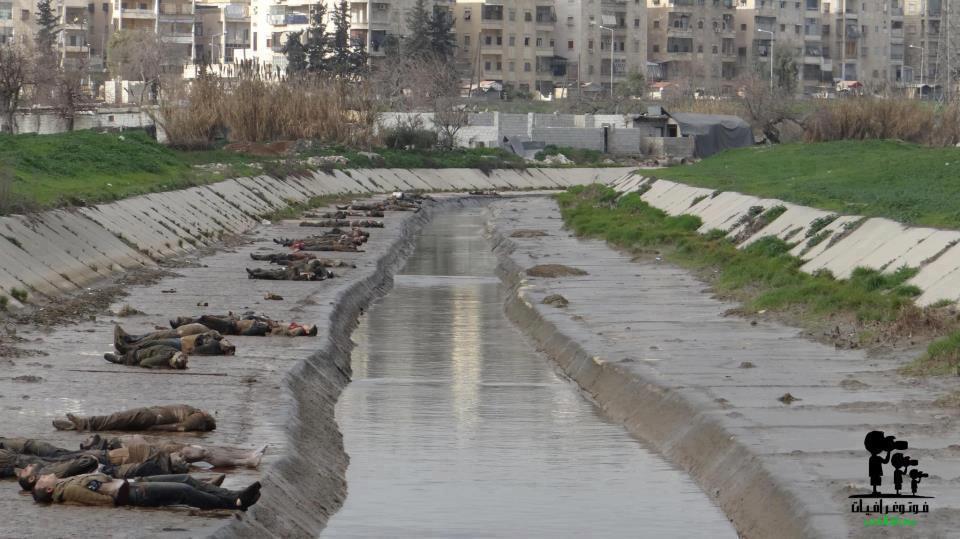
Meanwhile, Hezbollah continues denying any role in the conflict as the refugee count hits 1 million, civilian casualties claim more children, and the human rights abuses committed add on to the invisible list.  The UN’s registered number is over 779,910 refugees.  On this note, we’ve included a series of links and photographs collected by a dedicated Twitter follower who tweets in English, French, and Arabic: @Tintin1957.

January 29th: “Bodies lined up on the banks of Quweik river in #Aleppo. Most bared signs of torture, and were executed.” – Source: @Tintin1957 #Syria pic.twitter.com/1oz6J8vg

Only in Syria do children enter heaven before they enter preschool.” – Source: @Tintin1957 https://twitpic.com/bdaroo .

“This is most horrific photo I have ever seen from #Syria. I can’t even describe… #Shabiha torture of a baby.”


Leave a Comment

Filed under Interests, Politics

Iraqi Women’s Rights: Perspective from an Arab Civil Society Group

We are pleased to have received this article from our latest Pitapal: Raya Abu Gulal.  After tweeting back and forth regarding Iraq’s underground prostitution market, we wanted to revisit the larger issue of Iraqi women in the civic and political life.  Since 2003, the question persists: how much has women’s role regressed since Iraq’s political turmoil in the last 10 years?  Intended to be a liberation, 2003 proved to be the beginning of a process of deterioration for Iraqi women–as if Iraqi sanctions and three wars hadn’t disrupted the role of women enough.  As we had reflected last year in “HDI, Gender Gap Index, Gender Parity Index: None Incorporate Iraqi Women’s Conflict Management Efforts”, maybe we should reframe the question.  Maybe the larger question should be: how much have the political, civic, and economic roles of Iraqi women in the public space regressed in some respects, while advancing in other areas?

 Ms. Abu Gulal is currently running her own legal consultancy firm providing legal advice specializing in the Middle East. She is the co-founder of the Women Lawyers Group Middle East and member of various business groups. Raya is also appointed as committee member of the International Women Business Group (Abu Dhabi).

Iraqi women in the current political turmoil

By: Raya Abu Gulal   Originally posted on Your Middle East

Iraqi women began to enter the country’s job market in the 1920s and 1930 and have enjoyed fundamental women’s rights since late 1950s. This made Iraq one of the first nations to uphold modern standards of women’s rights in the world as well as a proponent of women’s rights in the Arab World. In 1979, the Iraqi constitution declared all women and men equal before the law, women studied and worked alongside men, and women formed at least 35 percent of the working population in various fields of work until the 2003 US invasion of Iraq.

Intended to be a liberation, 2003 proved to be the beginning of a process of deterioration for Iraqi women. The country’s new government and constitution does not appear to be an evolution from the historic precedent mentioned above, in terms of women’s rights and role in society. Also, Iraqi women, in particular, have become the victims of the current events in Iraq after 2003 and have been deprived from their basic rights, including security, salaries, and basic allowances. Many of the reasons behind this appear to be resulting from principles that are more orientated towards political survival of religious and sectarian movements rather than a genuine and accurate commitment to the religious foundations of Iraq’s dominant religious political movements.

The situation is causing a serious impact on Iraqi women and Iraqi society as a whole. There is a sharp increase in the exploitation of Iraqi women, particularly from extremist groups, resulting in the use of Iraqi women in suicide missions, forced prostitution, drug smuggling and other such terrible situations. This has also led to an increase in women suffering mental problems and other acute illnesses, which further impact Iraqi society, reaching into Iraqi families with severe impacts on children.

Click here to continue.

Leave a Comment

Filed under Analysis, PIDE (Policy, International Development & Economics), Politics