Conflict Resolution: #Iran Breaks Deadlock

Dear Pitaconsumers,

Step one in the deadlock with Iran broke last night around 9PM EST as Iran’s Chief Negotiator, Javed Zarif, shared an historic tweet:

@JZarif “We have reached and agreement.”   #Iran #Irantalks”.

World powers by way of the P5 + 1 reached a deal with Iran on its nuclear program at Iran’s Arak facility. The P5 +1 include the permanent UN Security Council members of the US, Russia, China, Britain and France;  the “plus 1” is non-permanent member Germany.  Turkey and Brazil were key in the 2006 negotiations.  It is a shame that they were excluded in this historic deal.  Nonetheless here’s Turkey’s official–and optimistic–response in the Turkish Foreign Ministry’s statement to Turkey’s English daily:

“The agreement reached by the sides today has become the first positive concrete development since the Tehran declaration in 2010… Naturally, the deal in question forms the beginning of the process and a part of measures to promote confidence.

We call on the sides to keep up their constructive approaches to carry the process further,” the statement said. “We hope both sides will take the necessary steps required by the agreement, so the problem can be solved in a diplomatic way that would satisfy everyone.

Turkey is ready to support this process in all ways as it had made every effort to keep the diplomatic process alive to find a solution. Turkey will keep on defending the right to nuclear energy use for peaceful purposes, while expecting the obligations of the Treaty on the Non-Proliferation of Nuclear Weapons (NTP) to be carried out.”

In 2003, when Iran made offer to Bush admin there were 164 centrifuges.   Today, after sanctions, there are 19,000 centrifuges.said U.S. Secretary of State, John Kerry, in analyzing the impact of sanctions on Iran’s nuclear program status.   Kerry says if abides by deal sanctions will be reduced. Here is the complete story:

World powers reach nuclear deal with Iran at Geneva talks

Source: Al Jazeera

Iran and six world powers including the United States have reached a deal to limit Tehran’s nuclear program and ease the tough international sanctions that have long been imposed because of it.

The deal – struck after negotiations in Geneva that stretched into the early hours of Sunday (late Saturday in the U.S.) – has “opened a new path toward a world that is more secure,” President Barack Obama said in an address broadcast live on television networks.

“While today’s announcement is just a first step, it achieves a great deal,” Obama said.

Iran’s Foreign Minister Mohammad Javad Zarif echoed Obama’s point that the deal is just the beginning of a political rapprochement.

“We need to start moving in the direction of restoring confidence, a direction in which we have managed to move against in the past,” Zarif  said.

alt

Photo Credit: Fabrice Coffrini/AFP/Getty Images

Obama said the deal includes “substantial limitations which will prevent Iran from building a nuclear weapon.”

Even so, Zarif said Sunday’s deal with world powers contained a “clear reference that (uranium) enrichment will continue.”

“The burden is on Iran to prove to the world that its nuclear program will be exclusively for peaceful purposes,” Obama said in his address.

The deal includes an agreement that Iran will halt some progress on its nuclear program, including a plutonium reactor at the Arak facility. The deal also reportedly calls on Iran to neutralize its 20 percent enriched uranium stockpiles.

Iran will suspend its enrichment of all uranium above 5 percent.

Iran has further committed to halt its expansion of the nation’s uranium enrichment program, halt the installation of additional centrifuges and ban the use of advanced centrifuges.

In addition, Tehran has agreed to intrusive inspections under the terms of the deal.

“We will gain daily access to key facilities,” Secretary of State John Kerry said at a news conference on the deal in Geneva.

In the interim, Obama promised that the U.S. “will refrain from imposing new sanctions and allow the Iranian government a portion of the revenue” it was previously denied.

Still, he said, “If Iran does not fully meet its commitments in six months, we will turn off the relief and crank up the pressure.”

Zarif indicated in comments early Sunday that in the final step of negotiations, set to take place in six months, negotiators will achieve a comprehensive deal on Iran’s enrichment program when all sanctions are lifted.

The U.S. maintained the controversial sanctions had always been a measure aimed at bringing about the kind of agreement reached in Geneva.

“Make no mistake, and I ask you, don’t interpret that the sanctions were an end unto themselves. The goal of the sanction was always to have a negotiation,” Kerry said.

Obama said that if Iran breaks its promise, it will face more of a backlash from the U.S.

“Because of its record violating obligations, Iran must accept strict limitations on its nuclear program,” Obama said.

Top European Union diplomat Catherine Ashton told Reuters the deal would create the time and space for a more comprehensive deal on Iran’s nuclear program.

Obama and Kerry sought to reassure international allies, including Israel, that commitments to their safety would remain unchanged by the deal.

Still, Israel’s Prime Minister Benjamin Netanyahu called the agreement “a bad deal.”

“No deal is better than a bad deal,” Kerry said, expressing confidence in the agreement.

Kerry and his counterparts from Russia, Britain, France, China and Germany joined the Geneva talks after Zarif and Ashton reported progress on uranium enrichment and other issues on Friday.

The diplomats had aimed to hammer out an agreement to freeze Iran’s nuclear program for six months, while offering the Iranians limited relief from crippling economic sanctions. If the interim deal holds, the parties will negotiate final-stage agreements to ensure Iran does not build nuclear weapons.

**************************************

PITAPOINTS

Great, “step two” may be on its way to be checked off as complete; Step three: talk    As Qayyum discussed last week, no deal to remove Assad from power (without killing him) will emerge without including Iran at the table.  Regardless of Saudi Arabia’s nor Israel’s disappointment–Netanyahu called it an “historic mistake”– with what they perceive as the U.S. being “duped” by Iran, the P5+1 broke the deadlock on a decades old issue.  More may follow.  “You can’t have peace in without in negotiations,” observed Mohsen Milani on the Syria Crisis.

Leave a Comment

Filed under Analysis, Interests, Politics, Technology

Middle East Institute Annual Conference: Managing Transition, Containing Conflict but #NODrones

“You can’t have peace in without in negotiations.”~Mohsen Milani

Middle East Institute 67th Annual Conference: Managing Transition, Containing Conflict

From November 14th to 15th, the Middle East Institute held its 67th annual conference.  To kick off the MEI banquet, Washington, DC’s oldest think tank devoted to the study of the Middle East and North Africa region, awarded Zaha Hadid the Issam Phares Award for her global contributions as an architect.  Hadid, who was born in Iraq, is the only Arab as well as the ONLY woman to win the Pritzker Prize, the HIGHEST honor in global architecture.  In addition, MEI awarded its Visionary Award to Abdlatif Al-Hamad from Kuwait.  Al-Hamad was recognized for his work at The Arab fund for Economic & Social Development, which accrued $120 Bil to support electricity & projects.

The keynote address was delivered by Ambassador Susan Rice, former U.S. Ambassador to the United Nations, and current National Security Adviser.  She was introduced by Richard Clark, who began with describing a U.S. success in Libya.  As he stated, “Chapter 7 Resolution important not just for US action in  in 2012, but in setting a precedent.” Note: Richard Clark was Ambassador Susan’s first boss in the national security sector.  Years later, she holds his same position as National Security Adviser)  Syria was mentioned, but not in the context of one of the major sponsors of MEI’s conference, Kuwait. (“One Kuwait-based effort raised money to equip 12,000 rebel fighters for $2,500 each.”

Rice stated that the U.S. must continue to: “confront aggression”; securing open markets (and mentions protection of women and minorities in same thought, unrelated); dismantle terrorist network; prevent proliferation of WMDs.  The U.S. must “stand with those who share fundamental interests and values”.  She discussed U.S. developments in MENA since 2012:

1) Iran- we are working w/P5 + 1 partners that will halt progress in nuclear program and roll it back. Goal to put real time on clock. We will continue to enforce exisint sanctions, revenue will far exceed any amount of relief of any first step agreement

  • “For the first time in many years, we are seeing an Iran where a nuclear deal may be possible,” stated Rice.

2) Israel-Palestine

  • The US does not accept the continuing “illegal settlement activity” in Palestine.

3) Syria – “There is no military solution to the conflict in Syria….no viable future for Syrians while Assad in power,” continued Rice.

  • Only a negotiated settlement, welcomes participation at the Geneva 2 conference, June 2012 Communique calling for a political transition to a new Syria, governing body formed on the basis of mutual consent–meaning: Assad must go.
  • The U.S. is working “intensively with partners and vetted opposition to counter Assad and extremist groups.”
  • Rice claimed a U.S. achievement in nonproliferation: “reducing extreme threat of weapons of mass destruction.”
  • The International Community must “alleviate humanitarian crisis” in Syria.

4) Egypt – US Intensifying efforts to make difference in day-to-day lives of people throughout the region.  Change is taking root, and no less true in Libya.

November 15 Conference: PITAPOINTS

The first panel “Assessing the Transitions” got a status check on the Arab transition among North African countries–sans Morocco and Algeria.  The most succinct assessment that addressed political, economic, and social issues came from Noureddine Jebnoun, professor at Georgetown University.  He summed up the Tunisia power struggle with caveats about terminology. His key points:

  • “Ennahda party versus others is more of a struggle to hold power. Period. Not “Islamist” vs non-Islamist.”
  • The polarization is a consequence of divided elites.
  • There has been no reform of security or judicial systems, which is necessary to move forward.

Larry Diamond dominated the question and answer session in a pseudo economics-ridden lecture.  Nonetheless, the most controversial points, though valid, came from Dr. Rabab El Mahdi.  She challenged a popular Egyptian narrative “movements of were overrated” and that the image of the middle class & youth created by media.  In a nutshell, “it doesnt reflect totality of picture” of what transpired in Egypt.  MEI’s Egypt scholar, Khalid Alaini stated that the Nour Party sided with Morsi’s ouster because they are trying to tame the Muslim Brotherhood.

Latter panels discussed the “Sectarianism & Balkanization of the Levant”, the status of “In Search of Coherence: U.S. Policy in the Arab World”, and the “Arab Youth in Post-Uprising Politics”.  In response to whether Syria, Jordan, and Lebanon are undergoing “Balkanization”,  MEI scholar Paul Salem explained that it’s “Balkanization with a small ‘b'”–  meaning state authority breaks down but borders aren’t actually redrawn. However, it was harder to interpret Mona Yacoubian’s (Stimson Center) response: it is “compelling for the West” to talk about redrawing borders.

“You can’t have peace in without in negotiations.  It’s fantastic that Secretary Kerry & Zarif spoke about Syria for 30 seconds,” shared Mohsen Milani, professor at University of South Florida, who was the most optimistic among the four panelists.

It was ironic that Iran emerged as a key topic within the Levant discussion regarding nuclear talking points when Israel meets both criteria for discussion: being located in the Levant AND possessing nuclear weapons.

On Syria, Salem went beyond the proxy war discussion by saying that, “Lebanon taught us that no one wins a .”

Overall, drone discussion only emerged after a question from the audience and youth movements discussion were relegated to the end of the conference…how symbolic.

MEI Conference Sponsors

Sponsors of MEI this year included: National Bank of Kuwait; Embassy of Qatar; Embassy of Kuwait, Embassy of Saudi Arabia; Embassy of UAE; US-UAE Business Council; Embassy of the League of Arab States; Embassy of Bahrain; Embassy of Iraq; International Relief & Development; BAE Systems; Carlyle Group; Morganti, Hunt Oil Middle East Limited; Chevron; Conoco Phillips; Shell; Raytheon; Ergo; Exxon Mobil; Foundation for Middle East Peace; Good Harbor Security; Sahouri Insurance; MENACA

Technology: Lebanon’s Forgotten Space Program http://www.bbc.co.uk/news/magazine-24735423

  • Note that both small and big economies must choose between funding a conventional weapons program or a space program.
  • It’s not just the rate of brain drain, but the type of fields that lack the critical mass needed to initiate different programs, like a space program.  How much engineering talent and number of physicists do MENA countries lose to very advanced industrialized economies, like the United States?


Leave a Comment

Filed under Analysis, Interests, PIDE (Policy, International Development & Economics), Politics, Technology, Uncategorized

Colbert Interviews Trita Parsi, Iran Negotiations Expert: Reroll the Dice

PITAConsumers–you know how much PITAPOLICY is a fan of The Colbert Report!  Last night, we couldn’t help but “ruminate” and share thoughts on the book mentioned in Parsi’s interview: “A Single Roll of the Dice”. (Note how ruminate probably comes from famous Persian philosopher and Poet, Rumi!) The thoughts by PITAPOLICY Founder, Mehrunisa Qayyum, ‘ruminate’ about the involvement of emerging economies, like Turkey, taking a turn at nuclear power negotiation.

For more by Trita Parsi, follow him at @tparsi on Twitter.

Stephen Colbert’s Interview of Trita Parsi, Founder of National Iranian American Council

http://www.colbertnation.com/the-colbert-report-videos/430406/november-12-2013/iran-nuke-negotiations—trita-parsi?xrs=share_copy

Link if Video not working

A Single Roll of the Dice


Originally published on Kabobfest

Contributed by Mehrunisa Qayyum.


The die was cast on the sanctions during the summer of 2009, a senate staffer said, “It was basically understood that sanctions were going to go through.”


Middle East Foreign Policy expert, Trita Parsi, recounts the comment above in his latest book “A Single Roll of the Dice: Obama’s Diplomacy with Iran”,  to underline one of his primary concerns in regards to current American-Iranians relations.


Although Parsi was born in Iran, he moved to Sweden with his family because his academic father faced persecution. Later, he completed his Doctoral thesis on Israeli-Iranian relations under Professor Francis Fukuyama at Johns Hopkins University School of Advanced International Studies. Parsi’s diplomatic experience includes his stint working for the Swedish Permanent Mission to the United Nations. He has also advised several Asian governments and the U.S. Capitol.


Punitive actions and heated rhetoric are not new to the US-Iran sphere of foreign policy. But it was even more troubling to learn that when other countries (Brazil and Turkey) attempted to assume a neutral role in easing the tension, and in fact received positive results, they were not commended for engaging multilaterally. Although Parsi’s new book examines this newer effort conducted by Brazil and Turkey, he connects this book to his earlier observations with his 2007 book: “Treacherous Alliance: The Secret Dealings of Israel, Iran, and the United States”. This book is recommended reading for those who recognize that hawkish US policymakers continue to nurture the intransigent paradigm that does little to progress relations with Iran. There are other competing paradigms to view Iran, a nation that also may be consumed by its own domestic challenges and vibrancy. (I am hoping that if I refrain from referencing AIPAC I can still talk about Iran.)


Getting a book review published on “A Single Roll of the Dice…” has been almost as challenging as reading this book on a DC metro without having someone ask me: “So, is Iran going to close the Strait of Hormuz and interrupt the oil flow?”


Despite these personal challenges for me, it cannot be as difficult as Parsi’s effort to conduct and assess over 60 interviews with contradicting voices in order to investigate how the “pre-breakdown” of US-Iran dialogue happened before official diplomacy actually restarted. I foolishly thought that if I discuss a book that serendipitously addresses a ‘hot topic’, then reviewing where the diplomacy option stands in a US election year would make up for the emotional discourse that predictably played out in DC while ‘netizens’ used #OccupyOccupyAIPAC and #Iran.  As The Daily Show noted: national elections tend to increase the vitriolic rhetoric as leaders demonize a potential threat to appeal to voters.


In “ A Single Roll of the Dice…” Parsi outlines two chronologies to represent each track that the US pursued immediately after Iran recognized that shared a message to dialogue:


  • The first track represented sanctions, which enhanced the status quo–because the last three decades achieved so much in US-Iranian relations.
  • The second track illustrated what revisionists might call an “Obama Doctrine” since President Obama exerted a significant amount of political capital to act on what the Bush Administration chose not to pursue.


Perhaps one could argue that the third track of military confrontation also exists, but as Parsi makes clear: the whole point behind Iran’s intent and the Obama administration’s posture was to avoid confrontation. Nevertheless, the book provides several anecdotes to highlight how “Rather than being an alternative to policy, sanctions have become an alternative to policy,” and what the driving force behind confronting “Iran’s nuclear problem” is .


Fundamentally, US sanctions have operated as a response to Iran’s nuclear potential, and thereby trumped all other recommended avenues to engage Iran on developing issues such as a long-term collaboration on Afghanistan. Moreover, the Iranian leadership has persistently said that it is not pursuing a nuclear weapon for militarized purposes as exemplified by Ayatollah Khamenei’s February 22 statement, “The Iranian nation has never pursued and will never pursue nuclear weapons.”


Another book that tackles Iran’s nuclear developed comes from Shahram Chubin, which is more defined by a security point of view: “Iran’s Nuclear Ambitions”. A more hawkish view of Iran may be encountered in “Showdown with Nuclear Iran: Radical Islam’s Messianic Mission to Destroy Israel and Cripple the United States” by Michael D. Evans & Jerome Corsi. In contrast, Parsi provides added value with the back-story of the current situation, which does not fixate on the philosophical definition of “rational actor” because he reviews each participating power’s role, considering its rhetoric and reaction. As a result, I see how a country may be acting rationally according to its interests while another country disagrees with policy. Nonetheless, it is more attractive to question a state’s sanity as opposed to its policy — a tool used by many involved.


In fact, discussing Iran as a rational actor–distinct from what its neighbors think or believe–has been consistently difficult, if not considered unwise. Historically, the US has consulted with he Europeans and Israel when dealing with Iran. But when newer rational actors participated, like the rising economies of Brazil and Turkey, somehow the new kids on the block were begrudgingly allowed to join the P5+1 soccer team. As a result, the US position preferred to spend more political capital maintaining the isolationist path of crippling sanctions rather than leveraging the political capital expended by Brazil and Turkey, which persuaded Iran to accept an agreement that the US had originally proposed. (By crippling sanctions, I mean the updated “targeted” sanctions policy.)


As Parsi commented, “Obama administration invested a lot of political capital in testing diplomacy with Iran …away from public view, Obama had sought to establish a direct challenge of communication with Khamenei via the Swiss embassy direct dialogue” Similarly, Iranian author Hooman Majd, noted in the New York Times, that sanctions on Iran, as a policy, have not been working either. [Click here to continue for complete article.]


Leave a Comment

Filed under Analysis, Interests, Politics

Live-Blogging #MENASocialGood – Complete! #Funtabulous

Since 2011, PITAPOLICY Consulting & Blog has been a Creative Partner for Al-Mubadarah by contributing interview blogs exploring development issues in the Arab world as well as partnering for social media action.  PITAPOLICY Consulting & Blog is pleased to be among the sponsors for #MENASocialGood, which was organized by Al Mubadarah (The Arab Empowerment Initiative) and its +SocialGood partners.  Al Mubadarah focuses on Arab human development and is spearheaded by Hazami Barmada and Victor Shiblie.  Our previous post asked: “How Will Investing in MENA Technology Fuel Philanthropy?” (November 4th, posted our Huffington Post Social Entrepreneurship piece questioning the status of innovating technology and philanthropy fields in the Middle East & North Africa region).  The first summit on Arab philanthropy & technology is over–so all the MORE reason that PITAPOLICY looks forward to continuing in its Creative Partner role.

A special thanks to +SocialGood partners (Microsoft, Bill & Melinda Gates Foundation, Mashable, the United Nations) as well as Turkish Airlines, Cisco, Booz Allen Hamilton, and others for financial support.  There were 17 global meetups with the support of Ashoka Arab World, Endeavor, and others to arrange in the following countries: Qatar, Dubai, Egypt, Palestine, Morocco, Tunisia, Lebanon, Belgium, Canada, France, and Ireland. 

Thanks to those who joined us throughout the day as we live-blogged here and tweeted from @PITAPOLICY & @PITAConsumer at the Newseum Building in Washington, DC.  Below are the highlighted talking points we gathered from each session.  Al-Mubadarah is working on its site to provide some video segments for pitaconsumers who want to watch what they’re reading!  Also, again, discussion is not over–so tweet your commitment to promote human development in the Arab World using ‘#MyArabWorld’.

Questions: The Nexus Between Technology & Philanthropy

Technology:

Growth of Technology for Social Good

  • How technology can mobilize people for social good?
  • How to utilize technology to mobilize social mobility?
  • How can MENA more effectively incubate technology and inspire innovation?
  • How online platforms can facilitate Harnessing Global Talents & develop mentorship relationships
  • How to use technology for education?
  • How to use technology to grow your business?
  • How social media is engaging youth? How can it be more constructive?


Knowledge Transfer & Capacity Building


  • How to build successful public-private partnerships?
  • How to use technology for capacity building and knowledge transfer
  • How technology can expand education initiatives – virtual classrooms

Philanthropy


Innovative Philanthropy: Redefining the Donor & Online Giving


  • How to unleash philanthropy in the Arab World?
  • The importance of philanthropy to development
  • How is crowd funding growing in MENA?
  • How to cultivate and boost diaspora giving?


  • How to use social media to build strategic partnerships
  • How to fundraise online for your NGO?

Panel – Peace & Education through Gaming Emily Jacquard, Country Director in Lebanon, Search for Common Ground & Cedaria: Blackout

  • Hazami: What’s the space for videogaming in engaging youth on other issues besides violence?
  • EJ: At least 96% of youth play on videogames, many are violent.
  • Wargames is about demonization, so need to get past challenge of dehumanizing humans.
  • Trying to attract youth to look at corruption, refugees via gaming.

Panel – From Pain to Solution: The Little Engineer designed by Rana Chameitelly, Founder, The Little Engineer 
(Beirut, Lebanon)

  • Hazami: Do you find that there is a lot of programming in cultivating technology education?
  • RC: Engineer whose mission is to expose kids to technology of robotics to get kids before critical age into real technology
  • RC: Robotics isn’t just programming; learn concepts of engineerings w/hands on experience.
  • Hazami: What are your thoughts on programming for youth? To create a space for innovation by youth?
  • RC: Need to keep udpateing as youth change.

Panel – Youth Diplomacy: Empowering a Mainstream Youth Voice
Ahmad Alhendawi, United Nations Secretary-General’s Envoy on Youth
(New York, NY)

  • Hazami: How have Arab Governments responded to social media to engage since Arab Awakening?
  • We need to join forces, coordinate this fragmented scene, and bring youth onto the global stage.
  • It is time to invent jobs, not just seek jobs. Write business plans, not just CVs.
  • Young people no longer define democracy as voting every 4 yrs, as they voice in real time w/social media…

Panel – Reporting Live: Fusing Citizen & digital diplomacy with Technology Hend Alhinnawi, Co-Founder, Humanitarian Tracker

  • With new info paradigm, everyone is active participant… can get information ahead of official sources
  • Syria Tracker: Eye witness reporting + social media mining to give a holistic view of what is happening on the ground
  • Official orgs, like State Department use reports.
  • Got info out of Syria even during Internet blackout. Ppl took pics & video and uploaded later or used satellite


Panel – Harnessing Passion: Diaspora Engagement in Tunis & Beyond
Mohamed A. Malouche, Board Chairman, Tunisian American Young Professionals
(Washington DC)

  • MM: Upside of being a small diaspora community: to mobilize & gain consensus on 1 cause: Econ Development
  • Hazami: We receive criticism as a Diaspora community that we have a  “Savior Problem”: You’re 3rd 4th generation, so you don’t know our problems. How to deal with that?
  • Haven’t been able to make it a massive engagement… trying to address that we selected 10 15 selected entrepreneurs to success as a way to sidestep political connection factor.
  • Don’t be a Lesson Giver, but as a Partner

Workshop[WORKSHOP] Need Cash? How to Use Online Tools to Support Your Work with Britt Lake, Director of Programs, Global Giving
(Washington, DC) @globalgiving:

  • If you’re not doing online donations you’re probably leaving money on the table.
  • Do’s: use photos, explain challenges faced; use direct call to actions
  • Don’ts: use jargon, don’t make every post abt asking for donations
  • Send Thank You notes w/o asks
  • Use Networks

Panel -E-Commerce: Powering Digital Business with Omar Elsahy, General Manager, Souq.com
(Cairo, Egypt)

  • Amazon is looking into opening warehouses in the MENA with fulfill by Amazon options to support small retailers in MENA
  • @Omar_Elsahy @Souq: With  E-commerce removes traditional barriers of age and gender. Competency becomes important factor.

Panel – Entrepreneurship Revolution: The Boom & its Future
Mohannad El-Khairy, Director, International Partnerships, Plug and Play Tech Center
(Palo Alto, California)

  • HB:El-Khairy  comes from the pioneering Zawya.Com to focus specifically on pushing entrepreneurship.
  • ME: Sense of owenrship needs to be given to university
  • ME: Tap into corporate segment.
  • ME: Angel Investing fits into model of Islamic Banking principle of “musharika”

Panel -The Culture of Philanthropy: How Do We Give? with Nadia Roumani, Professor, Stanford D-School, Founder, Muslim Giving Project
(Palo Alto, California)

  • Misperception: not just a shortage of resources… if we had more money, we could solve all of these problems
  • In MENA, many institutions have lost the trust of the communities they’re trying to engage. #MENASocialGood
  • “Redesigning philanthropy” efforts of looking at how resources can be used more efficiently for social change.

Panel – Internet Connect: Entrepreneurship Across Borders
Ossama Hassanein, Co-Founder & Chairman, TechWadi
(Palo Alto, California)

  • Hazami: How does TechWadi’s mentorship program work?
  • Hassanein: It takes between 1 to 3 months. Each startup goes through the 5 step process.
    Step 1: Exposure in Silicon Valley attend up to 5 events each week…but could be 3 times that much
    Step 2: Acceleration: 2 weeks immersion
    Step 3: Human Capital Dev, Hiring focus on human capital
    Step 4: Personnel Building, Conflict Resolution
    important to ensure no issues
    Step 5: Financing.

Panel – Digital & Diaspora Diplomacy with Edward (“Ned”) Sebelius, Senior Advisor, The Secretary’s Office of Global Partnerships, United States Department of State
(Washington, DC)

  • Dont’ see SOcial media as replacing our current efforts.Diaspora community is very important to us. Look at remittancesEngagement w/MENA audience: US State Dept will listen and take steps to look for entrepreneurs in Africa, SE Asia, MENA region
  • Responding to frustration is a priority at-large. Listening to and gathering people.#SecKerry has made it a personal priority to engage the youth of the #MiddleEast, and to improveHow R they actively making connections w/in MENA. Want to tap into incubators.

Panel – Social Business: Doing Good by Doing Well
Ahmed Ashkar, Founder & CEO, Hult Prize
(Washington, DC)

  • Hazami: Business words don’t always translate in ARabic, so there’s a linguistic challenge.
  • Ashkar: True, it’s a challenge in communication in business world too. Foced to use words that don’t exist in Arabic…b/c it goes into philanthropy.
  • Ashkar: Profits are given back to the cause. Every add’l person serviced, is that the cost declines
    A social business is one where the cost curve declines as capability improves. Charities often run on linear basis.
  • Applications are open–we are looking for a focus on healthcare.
  • Wasta is “network” that very few have access to… (PITAPOLICY Note: wasta exists in many cultures…what we’re concerned about is the level “wasta” has or has not been democractized)

Panel – Shifting Paradigms: A Driving Voice on Arab Development w/Muna AbuSulayman, Development Expert, Philanthropist, Social Activist
(Riyadh, Saudi Arabia) @MunaAbuSulayman

  • Hazami: What should we be expecting from conferences– there Arab conferences left and right!
  • MA: Conferences are for networking and an opportunity for those to showcase their CSR.

Panel – Sharing Good: The Contagious Effect of Positivity Nawara Chakaki, Editor-in-Chief, Baraka Bits
(Dubai, United Arab Emirates)

  • Hazami: What does sharing good information do?
  • From #Dubai @nchakaki w @barakabits “postive local narrative that is uplifting and inspires us to make a difference” #MENASocialGood
  • Need to use inspiring stories! We have become desensitized to the negative images media portrays. @nchakaki wants to focus on the positive.
  • Baraka bits has grown to be #1 news source in #MENA on good news, which inspires to take action
  • Positive Story examples: Shelter for Abused walls in Qatar, Green Wall in Kuwait, Talent emerging.
  • Creative Commons license to share our stories as long as not for commercial use nor altered content.

Workshop: Research: Social Media 4 Social Good in Arab World
Fadi Salem, Director, and  Racha Mourtada, Research Associate, Governance & Innovation Program, Mohammed bin Rashid School of Government
(Dubai, United Arab Emirates)

  • Based on our last report: we found FB users reached 55 million users, quadrupeld since 2010, and penetration of 15 %. Twitter is around 3.8 million.  336 tweets /month. Twitter: top 5 are all GCC countries
  • Top Hashtags: KSA, Egypt, Bahrain and Syria in ARabic new phenomena
  • only 1 in 3 are female, vs. 50% in world  social & cultural constraints on women
  • Social Media is becoming a primary source of news, according to our survey this year
  • Convergence of traditional and social media: economic growth and socent
  • Fadi Salem: “”virtual civil society developing among users of social media in Arab region””

See their report: Arab Social Media Report.com

Panel: Annette Richardson, Senior Advisor & Acting Chief of Office, Office for Partnership, United Nations
(New York, NY)

HB: How do we respond to the concern that we’re cultivating citizen activism for a purpose?  It creates concern for some power holders.

AR: Cultural dimensions in Emerging economies differs from the West.  I meet with groups individuals to develop a relationship.


Panel – Digital Philanthropy: Changing the Landscape of a Donor in MENA with Justin Sykes, Director of Microenterprise Silatech

Justin @Silatech: We invest in institutional resources , but still need to involve citizen activism.  18 months ago, we launched an initiative w/Kiva.  Young professionals across Arab world might not be used to crowd-funding for philanthropy goals, so we launched another platform. Challenges in currency transaction and language remain.

Panel w/Afeefa Syeed, US Agency for International Development

  • Syeed:”Development is an action word that requires active learning and not just talking”
  • Barmada: If you were to give Arab Governments advice on how to better listen, regarding access to education and healthcare, what would it be?
  • Syeed from USAID: Hard to answer.  Internalize process of supporting innovation and to bring in youth.
  • Barmada: Hopefully, even if one offers constructive criticism of #USAID and govts, one can still work together.
  • Barmada to Doha Meetup participants: How do you define a donor? (Mowil, arabic word to create)


Leave a Comment

Filed under Analysis, Interests, Technology

How Will Investing in MENA Technology Fuel Philanthropy? #MENASocialGood

What's the Nexus Between Technology & Philanthropy to Produce #MENASocialGood?

What’s the Nexus Between Technology & Philanthropy to Produce #MENASocialGood?


 Originally published on November 4th, Huffington Post Section of Social Entrepreneurship in Partnership with Schwab Foundation

What will tackle the biggest social, health or economic problems in each country? Philanthropic missions? Innovative technology? Or a version of Bill Gates in each region of the world?

One lesson to take away from the 2008 Global Financial Crisis is that no country is too rich for problems — nor is protected from thedownturns faced by others, like Turkey. Back in September, Mashable partnered with the Bill & Melinda Gates Foundation and the United Nations to embrace this discussion of technology and philanthropy in the “Social Good Summit.” But, while combing through the tweets, not much discussion about how “Social Good” has taken root in the Arab World. This was odd since philanthropy in the MENA region is as old as the MENA region itself. Technology, on the other hand, has made more inroads further East.

Yet, lately, for the Middle East & North Africa region, a long list of big-name institutions, like the Milken Institute, and investors have been recommending that investing in MENA’s technology sector may be the way to address their unemployment and infrastructural problems — even the political unrest. Meanwhile, a variety of NGOs are establishing themselves in the MENA region, or regrouping, to better fix the infrastructural problems they see — and maybe the unemployment. So will both of these paths, technology and philanthropy, continue to operate independently? Or will they move towards each other like awkward dance partners — or choreograph something better?

According to a World Economic Forum report, the UAE and Qatar lead the Arab World in leveraging information technology for growth. That’s great. There is a downside, though. The UAE and Qatar do not represent the bulk of the Middle East & North Africa region when it comes to country finances. Like Saudi Arabia, they are oil-rich economies and can more easily invest in the ICT sector.

Nonetheless, China has noted the Arab countries’ potential for technological growth. Actually, China has more than “noted” — Chinese businesses have invested over $1.4 billion in Qatar, Jordan, Kuwait, and Egypt, for example.

Will Investing in MENA Technology Fuel Philanthropy?

Technology is a sector that requires huge capital investment — on top of millions of dollars (or dinars) in research and development projects. This was even more evident when young Egyptians presented their “social good” projects as Gabr Fellows to the Arab American Institute and the Shafik Gabr Foundation. Two of the team projects leveraged technology space toward a “social good” mission. One focused on micro-health clinics. The other focused on renewable energy. Both projects will require more investment that the other Gabr Fellows’ proposals — but will probably do more to address infrastructural and economic problems mentioned earlier.

Big-time philanthropists, like Bill Gates, lend their technology to achieve “social good.” So how does philanthropy intersect with technology — a sector that requires huge capital investment? One idea is that technology and philanthropy may operate better within a social enterprise model that rewards talent — achieving “social good” together. However these two sectors combine, under whomever, below include some key lessons learned from the Chicago Booth School event held in the 1776 Campus in Washington, D.C.

1776 was established in January 2013 as a hub to support innovative startups. In Jordan, the Oasis500 initiative operates in a similar way, but it targets only startups in the ICT sector. Similarly, Egypt has Flat6Labs and its own culture where philanthropy, venture capital investments, and technology link up where public sector hovers.


  • Social entrepreneurship risks failure at this point: if no succession plan or depends on ONE person whose ego gets in the way.
  • Doing “social good” work should not mean you earn low salary. Social enterprises should pay more to retain talent because searching and training them are costly.

See a pattern of learning how to be a “Changemaker” at a very young age — won’t stop until they make the change.~ Lucy Perkins, Leadership Group Member, Ashoka

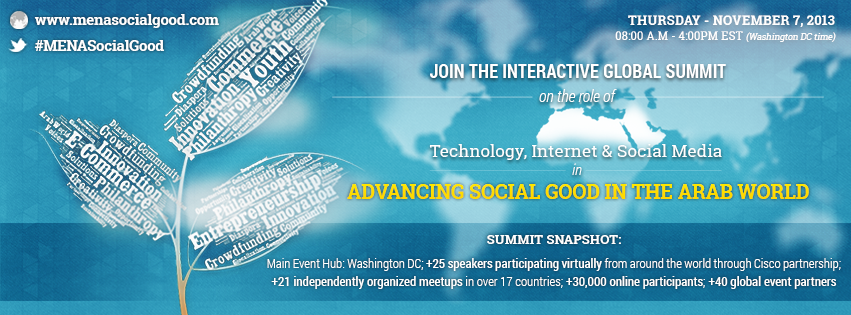
On Thursday, November 7, Al-Mubadarah (The Arab Empowerment Initiative) will host the first summit on philanthropy and technology in Washington, D.C.: MENA + SocialGood that has also organized virtual meetups for those participating in the Arab World. Speakers will include Rama Chakaki of Barakabits, Mona Abusulayman (philanthropist), Ahmed El-Alfi of Sawari Ventures, Ossama Hassanein of Techwadi, Ahmed Alhendawi (United Nations) among others. Follow the discussion of #MENASocialGood. See if there is an Arab version of Bill Gates — one who used the technology platform to increase philanthropy — or if there is an Arab changemaker who can use the philanthropy vision to increase technology. Either way, it’s all #MENASocialGood. Can’t wait to tweet back at your comments Thursday!

Leave a Comment

Filed under Technology

When the Government Fears the Satirists You Have Change #Egypt

When the people fear the government you have tyranny….when the government fears the people you have liberty. -Thomas Jefferson

So does Egypt have tyranny or liberty?  Or maybe in Egypt’s case: When the satirists fear the government you have tragedy…when the government fears the satirists you have change.  Either way, we are terribly sad to hear that Egyptian TV Channel suspended one of the Arab World’s most famous contemporary commentators, Bassem Youssef, for being what he claims: a satirist.  Youssef made fun of Egypt’s army Chief General Abdel Fattah al-Sissi–as done to Adly Mansour (current president) and Mohammed Al Morsi (ex-president) before the June-July 2013 transitory period.  Youssef hosts El Bernameg, which continually raises points that often provoke controversy, but more importantly encourage debate within Arab society of its own politics, economies, and societies.

In September, Bassem Youssef was honored with the Committee to Protect Journalists’ 2013 International Press Freedom Awards.  Just to highlight Youssef’s popularity, check out what was shared by Al Ahram newspaper (via Egyptian journalist and blogger, Bassem Sabry):

Baseera poll: 61% of Egyptians have heard of Bassem Youssef’s programme, 29% of those watch it regularly.

We think that the poll has understated his local popularity…but for those of you who may disagree with us, we cannot help but be disappointed that the “marketplace of ideas” has been monopolized when censors and suspensions determine what media viewers consume.

Over a thousand protests in Egypt during October: Democracy Index

According to the report, 41.48% of all protests were organised by the Muslim Brotherhood, a proportion which is nonetheless in decline compared to previous months.

Share     Print       Email
An Egyptian student of al-Azhar university kicks a tear gas canister fired by riot police during clashes outside their university campus in Cairo on October 20, 2013 following an anti-army protest. (AFP PHOTO / KHALED DESOUKI)

An Egyptian student of al-Azhar university kicks a tear gas canister fired by riot police during clashes outside their university campus in Cairo on October 20, 2013 following an anti-army protest.
(AFP PHOTO / KHALED DESOUKI)

By Mahitab Assran

Egypt witnessed a total of 1,116 demonstrations during October, according to a monthly report by local group Democracy Index, with about a quarter of them in Greater Cairo alone.

According to the report, 41.48% of all protests were organised by the Muslim Brotherhood, a proportion which is nonetheless in decline compared to previous months.

The report said students represent the second largest faction organising demonstrations, with a total of 378 demonstrations which represent 33.47% of the total number demonstrations. It went on to qualify, however, that the Muslim Brotherhood has changed its demonstrating strategy by dividing its supporters into groups, one which being students. The report further said this shift in methods and tactics comes in an attempt to create an atmosphere that “the country as a whole is protesting” but in reality these groups are “pursuing its [the Muslim Brotherhood’s] objectives.”

The report also showed that 80.18% of all demonstrations were for political reasons while 19.81% were for economic and social reasons. The three main political motivations behind the demonstrations the report cited included: pro-legtimacy and anti-coup, against the Muslim Brotherhood and their actions, and against the new Protest Law, which the report described the draft Protest Law as “flawed”.

The report indicated a significant 50% increase in labour strikes.

Leave a Comment

Filed under Politics

“I’m not an employee…I’m a Political Activist.”~Deputy PM for Economic Affairs #Syria #QadriJamil #Defection

We’ve counted 403 news stories about Bashar Al Assad’s sack of his senior official, Deputy Prime Minister for Economic Affairs, Qadri Jamil, yesterday.  This came after Jamil met with American official in Geneva. Jamil is a Russian educated economist.  Lately, he has been the regime’s “scapegoat” for Syria’s increased inflation and other economic woes as Syrian state media blames him since his firing.   Although Jamil has tried to gain entry into the opposition, he has not been accepted.

Also, in a disturbing development: the World Health Organization warned of a deadly polio outbreak in Syria–which has not witnessed a case since 1999.  Reuters reported that ,”Health groups said in April that a $5.5 billion vaccination and monitoring plan could entirely rid the world of polio by 2018, but recent outbreaks in Pakistan and Somalia, as well as this latest reappearance in Syria, threaten that timetable.”  How many more officials will attempt to broker a deal with the opposition before defecting?  Now the Assad regime has launched the “Starvation Until Submission Campaign”, termed by Assad supporters, which already exacerbates the earlier food blockades on Eid.

Syria Fires Official Who Tried to Broker Peace

The official, Qadri Jamil, was dismissed for spending too much time outside Syria, neglecting his duties and holding meetings “without coordinating with the government,” state television said. Mr. Jamil was fired shortly after he told the Russian news media that he had met with United States officials. Meetings between Syrian and American officials have been rare since the Syrian uprising began in 2011.

A State Department spokeswoman confirmed on Tuesday that the United States ambassador to Syria, Robert S. Ford, met with Mr. Jamil on Saturday in Geneva, calling the encounter one in “a long list” of meetings with people directly or indirectly connected to the Syrian government to discuss the potential peace talks.

Mr. Jamil, a Soviet-educated economist, was one of two members of tolerated opposition parties appointed to the government last year in a move billed as broadening its base. In an interview last month in Damascus, the Syrian capital, he blamed corrupt people on both sides for prolonging the war, and he said that despite his post, he was part of the “patriotic opposition,” which has not supported the armed uprising.

Behind the scenes, American and Russian officials have been meeting with Syrians inside and outside government to set up the planned talks. But there is little sign of movement, with the main exile opposition group demanding the departure of President Bashar al-Assad as a precondition and Mr. Assad saying he will not talk with those bearing arms against him.

The State Department spokeswoman, Jen Psaki, said the firing did not represent any broader message about the Syrian government’s willingness to participate. But opposition activists called it a ploy that would allow Russia to present Mr. Jamil as a representative of the opposition during peace talks.

And analysts said it could be a strong warning that Mr. Assad planned to remain fully in control of any peace talks or political transition — a message delivered as Lakhdar Brahimi, the joint United Nations-Arab League envoy on Syria, visits Damascus to try to catalyze a peace process.

Randa Slim, a Syria expert at the New America Foundation, a public policy institute in Washington, said the firing of Mr. Jamil served to remind the United States and Russia that any peace talks “must go through Assad.”

“Sacking Qadri Jamil is also a sign of how strong #Assad feels today,” Ms. Slim posted on Twitter. “Jamil was very much #Russia’s man.”

Analysts in the region and supporters and opponents of Mr. Assad alike say that with the Syrian government holding its own and the rebels divided, it appears increasingly likely that the talks, if they take place, will work toward a deal in which Mr. Assad stays on, at least for an initial transition phase.

Mr. Jamil, speaking from Moscow to the Lebanese television channel Al Mayadeen after being fired Tuesday, said that his disagreements with the government were mild and declared that the demand for Mr. Assad to step down was “crippling” the dialogue before it could start.

“The idea of Assad stepping down is out of the question,” he said.

Mr. Jamil said it made little sense for the government, which has said it will attend the Geneva talks, to blame him for meeting with the talks’ sponsors, adding that he was working to “end the blood bath in Syria.”

But he said that while he did not want to work with the Syrian government as a full-time partisan, he would go to Geneva as part of a loyal opposition and would eventually return to Syria.

At their meeting last week, Mr. Jamil tried unsuccessfully to persuade Mr. Ford to allow him to attend the meeting as an opposition member, Reuters reported, citing a Middle Eastern official. Neither the armed opposition nor the main umbrella group for the nonviolent opposition, the National Coordination Body for Democratic Change, accept Mr. Jamil as an opposition member. And in recent weeks, he had been stripped of his economic portfolio and scapegoated by state-controlled media for Syria’s inflation and food and fuel shortages.

In another move that appeared aimed at positioning the government for Geneva, Mr. Assad on Tuesday issued an amnesty lifting criminal penalties for those who deserted the army, provided they turn themselves in and rejoin the service within 30 days if they are in Syria and 60 if they are abroad. [Click here to continue.]

Syria sacks deputy prime minister who met US officials

Source: CBS News

DAMASCUS, Syria Syria’s president sacked a deputy prime minister who met Western officials to discuss the possibility of holding a peace conference, saying he acted without permission. The Tuesday decree was the latest blow to diplomatic efforts to bring the country’s warring parties to the negotiating table.


The sacking came as the U.N.’s health agency said it confirmed 10 polio cases in northeast Syria – the first confirmed outbreak of the highly contagious disease in the country in 14 years. Officials warned the disease threatened to spread among an estimated half-million children who have never received immunization because of the 2 1/2 year civil war.


Deputy prime minister Qadri Jamil was fired after a weekend meeting in Geneva that Washington says was with its ambassador to Syria, Robert Ford.


The Oct. 26 meeting was to discuss the possibility of holding a conference next month, also in Geneva, to negotiate a settlement to Syria’s conflict, said a U.S. official who spoke anonymously because he was not authorized to discuss the private conversation.


Three days later, President Bashar Assad issued a decree relieving Jamil of his duties for “undertaking activities and meetings outside the homeland without coordination with the government,” Syria’s government news agency SANA said.


Jamil told Lebanon-based Al-Mayadeen TV that he also met with a Russian diplomat and U.N. officials. He did not say whether his moves were coordinated with Assad.


“I am not an employee,” he said. “I am a political activist.”

Leave a Comment

Filed under Analysis, PIDE (Policy, International Development & Economics)

Gini Out of the Bottle: How Dangerous Is Wealth Inequality to Democracy?


The “Gini is out of the bottle” as we grossly joked last week.  (We couldn’t help but insert a pun about the Gini Coefficient.)  Gini Coefficient measures the level of wealth distribution…the higher the number, the higher the inequality — less people are above the mean.  So if a country scores a ‘0’, then there is complete equality regarding distribution of wealth within a country.  Think: ideal communism in China.

“The most important problem that we are facing now today, I think, is rising inequality in the United States and elsewhere in the world,” ~Robert Shiller, Nobel Prize for Economics Winner for 2013 

This quote comes from an interview by Robert Shiller with Associated Press.  How concerned should we be that wealth distribution is more skewed in some countries compared to others?  Earlier this month, The Executive Magazine wrote that about less than 1 percent (five families) in Lebanon represent about 48 percent of Lebanese wealth.  Growing up in the U.S., there is this presumption–or assumption–that countries with extremely high inequalities of wealth distribution turn out dissatisfied majorities.   More simply put: disproportionate wealth distribution translate into disproportionate political power.  How true is this?

This could easily apply to the United States as easily as it does for Tunisia and Lebanon…Turkey, and Egypt…and Syria.  The list is long outside of the MENA world too (Israel, Mexico, Chile, Brazil and India).


Filthy rich

Source: Executive Magazine    Published October 18, 2013

Half a percent of Lebanese adults own half the country’s wealth

At least 48 percent of Lebanon’s privately-held wealth is concentrated in the hands of some 8,900 citizens — just 0.3 percent of the adult population — according to calculations based on a new report. The nation’s staggering wealth inequality is detailed in Credit Suisse’s Global Wealth Databook 2013, released last week. The distorted wealth figures help to push the country’s Gini coefficient, a measure of inequality, to 86.3 percent — the fourth highest globally behind Russia, Ukraine and Kazakhstan (see chart, below left).*

While Credit Suisse did not directly publish how much wealth is in Lebanese millionaires’ hands, Executive was able to estimate a lower bound based on the report and Forbes magazine’s list of billionaires. Lebanese worth more than $1 million own at least 48 percent of the country’s wealth (see chart above). This figure, however, is a minimum estimate. It also implies that the rest of the country owns less than 52 percent of private wealth, valued at some $91 billion.

The richest Lebanese are its six billionaires, all from the Mikati and Hariri families. According to Forbes, their combined worth is $14 billion — some 15 percent of all private wealth. [Click here to continue….]

Leave a Comment

Filed under Analysis, Politics

National Council on US-Arab Relations Conference: Strengths, Weaknesses, & Opportunities #NavigatingUSArabRelations

“Sticks are becoming more lethalized whereas our carrots (soft power) less tasty-possibly rotting.”~Sharpe

From Tuesday October 22nd to October 23rd, the National Council on U.S. – Arab Relations held its annual conference.  This year’s title theme: “Strengths, Weaknesses, & Opportunities”.  Pita-consumers may consider this the “S.W.O.T. analysis” of U.S.-Arab reltions without the “Threats” discussion, but we assure you: the “Threats discussion” definitely was described within the softer context of challenges.  Also, with the panel on the Gulf Cooperation Council Geopolitical Dynamics, speakers like Dr. Al-Shayji assigned most of the blame for Gulf countries challenges and concerns to Iran.  Although the goal was to explain geopolitical dynamics in the Persian Gulf, the highly charged allegations against Iran most definitely made up for the missing “Threats” portion of the S.W.O.T. analysis.  The irony is that another panel called for U.S. relations to “pivot to Persia” calling for sanctions on Iran to be lifted.

Each year, the program booklet lists great, probing questions–many of which are not asked explicitly.  For example, How can interests benefit from plans to build passenger/freight railways?  It is a missed opportunity to get answers from the panelists who are assembled.

At the lunch keynote, NCUSAR awarded former Illinois Congressman Paul Findley for policy-making achievement.  Findley wrote “They Dare to Speak Out’ and “Deliberate Deceptions”, which discusses missed opportunities by the U.S.  in policy-making in the Arab world.

HRH Prince Turki-Al Faisal shared his remarks during lunch where he focused on why Saudi Arabia declined a seat at the U.N. Security Council last week.  This boiled down to two reasons:

  1. Dissatisfaction with how the UNSEC Council has handled the Israeli-Palestine issue.
  2. Disappointment with how UNSEC Council allows veto power of China and Russia to derail action in the Syria crisis.

Al-Faisal led into the Syria crisis by stating that Assad and his accomplices must be tried at International Criminal Court of Justice.  He added how Lebanon’s recent collapse of the AlMikati government will push Lebanon to the brink of another civil war.  He tried to support his apocalyptic scenario for Lebanon by warning of the spillover from the Syria crisis and pointed fingers at Iran for meddling (he added that Iran meddles in Bahrain, Iraq, Kuwait and even in Yemen)… his remarks foreshadowed the theme for the second half of the conference: call for harsher U.S. action towards Iran and ignore the upcoming P5+1 negotiating path on achieving a peaceful resolution on Iran’s nuclear aims.  He even stated that GCC nations may even consider acquiring a nuclear deterrent if Iran’s “leadership succeeds in pursuing a nuclear path”.

Interests & Technology

Panel 1: U.S.-ARAB ENERGY COOPERATION

Electricity generation through is oil declining stated the panelists.

Moderated by Ms. Randa Fahmy Hudome – President, Fahmy Hudome International; General Counsel, American Egyptian Strategic Alliance; former Associate Deputy Secretary of Energy; Member, Board of Directors, National Council on U.S-Arab Relations.


Speakers:

Dr. Herman Franssen – Executive Director, Energy Intelligence Group; former Senior Associate, Energy and National Security Program, Center for Strategic and International Studies.


Ms. Sarah Ladislaw – Co-Director and Senior Fellow, Energy and National Security Program, Center for Strategic and International Studies.


Mr. Kevin Book – Co-Founder and Head of Research, ClearView Energy Partners, LLC; Senior Associate, Energy and National Security Program, Center for Strategic and International Studies; Member, National Petroleum Council.


Ambassador Thomas Graham – Executive Chairman, Board of Directors, Lightbridge Corporation; Member, International Advisory Board, United Arab Emirates; former U.S. diplomat.

  • Shared great confidence in nuclear energy as an alternative energy source within the United Arab Emirates.
  • Regarding safeguards and security measures, is getting advice from former IAEA inspector, Hans Blix.
  • The 1st plant is scheduled for 2017.
  • The Baraka site would employ about 20,000 workers with a contract for construction amounting to about $20 billion.

PITAPOLICY NOTE: We were unconvinced on the case for nuclear energy use because there was no discussion on corporate social responsibility and specific examples of the stakeholder guarantees on safety.


Dr. Shihab Kuran – President, SunEdison Advanced Solutions.

  • Megatrend of solar power growing because gas commodities in Saudi Arabia are more expensive to liquify and export.
  • Despite high upfront capital costs, solar produces more per megawatt basis.

Panel 2: U.S.-ARAB DEFENSE COOPERATION


Moderated by Mr. Christopher Blanchard – Specialist in Middle Eastern Affairs, Foreign Affairs, Defense, and Trade Division, Congressional Research Service, Library of Congress.


Speakers:


Mr. David DesRoches – Associate Professor and Senior Military Fellow, Near East South Asia Center for Strategic Studies, National Defense University; National Council on U.S.-Arab Relations Malone Fellow in Arab and Islamic Studies.


Mr. Robert Sharp – Assistant Professor, Near East South Asia Center for Strategic Studies, National Defense University.

  • Strategic Inflection Point: is a “sharp” critique of how weapons, or the “stick” have grown increasingly more deadly and precise, which makes their use as a tool more attractive for immediate gratification.  At the same time, the “carrot” or the soft-power tools are facing more budgetary cuts in Congress, which makes it harder to balance the use of force.
  • Borrowed Samuel Huntington’s phrase “Clash of civilizations” in that conflicts are between the “‘Haves’ and ‘Have-nots'”: those with food security versus those without.


Dr. Janet Breslin-Smith – former Professor of National Security Strategy and Chair of the Department of National Security Strategy, National War College.


  •  Built up on Sharp’s framing of conflict as “‘Haves’ versus ‘Have-nots'” but departed from his assessment because conflict is not just about using solutions to focus only on alleviating poverty.
  • Argued that relationships are different in that ideology are not clashing because of economic differences, unlike during the Cold-War era.  Now religion has entered certain ideological strains, which creates more conflict beyond borders.
  • PITAPOLICY NOTE:  Sharp’s and Smith’s comments forced us to ask: “How do you ask their question (how do we dig deeper in the culture to understand defense politics) without sounding Orientalist?”We do not agree entirely with her premises or logic, but we agree with her conclusion: need more depth of understanding.


Panel 3: GULF COOPERATION COUNCIL: ROLE IN REGIONAL DYNAMICS

Moderated by Dr. John Duke Anthony

Speakers:


Mr. Jason Buntin – Director for Europe and Middle East Affairs, Office of the U.S. Trade Representative.

  • In 2012, Gulf Cooperation Council (GCC) of 6 countries represented a combined GDP of $1.5 trillion. GDP per capita was $35,000 per person–which catapults them into high-income country status.
  • Represents the 6th largest supply of imports to the U.S., which is over $1.2 billion.


Dr. Abdullah AlShayji – Chairman, Department of Political Science, Kuwait University; author, Kuwait’s Ceaseless Quest for Survival in a Hostile Environment.

  • Focuses on the ‘trust deficit’ between the U.S. and the GCC regarding Iran.


Dr. Ken Katzman – Specialist in Middle East Affairs in the Foreign Affairs, Defense, and Trade Division, Congressional Research Service, Library of Congress.


Mr. Mohammed Al Rais – Senior Vice President and Managing Director of Middle East Operations, Hill International.


Ambassador Richard Schmierer – Deputy Assistant Secretary for Public Diplomacy, Bureau of Near East Affairs, U.S. Department of State; former U.S. Ambassador to the Sultanate of Oman.

************

Ambassador of Iraq to US Lukman Faily () opens 2nd day of 22nd Arab-US Policymakers Conference

  • Iraq favors diplomatic means to settle disputes

Panel 4: THE PALESTINIAN FUTURE

Chair:


Dr. Thomas Mattair – Executive Director, Middle East Policy Council; former Research Scholar, Emirates Center for Strategic Studies and Research; author, The Three Occupied UAE Islands: The Tunbs and Abu Musa and Global Security Watch — Iran: A Reference Handbook.


Speakers:


H.E. Ambassador Maen Areikat – Chief Representative of the Palestine Liberation Organization (PLO) to the United States; former Deputy Head and Coordinator-General of the Negotiations Affairs Department of the Palestinian Liberation Organization.


Mr. Bill Corcoran – President and CEO of ANERA (American Near East Refugee Aid); former Vice President, Child Fund International.


Mr. Chris McGrath – Senior Liaison Officer and Acting Head of the Washington Representative Office, United Nations Relief and Works Agency for Palestine Refugees in the Near East (UNRWA); former Communications Strategist for U.S. Senate Majority Leader Harry Reid.


Ms. Leila Hilal – Director, Middle East Task Force, New America Foundation; former Senior Policy Adviser to the Commissioner-General of UNRWA.


Panel 5: GEO-POLITICAL DYNAMICS: SYRIA, LEBANON, IRAQ, & IRAN


Moderated by Dr. John Iskander – Chair, Near East and North Africa Area Studies, Foreign Service Institute, U.S. Department of State.

Speakers:


Dr. Trita Parsi – Founder and President, National Iranian American Council; author A Single Roll of the Dice – Obama’s Diplomacy with Iran and Treacherous Alliance: The Secret Dealings of Iran, Israel and the United States.


Dr. Judith Yaphe – Distinguished Research Fellow for the Middle East, Institute for National Strategic Studies; Adjunct Professor in the Elliott School, George Washington University; former senior analyst in the office of Near Eastern and South Asian Analysis, Directorate of Intelligence, CIA.


Dr. Bassam Haddad – Director, Middle East Studies Program and Assistant Professor, Department of Public and International Affairs, George Mason University; Co-Founder/Editor, Jadaliyya Ezine; Visiting Professor, Georgetown University; author, Business Networks in Syria: The Political Economy of Authoritarian Resilience.


Dr. David Lesch – Professor of Middle East History, Trinity University; author, The Fall of the House of Assad, The Arab – Israeli Conflict: A History, and The New Lion of Damascus: Bashar al-Asad and Modern Syria.


Dr. Michael C. Hudson – Director, Middle East Institute and Professor of Political Science at National University of Singapore; former Director of the Center for Contemporary Arab Studies, Professor of International Relations, and Seif Ghobash Professor of Arab Studies, Georgetown University.


Commentator:


Ms. Leila Hilal

Panel 5: U.S.-ARAB BUSINESS, FINANCE, AND HUMAN RESOURCE DEVELOPMENT

Moderated by Ambassador Ford Fraker – former Senior Adviser and Chairman for the Middle East and North Africa Group, Kohlberg Kravis Roberts & Co. L.P.; former U.S. Ambassador to the Kingdom of Saudi Arabia.


Speakers:


Ambassador Patrick Theros – Executive Director, U.S.-Qatar Business Council; former U.S. Ambassador to Qatar.


Mr. Ken Close – Founder and CEO, Quincy International; former Senior Policy Advisor to HRH Prince Turki Al Faisal.


Ms. Nahlah Al-Jubeir – Director, Center for Career Development, Saudi Arabian Cultural Mission; former Deputy Director for Financial and Administrative Affairs, Saudi Health Mission in Washington, DC.


Mr. Nathan Regan – Country Manager for the United States, Bahrain Economic Development Board, Embassy of the Kingdom of Bahrain.


Commentator:


Ambassador Dr. Rene Leon – Economic Growth Consultant, Creative Associates International; former Ambassador of El Salvador to the U.S.


Panel 6: GEO-POLITICAL DYNAMICS: EGYPT & ARAB NORTH AFRICA

Moderated by Ms. Elizabeth Wossen – Principal and Lead Consultant, Energy Links Group LLC; former Coordinator, Congressional and Government Relations, Kuwait Petroleum Corporation; Member, Board of Directors, National Council on U.S.-Arab Relations.

Speakers:


Dr. Paul Sullivan – Professor of Economics, Eisenhower School, National Defense University; Adjunct Professor, Security Studies, Georgetown University; Columnist, Turkiye Gazetesi, Istanbul, Turkey.


Mr. Karim Haggag – Visiting Professor, Near East South Asia Center for Strategic Studies, National Defense University; former Director, Egyptian Press and Information Office in Washington, DC.


Ms. Alexis Arieff – Analyst on Africa and the Maghreb, Congressional Research Service, Library of Congress.


Commentators:


H.E. Ambassador Mohamed M. Tawfik – Ambassador of Egypt to the United States.


Dr. Nejib Ayachi – Founder and President, Maghreb Center.


Panel 7: ARAB-U.S. RELATIONS: VIEWS FROM THE ARAB MEDIA


Moderated by Dr. Andrew Parasiliti – Editor & CEO, Al-Monitor; former Executive Director, International Institute for Strategic Studies-US and Corresponding Director, IISS-Middle East; former Foreign Policy Advisor to U.S. Senator Chuck Hagel.


Speakers:


Commodore (Ret.) Abdulateef Al-Mulhim – Columnist, Arab News and Al Yaum; Retired Commodore, Royal Saudi Navy.


Mr. Steven Clemons – Editor-at-Large, The Atlantic; Founder, American Strategy Program, New America Foundation; Publisher, The Washington Note.


Leave a Comment

Filed under Analysis, Interests, PIDE (Policy, International Development & Economics), Politics, Technology

Live-Blogging MENA Women in the Reformist Process: A Retrospective @TheWilsonCenter

MENA Women in the Reformist Process: A Retrospective @TheWilsonCenter

Right after the largest religious holiday in Saudi Arabia, a Blogger was detained in Saudi Arabia for defying the female driving ban.   Note, if we want women to be heads of state, they must be considered heads of households in order to move across various levels of civil society. Today, @PITAPOLICY is live-blogging from The Woodrow Wilson Center the MENA Women in the Reformist Process: A Retrospective.  The first panel will cover the status of political and legal reform.  The second panel will cover the economic reform and social change.  Although we don’t agree with all conclusions provided by panelists, each provide a perspective worth noting because they represent a subset of opposition–even within women’s reform movements.  Both panels include recommendations to marry CEDAW to actual country legislation. CEDAW is the Convention to Eliminate All Forms of Discrimination Against Women.  Overall, there is some hope to note the “ladders of developmental progress” as we note the lower participation rates of women in the labor force from the Middle East & North Africa region.

Interesting, yet controversial, example provided by Marina Ottaway  in the post-disucssion.  She explained how an industrialized zone in Turkey included women who worked in a factory wearing the full faced covering on the presumption that these women would probably not have had an opportunity to leave the home to go work UNLESS she was covered in this way.  Much debate followed as to what her entry-level options were had she not been comfortable working without the niqaab.

Best quotable comes from Haleh Esfandiari who retold an old story of a woman in Iran who held up her arms and shook her gold bangles when asked “Where is your bank account?”  In some countries, a husband still needs to give permission to wife for her to open a bank account.

Panel 2: The Role of Women in Economic Reform and Social Change

(Moderator) Caryle Murphy, Former Public Policy Scholar at Woodrow Wilson Center

Moushira Khattab, former Public Policy Scholar at WWWIC, former Egyptian Ambassador to South Africa, Former Minister of Family and Population, Egypt

  • “The Women’s Struggle Continues” in presenting Economic Empowerment & Political Participation
  • Comment on quotas: cannot separate the economics from the politics because it relates to education and socialization.  Therefore, women’s rights are not a distraction from the discussion of inclusion of all groups.
  • “We pass laws in the name of women’s rights, but it distracts from women’s rights.  Instead of using big words and impressive terminology, we need to look at rights of women.”
  • 2012: MENA performed the worst.  Global Gender Index considers participation in economy and politics, health and reproductive rights.
  • This past Eid in Egypt experiences lowest level of sexual harassment of women on the street in part because of Egyptian women’s groups more active participation.
  • “There is no problem in putting shariah in constitution if living in a culture where genders are treated equally.”

Economics

  • Look at Arab Human Development Report in 2013, which looks at “Rise of the South”.
  • Most countries in the lowest subset of Human Development Index have progressed, but not in MENA region.
  • Egypt’s economy has faced a nosedive where women affected the most: Sharp decline in investments and higher rates of unemployment, 24.7% unemployed (3.5 million). Men fared under 10% unemployment, according to World Bank data.

Kathleen Kuehnast, Director of Center for Innovation for Gender and Peace-building at U.S. Institute of Peace

  • As an anthropologist, we need allies among men because culture can be change.
  • How do we engage religious leaders? project in Afghanistan identified common ground of ‘Personal Security’
  • How to address gap in education resulting from fighting Soviets from invasion.  (PITAPOLICY: (not just women…but men fell behind too.)
  • Coalition building to bridge gap between educated and those excluded as well as those “secular” versus those “religious”: find a regional voice.
  • Khattab: Must challenge the binary categorization of “secular” vs. “religious” categories of women: They’re all equal in status, so why even hyper-focus on this divide?  Find common ground on something that affects everyone, like micro-credit reforms.

Fatima Sbaity-Kassem, Visiting Scholar, Institute for research on Women and Gender (IRWaG), Columbia University, former Director, at UN-ESCWA Centre for Women

  • Violence and conflict always affect women and children more, even in times of reform
  • 29% of women participate in the Labor Force
  • Algeria, Yeman, Syria, Kuwait, Jordan=22 to 25 % women’s labor unemployment–usually lowest in GCC countries (13% to 18%) with the exception of Kuwait.
  • Note more women labor participation in agro-economies versus industrialized or service oriented economies: 88% of women working in Yemen work in Agriculture (51% in Iraq and 24% in Syria).
  • Women’s gains since 1975 have been more in economic domain as opposed to political domain.
  • Recommendations: Women should work more to make themselves a bigger stakeholder.  Need quotas as an interim measure even if there are women who don’t play a positive role in legislation because of “Moderation theory” in that more participation is better than less.
  • If women participate more in the economic sphere, then they can demand more political voice; Must remove legal barriers because only Algeria and Morocco are the only countries that have laws on sexual harassment in the workplace.
  • Women should lobby on gender sensitive legal reform…e.g. International Labor Organization Conventions and CEDAW.

Aucur: In Lebanon we have an NGO that takes on the empowering the enterpreneurial role of women. We hosted a session on just micro-credit because Lebanese personal status law says a woman needs approval from husband to use her property or assets as collateral to obtain these loans.  Religious authorities have disapproved of our legal fight so we are trying to involve religious leaders by targeting younger religious leaders. 

Khattab: We see how religion is co-opted for political purposes….

PITAPOLICY: But how do we vear discussion and coalition-building back into the economy realm.  What’s the impact of women in Science, Technology, Engineering & Math (STEM) being reabsorbed into labor force?

Panel 1: The Role of Women in Political and Legal Reform

(Moderator) Rangita de Silva de Alwia, Director of Global Women’s Leadership Initiative, Woodrow Wilson Center

  • Except for Iran and Sudan, all MENA countries have ratified CEDAW
  • Morocco’s Article 30 Constitution called for equal access for men and women to political process
  • Lebanon: some effort to reform the nationalization law, which prohibits Lebanese women from passing on their nationality to their children. (Lebanese citizenship that allows access to public services, like education)
  • Egypt: We see some progress in tracking sexual harassment through a mobile phone application.
  • Laws needed to propel women’s rights as well as given a seat at the table.

Farahnaz Ispahani, Public POlicy Scholar at Woodrow Wilson Center, former Member of Pakistan’s parliament; former Media Advisor to the President of Pakistan

  • Let’s remember how women fought for gender and family rights before the Arab Revolutions occurred in 2011.
  • Less than 6% of seats in national parliaments are held or allocated by MENA women.
  • In Iran, women also lost the right to serve as diplomats.
  • Calls for “the West” to get involved with MENA region’s curriculum reform, which affects gender reform.  This will change the mindset…as well as calling for a mass media program. (short to medium-term goal)

Interests- Quotas

  • In Pakistan, we tried leveraging the power of quotas by forming a women’s caucus and tried bargaining on widow’s bill…it worked.

De Silva: How will Libya’s Constitutional process produce a ripple effect?

Isobel Coleman

  • Responded to Egypt’s 2011 revolution in an op-ed in the Washington Post: “Are the Mideast Revolutions Bad for Women?”
  • Concern that revolutions often rollback women’s rights during interim period.  Look at Iran and Libya, which called for a return to polygamy after Gaddhafi fell from power.
  • Governments that come out fair on women’s rights are more likely to come out for minority rights…more likely to trend in a positive direction towards democracy
  • Tunisia and Egypt started in different places: Tunisia’s fertility rate dropped the most in MENA region.
  • Saw Ennahda making assertions in support of women’s rights because they heard the criticism and realized that women’s rights was a marker for other types of democritization advancement.
  • Tunisia only country that has come out with a constitution not citing.
  • There was a net gain.

Politics: Quotas

  • Quotas are not a panacea. We’ve seen it in Iraq. Conservative party lines reflected this.
  • Met with Iraqi secular politicians in Washington, DC and asked if they would include Shari’ah because seh reviewed Article 3 in Constitution.

Interests: Egypt

  • We saw so-called “Liberals” in Egypt attacking certain women’s rights reforms because they were perceived as being from Sawsan Mubarak’s agenda (wife of ex-President of Egypt, Hosni Mubarak)
  • only 2 women in Cabinet Positions…and only 5 in the drafting constitution process.
  • Would not rule out Egyptian civil society women’s groups.
  • Criticized Egyptian feminist movement as not being as active as the Irani women’s groups post-revolution.

Myriam Aucar, Committee on Womne’s Affairs and the Committee of Foreign Relations at the Beirut Bar Association, Lebanon (Follow her on Twitter @mkaucar)

  • Note: Aucar reviewed tax code regarding gender equality to ensure that Lebanese women afforded same recognition in counting dependents was the same as Lebanese men.
  • Will address 1) criminal law on the protections against domestic violence and 2) incorporation of gender quota disposition.
  • Amended discriminatory attacks laws in Lebanon, yet honor killings are still not considered criminal laws.
  • Incrimination laws regarding adultery differ between men and women.
  • Kidnapping and rape is suspended if attacker agrees to marry victims…in the same vein: marital rape is not a considered as such.
  • Success rate of parliamentary seats that women have won decreased from 6 to 4 of 128 seats.  Therefore, prime opportunity for quota.
  • Initiative to form women’s only political parties in some regions. (PITAPOLICY: We don’t feel that formulating a separate “only women’s party” will advance.)
  • Individual initiative of some judges regarding the children of Lebanese women who married non-Lebanese men. However, it was overruled during appeal.  Cites some cases reviewing personal status cases referring to French mandate prior to Lebanese independence.
  • Case of man forcing first wife and 2 daughters out of home lost because property of land treated as secondary when involving human rights.

Sawsan Zaher, Palestinian human rights lawyer from Israel; Yale World Fellow, Yale University; and lawyer, Adalah–the Legal Center for Arab Minority Rights in Israel

  • Many courts use right to dignity to address gender inequality.
  • Global Constitutionalism:  Why call for dignity now? Because all constitutions drafted after period of transition (Post World War II), drafting committees used transition period to incorporate right to dignity as a separate right.
  • Palestine is part of the Arab World.

Caryle Murphy, Journalist: How to deal with different perception of dignity? ( e.g. “traditional” versus “modernist” interpretation)

PITAPOLICY: Is there a tradeoff between constitutions between pre and post revolutions?

Quotas can be in interim measure, not a panacea.  There is always a tradeoff between quantity & quality.  Quotas can be manipulated to include voices that overstate one persuasion.  See how entrenched groups put in sisters/moms that reinforce patriarchy or more conservative lines that echo what their brothers in parliament say.

Leave a Comment

Filed under Interests, PIDE (Policy, International Development & Economics), Politics