Is the Popular Campaign to Drop Egypt’s Debt Right to Contest the IMF Loan?

  • PITAPOLICY has noted the debate involving the “Popular Campaign to Drop Egypt’s Debt”, which is actively contesting the IMF’s $3.2 billion dollar loan to Egypt scheduled to finalize by end of of Sunday.  PITA-consumers: what are your thoughts?
  • On a more positive development: PITAPOLICY and its past contributors would like to congratulate this year’s Time 100 Most Influential people.  In particular, those from the pita-consuming region are listed below and receive the “PITAPOLICY PLUG”:
  1. Ali Ferzat-Cartoonist, Syria
  2. Samira Ibrahim-Plaintiff, Egypt
  3. Manal Al-Sharif-Activist, Saudi Arabia
  4. Maryam Durrani-Broadcaster, Afghanistan
  5. Rached Ghannouchi-Politician, Tunisia
  6. Asghar Farhadi-Filmmaker, Iran
  7. Ali Babacan & Ahmet Davutoglu-“Neo-Ottomans”: Deputy Prime Minister, Foreign Minister, Turkey
  8. Hammad bin Jassem bin Jaber al-Thani-Prime Minister & Foreign Minister, Qatar
  9. Ayatullah Ali Al-Khamenei– Supreme Leader, Iran
  10. Iftikhar Chaudry-Chief Justice, Pakistan

10 percent of the list reflects global influence from the pita-consuming region! Last year, PITAPOLICY listed those from 2011.


Leave a Comment

Filed under Interests, Politics, Uncategorized

Please Retweet: We come in #Peace! #Listening #Seriously

PITAPOLICY is attending the 2012 Spring World Bank & IMF meetings and is grateful for being asked to participate in the Arab American Institute’s Emerging Leaders Training Day, April 19th–more on that in a future post. Observations of the IMF World Bank discussion on the pita-consuming region will be shared for this coming Wednesday’s post, April 25th.In the meantime, PITAPOLICY asks you to comment on the story below regarding US program to implement Peace Corps in Tunisia and send your responses to pitapolicy [at] gmail [dot] com. PITA-consumers, let’s pick up where we left off…

Please Retweet: We Come in #Peace! #Listening #Seriously 😉

By: Mehrunisa Qayyum & Ramah Kudaimi

We ask what the US Peace Corps will tweet about public diplomacy and engagement in the Arab world.  After a 16 year hiatus, the US Peace Corps is reopening operations in Tunisia. The first group of American volunteers is scheduled to arrive this year, and their assignments will focus on English language training and youth skills development in order to help prepare Tunisian students and professionals for future employment.

Why would a middle-income country participate in a US program that historically engages lower-income countries such as Vietnam and Mali?  Tunisia boasts the best education system in Africa, and the only other Arab countries the Peace Corps operates in are Jordan and Morocco, which ranks much lower than Tunisia in the UNDP human development index.

“Tunisia is one of our oldest friends in the world,” President Obama said when announcing the resumption of the program last October, pointing out that Tunisia was one of the first countries to recognize the United States. “I told the prime minister that thanks to his leadership, thanks to the extraordinary transformation that’s taking place in Tunisia and the courage of its people, I’m confident that we will have at least another two centuries of friendship between our two countries. And the American people will stand by the people of Tunisia in any way that we can during this remarkable period in Tunisian history.”

Thus the decision regarding the Peace Corps seems to be the latest example of the United States attempting to react positively to the Arab uprisings, which had their start in Tunisia in December 2010. Considering that the Arab world’s views of the United States and President Obama are increasingly negative and that 73 percent of Arabs see Israel and the United States as the two most threatening countries, there is a great need for the United States to alter its relationship to the region. But by focusing on providing services and aid as a way to shore up its image, the United States is failing to truly understand once again what is at the core of anti-American sentiment in the region.

Back in 2006 a GAO report for the House International Relations Committee attempted to review the reasons for anti-American sentiment in countries with significant Muslim populations. The goal was to examine what the United States could do to improve its image and reduce the tension between “Muslims and Americans” and thereby improve relations between the “West and everyone else.”  Considering that the majority of Arabs are Muslim, several Arab countries were included in the report.

Putting aside the problematic use of terms, what we learned from Americans abroad was that our public diplomacy strategy was paralyzed.  But this was not entirely true considering the new smart marketing and public relations campaigns the United States was engaged in under Charlotte Beers’ innovative leadership as Undersecretary for Public Diplomacy & Public Affairs.
Facebook was big, and perhaps there were interactive American websites. Twitter was not yet officially part of the foreign policy and diplomacy tool box and neither were pre-approved blogs.  We learned about the Echo Chamber, a Karen Hughes initiative for information sharing about lessons learned in other countries.  Then there were her “Listening Tours” to the region which tended to revert back to “Talking At” tours.

During the recent Social Media Week in DC, State Department officials shared their updated tactics.  The tone was not that different from six years ago. For example several explained how tweeting from embassy missions aided Foreign Services Officers in sharing the American message when they were limited in face to face interactions with foreign publics due to restricted physical security measures.  The “democratization of information access” was supposed to be aiding in our public diplomacy strategy by making our diplomats more accessible to the people in the countries they were serving.

What was very clear as well was that the foreign policy message had not changed. And here is where the problem lies: our public diplomacy strategy continues to be divorced from our foreign policy. What the State Department either fails to realize or refuses to address is that no amount of PR or rebranding techniques can address the primary goal of neutralizing anti-American sentiment because the problem is not that Arabs don’t get the American message, but rather that they get it loud and clear every time the United States chooses to support oppressive regimes instead of promoting human rights.

From a pragmatic point of view, why would anyone decide to change his or her point of view about the United States just because a newer technology is projecting the same message? It is like turning the volume up (or down) on a new song by the same musical artist. The voice is the same. Obama might choose to overlook US support for the 24-year dictatorial regime of Zine El Abedine Ben Ali, but the people of Tunisia won’t be quick to forgive and forget just because Americans are now coming to teach them English or there are American agencies tweeting job tips to them.

Maybe it’s time for the United States to engage in “raw listening” and realize that the problem isn’t that way the message is being relayed but the message itself.


The social media peace corps

 Original Source: Al Jazeera English
No amount of PR or rebranding techniques can address the primary goal of neutralising anti-American sentiment.

Washington, DC –  After a 16 year hiatus, the US Peace Corps is reopening operations in Tunisia. The first group of volunteers is scheduled to arrive this year and their assignments will focus on English language training and youth skills development in order to help prepare Tunisian students and professionals for future employment.

Why would a middle-income country participate in a US programme that historically engages lower-income countries such as Vietnam and Mali? Tunisia boasts the best education system in Africa, and the only other Arab countries the Peace Corps operates in are Jordan and Morocco, which rank much lower than Tunisia in the UNDP human development index…continued here.

Notes: An earlier version of the  complete article may be viewed on Al Jazeera English’s Op-Ed Section here.  Special thanks to Khaled Beydoun for facilitating the publication of the above article. Khaled is a civil rights attorney based in DC, and may be followed on Twitter as @legyptian.  
Also a special thanks to Dr. Stephen King, PITAPOLICY’s professor who first introduced her to Tunisia’s political economy issues; PITAPOLICY’s baba for emphasizing that writing is more important than talking –and to an excellent writing partner who inspires PITAPOLICY to get to the point.

Leave a Comment

Filed under Analysis, Interests, PIDE (Policy, International Development & Economics), Politics

Arab American Female POV: Post-Recession Business Model

PITA-Consumers, as PITAPOLICY covers and learns about the public and “third sector” practices from the World Bank & IMF Spring meeting this week, the private sector has not been forgotten!  PITAPOLICY contributors come from government, non-profit, and the private sectors. 

This week former investment banker, Hoda Tahoun, represents an Arab American female– equipped with an MBA–who left Wall Street in New York and is taking the entrepreneurial risk.  See below for her perspective in one of the fastest growing industries intersecting with the 21st century trend of socially responsible practices and “green” products.

The Business Model of the 21st Century

By: Hoda Tahoun

There is no doubt that we are still in difficult economic times. Companies continue to lay off people.  Unemployment still runs high: hovering around 8 percent in the US and above 10 percent in many pita-consuming countries. And morale generally is… well… dismal. People are working harder than ever before in jobs that they aren’t passionate about.  Dissatisfied employees do this so that they can keep their jobs, or worse even, be thankful that they struggle through a pay cut instead of being laid off.

If you’re like me, all of this would still not deter you from feeling that there must be another option. The good news is, there is. Unlike any job you’ve ever had, there is an opportunity out there that can give you everything you’ve ever dreamed of. Sound too fairy-tale like? Well yes, there is a catch. You’re going to have to work for it.

21st Century Business Model Includes Network Marketing
It was two years ago now that I was first introduced to Network Marketing. I had just moved back to New York City after living in Dubai for four years. As an Arab-American woman, I feel privileged to have had the chance to gain experience in of fastest growing business centers of the world, and quite proudly that it’s in the Arab World. I got to be a part of living and working in Dubai’s fantastic high times of glamour, success, and wealth, as an investment banker and had my fair (or even more so) of success. And then, like most people who worked in banking, I was there when it all came to a crashing economic halt. Similar to what happened in the US, people’s lives were changed overnight with downsizing, layoffs, and no hope for where the next job or paycheck would come from. Add to it being an expat and having to repatriate back to New York on my own dime. And the icing on the cake was that this all happened in early 2010 when Wall Street hadn’t finished spitting out investment bankers. Needless to say, job prospects looked bleak for me in terms of what was next in my career.

I had only been back in New York for a few weeks when a good friend told me to try some skincare products of a brand I had never heard of, Arbonne International. Having not much else to do, except wade through meager job postings, I took a full-sized set of products home and indulged my face and skin in some vegan and botanically-based products that my friend described “would change my skin”. I liked the products instantly. And then fell in love with them when everyone I met within days of my trial started noticing that my face was glowing. A few days after ordering my products, the same friend invited me to attend a presentation about Arbonne. As an investment banker, albeit an out of work one, she wanted my opinion on the business model, the company, and the growth plans. She knew that I had spent a career of 12 years analyzing companies and evaluating them; and so she asked me to put on my ‘business hat’ and listen.

Over the course of about 45 minutes, I heard about how people were ditching the traditional way of work, which is working to make their bosses money, and instead creating wealth for themselves. I heard how people were leveraging their time and duplicating a successful system of wealth creation that was residual and recession-proof. And they were doing this by doing something they do normally, which is referring people to products they love. I pondered for a brief moment as to all the referrals that I had made over the years for products or services I loved: fantastic hair salons, unique restaurants, quaint coffee shops, and for virtually everything else that I liked.. and never once did I get a financial reward for making that referral. And now I was being introduced to a business model that I could paid for making such referrals and telling people about something I loved? I didn’t have to stock nor deliver. I wouldn’t have to deal with payments as everything was done online. And I could do this business from virtually anywhere because all I needed was a phone and laptop. Well… they were the ones who are going to have to pay up because I am a talkative woman and I intended to tell everyone.

Investment Costs Reconsidered
From a business perspective, the company standing was solid. The sales growth had skyrocketed in the last few years as the Arbonne had expanded into a few new countries, now, the company was poised for full global expansion. The investment cost (usually a barrier to entry for most other business endeavors) was less than what the average spends on a week’s vacation. All important factors for a prospective investor.

So, this was all making sense. But as with any industry analysis, it’s important to know who is invested in these types of companies and who are the people endorsing this type of business model?

Well for one, Warren Buffet is not only an endorser of this type of business, but he is also invested in five (count them, five!) network marketing companies. Last time I checked, most of the world’s global businessmen aspire to Mr. Buffet’s business decisions without question. Who I am to argue with him? Robert Kiyosaki, the author of ‘Rich Dad, Poor Dad’, is another supporter of network marketing. His series of books explain that while most people are looking for a job so that they can work retirement and live modestly (he calls these people ‘poor’), rich people are building networks that they can get paid on. Check you the article he’s featured in with none other than Donald Trump, where they share their formula for success and wealth: http://www.professionalnetworkers.com/pdflibrary/WhyNetworkMarketing.pdf.

Mark Zuckerburg, case in point.

Finally, Paul Zane Pilzer endorses of this model of business. Paul is a respected economist and was an advisor for the Clintons. He first became highly recognized when he predicted the dot com boom, back in the 1960s. Yes. You read correctly, the 1960s.  He predicted that the boom would come from people purchasing products from their computers. Of course, back when computers were barely in each office, the world laughed at Mr. Pilzer. Today, nobody laughs when Mr. Pilzer makes an economic forecast and his next one is that the next wave of millionaires will be born from people who venture into network marketing and skincare, health, and wellness. So now do I have your attention?
What I heard that evening is the reason why I started my own Arbonne business today. I haven’t taken a headcount, but I am quite certain there are not enough Arab-American business owners, and certainly less who are women. Well, that’s what I love about this business. It gives the chance to everyone to be a business owner and the opportunity to earn the income you choose. Unlike other business models that have large financial investment costs to get started or may require special industry knowledge, this is a business model that allows you to “earn while you learn” and can have you earning an income from the first month you start.

My dream is to be able to create a means where I can contribute financially to my Arab community community, particularly with a focus on Arab Women. So much more can be done for our community, both on the ground here in the US as well as in the Arab World. Much more can be done in terms of education, healthcare, infrastructure, and so much more yet capital is scarce. There are some amazing people in networking marketing contributing hundreds of thousands of their own money to build schools, orphanages, and all types of other amazing charitable initiatives. And what better way to fund something I want to do than with my own wealth?

Arbonne has begun its’ global expansion and is currently in four countries. And now the company is buzzing about which countries will be announced next. And so it’s only a matter of time before Arbonne comes to the Arab world and people have the chance to take part in this incredible business opportunity. And this is where my true excitement about this business comes – the opportunities it will give us as a community to create wealth and make an impact!

Recession Proof Industry?
People ask me all the time how my business is doing in such ‘tough times’ and in a ‘rough economy’ and I LOVE that I get to tell people my business is booming! Yes, booming! I mean last I checked, even in a recession, people still take showers and women still buy cosmetics. That’s the beauty of this business: you’re showing people how to redirect their spending from products that they’re already using to Arbonne’s products. Last I checked, even in a recession, people still take showers and women still buy makeup. And so wouldn’t it be nice to earn an income for referring people to brand you love?

So.. if you’re tired of working for someone else; if you’re tired of your boss dictating how much and when you can take vacation; if you’re tired of someone telling you how much you can earn; and you’re just tired of the traditional way of working.. then take a moment and step off the hamster wheel.

Ask yourself: 1) where do you see yourself in 5 years if you continue to do exactly what you’re doing… will you be happy and will you be where you want to be financially? And, 2) If the primary source of income in your household were to be taken away due to lay-off, how long could you live off of your savings in a manner in which you’re accustomed?

It’s time to work smarter and earn what you deserve. And unless you’re working on the next new ‘Facebook’ idea, then now is the time to look into this business. It’s time to dream BIG and know that there is something else out there that will get you to where you want to be: more money, more vacation time, and basically more choices for you to live the life you’ve always wanted. And it’s all possible

In all my years of banking, I have not come across a smarter way to create wealth than this one.

Whether or not you are Middle Eastern-American, or a Muslim-American.. whether you are a PITA-consumer and have witnessed the job trends that have hindered career development and entrepreneurship or you are just looking to expand your financial portfolio… .  PITA-consumer, I invite you to explore the above business model.

I look forward to answering your questions that I needed addressed for my career goals when exploring Arbonne.
**************************************************************************************************************************
Note: Hoda Tahoun received her Bachelor’s Degree in Finance from Rutgers University and her Masters in Business Administration, with a Concentration in Finance and International, from New York University. Hoda may be reached via her website at: www.hoda.myarbonne.com or email her at hoda@myarbonne.com.

Leave a Comment

Filed under Interests

Media on MENA Part 2: Media Freedom

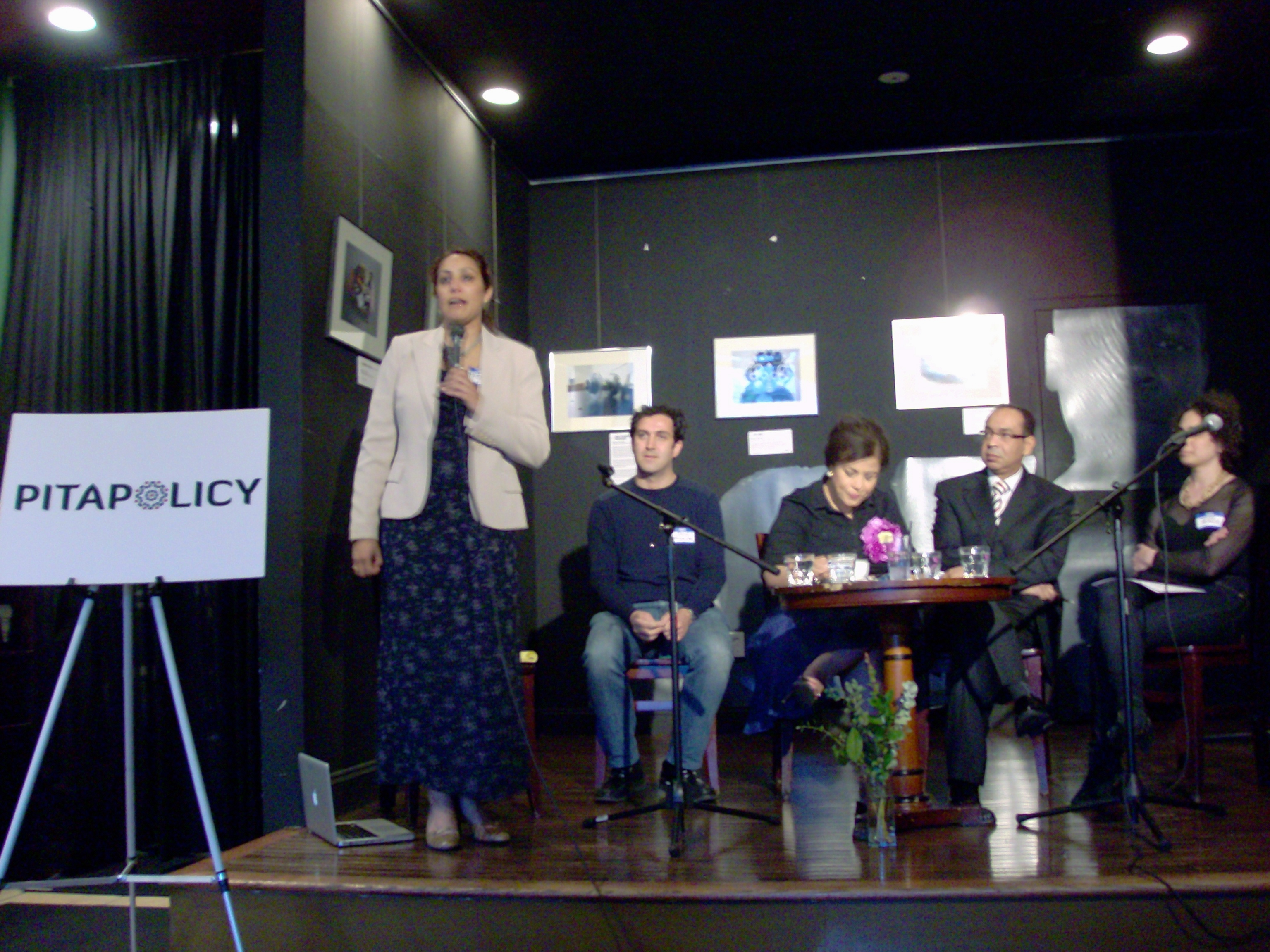
Panelists (seated from left to right): Omid Memarian, Hanan Elbadry, Fahd Benhawy, Danah Abdullah

#NAAPMM and Other PITA-Consuming Comments
By: Mehrunisa Qayyum

Media freedom varies across the pita-consuming region due to a) political culture (thanks Dr. Samer Shehata for providing great background on this subject during my Georgetown days); b) role of NGOs, c) types of media outlets, and d) who finances and shares ownership.

Q & A Session

On Monday, April 9th, PITAPOLICY sponsored its second event in the Media on MENA series in Washington, DC with the support of PITAPOLICY contributor, Ramah Kudaimi. The first Media on MENA event kicked off the series on September 29th, 2011.

Next month, World Press Freedom Day will be celebrated by UNESCO and the Government of Tunisia in Tunis from May 3rd-5th. It is exciting to see that the global forum has selected the theme: “New Voices: Media Freedom Helping to Transform Societies” and will be discussed in a pita-consuming country. PITAPOLICY was inspired to run with this theme for the #NAAPMM event. This was a great experience because Retweets from France, Oman, and Lebanon “re-shared” the speakers’ comments and statistics–in particular “More Arabs consume media than produce media #NAAPMM” by Sarah Hassaine, who live-tweeted as @shassaine.

Panelists discussed how media freedom varies across the Middle East & North Africa region due to:

1) Political culture;
2) Role of Non Governmental Organizations and watchdog agencies;
3) Types of media outlets; and
4) Approach to financing/ownership.

Below is the summary event press release prepared by PITAPOLICY contributors.

PITAPOLICY Co-sponsored 2nd Media on MENA Series Event: Media Freedom

On Monday, April 9th, PITAPOLICY Consulting and The Network of Arab American Professionals, Washington, DC Chapter (NAAP-DC) organized its second event in its Media on MENA series: Media Freedom Busboys & Poets on 1025 K Street. PITAPOLICY shared its media contacts to work with Cindy Ragab to coordinate the panel of four experienced Middle Eastern-American journalists across print, online, and television broadcast:

Hanan Elbadry, US Bureau Chief for Cairo News and returning panelist
Omid Memarian, IPS News Agency, Huffington Post Contributor Follow him on Twitter: @Omid_M
Fahd Banhawy, Journalist with several news agencies
Danah Abdulla, Founder of Kalimat Magazine Follow her on Twitter: @theyuppie.

“Journalists have been successful in changing the state’s narrative,” opened Memarian but noted how over “150 journalists in Iran have left” due to censorship and the state. Outside of MENA, Abdullah’s English language magazine, which invites writers from the Arab Diaspora to participate, will release its first print version this month.

Local DC bloggers & netizens participated online and offline under #NAAPMM–in particular: @omarbaddar @nermin79 @ramahkudaimi @shassaine @ayadmirjan @nadabrain. PITAPOLICY agrees with NAAP-DC that the goal continues to help promote knowledge sharing among the NAAP-DC community who work in or engage with the media industry. Banhawy presented in Arabic to showcase the range of skills needed to engage with MENA audiences.

Emily Manna & Omar Baddar of Arab American Institute

MENA journalists are global. In Hanan Elbadry’s case: she has interviewed dozens of prominent leaders, ranging from President of Sudan, Al Sadeq Al Mahdi, to US Secretary of State, James Baker–not to mention dozens of US Congressmen and Presidential Candidates, like Ralph Nader.

In the investigative journalism realm, Ms. Elbadray was the first reporter to be allowed inside Guantanamo Bay Prison and report on the super maximum security cell blocks (Camp 3). So it was exciting to hear her speak about her 20 + years of journalism experience to explain how Egyptian media has swung across the pendulum of media freedom–before and after the resignation of Hosni Mubarak’s presidency.


Egyptian Media: An In-Depth Perspective by Hanan Elbadry
Ms. Elbadry shared the following comments with PITAPOLICY after her panel participation:

  • “The remnants of the Mubarak regime figured out that it is best to fight the revolutionaries who used social media with a similar but more effective weapon. They provided one of their second tier men with billions of dollars and he went and bought or launched fourteen TV stations in less than two month.
  • Their objective was clear, control the information flow to the average citizen who does not read. He recruited journalists and media personalities who were loyal to or implicated with the Mubarak regime *plus some independents that were offered unbelievable salaries, and called the whole bunch the “Opposition”.
  • These TV station thrived thanks to massive advertising revenue by the“Oligarchs” of the Mubarak regime. The same person established a new daily newspaper and hired the “Almasry Alyom”editor to run it.
  • In addition, both the Muslim Brotherhood and the Salafists started their own TV stations and newspapers with money rumored to come from Saudi Arabia for the Salafists and from Qatarfor the Muslim Brotherhood.
  • The opponents of the revolution did not even leave alone the “Tahrir” TV channel, which was started by progressive journalists and became very successful in a very short time, so another one of the Mubarak remnants bought it.
  • Hamdi Qandil, of the clear political views, sharp pen, and distinctive writings evaluates one year of the revolution through the following dialog:
-Why did you leave the Tahrir channel?
-I did not leave the channel, but I froze my program until there is a change in management. My objection was not the person of “Mansour Amer” the new owner of the channel but I am against the businessman who buys the channel and also wants to set its policies and its editorial lines and the extent of its freedom.”

Special Thanks
PITAPOLICY would like to extend a special thanks to the Arab American Institute for promoting the event with their piece: Media Freedom. Also, a special thanks to Said Durrah, DC media personality; Rami Khater, Senior New Media Producer for Al Jazeera English; Feras Nabulsi (technical support); NAAP-DC Board members, Cindy Ragab (Programs Chair) Samer Korkor & Ethar Darwish (Chairs), Fatima Ahmed (Membership Chair & offline support), Mohamed Hafez (joint event logo design), Laila Mokhiber, Issa Salama (NAAP); and Sarah Hassaine and Ridah Sabouni, Advisory Board Members for engaging online and promoting outreach on media. NAAP is consisted of volunteers, so their support is immeasurable as they step up to engage.
######################
Note: PITAPOLICY looks forward to sharing the response to this event by a guest contributor next Sunday. Until then, keep tweeting about media freedom in MENA/pita-consuming countries using hashtag #NAAPMM–it might come up in our third event in the series, tentatively scheduled in the Fall.

Leave a Comment

Filed under Analysis, Interests, Politics

End of Pluralism: Where Does Syria Stand?

Today from 11:30 AM to 1:00 PM EST, PITAPOLICY Consulting will be livetweeting from the US House of Representatives to cover the Arab American Institute’s briefing: “The End of Pluralism: Religion & Conflict in the Middle East”. Pita-consumers are invited to watch the event on the web by tuning in to AAI’s livestream channel. (Do not forget to join AAI in its annual Khalil Gibran Awards Gala for April 18th by purchasing your ticket here. PITAPOLICY Consulting will be livetweeting from next week’s event as well to highlight the Awardees, like AMIDEAST President, Ambassador Theodore Kattouf.)

On that note, the piece below by local Syrian DC activist, Myhar Alzayat, reflects another perspective on the costs and benefits for more international intervention in Syria. PITAPOLICY believes in providing a platform to all pita-consumers to adhere to our credo of “breaking bread”: if one can “break bread” with another, they have taken the first step towards engagement, and building more concretely upon that diplomacy. The views expressed in “Living in Syria” are those expressed solely by the author.

Living in Syria: Another Perspective
By: Mhyar Alzayat

Living in Syria, seeing pictures of Assad the father, Hafez Assad, everywhere — from bakeries to hospitals to (on Taxi Cabs) – had its effect on people. The picture came in all sizes, but Assad’s face never aged as the “omnipresent” picture imposed on my life. It had its effect on me.  As a kid, I always wondered why Assad’s picture hung on the wall behind me in my classroom.  

As if he was watching me and my friends.  

I wondered why some men were holding guns at the entrances of government buildings. Buildings that the average Syrian would go out of his or her way to avoid, by walking on the other side of the road.

Syria has been ruled by the iron-fisted Assad family dictatorship for over 40 years.  This authoritarian dynasty stole the freedom of the Syrian people by implanting fear in them, by detaining and killing men, women and children, whose only way of expressing their opinion is through their voice.  The Assad regime has committed many crimes since the 1970s, such as the notorious Tadmor Prison Massacre and the infamous Hama Massacre in 1982.  It is said that over 20 thousand died in Hama, the vast majority of them civilians.

A generation later, the same mother who lost her husband in Hama in 1982 has lost her son in 2011.  

History repeats itself.

Only, this time, Assad the son is committing the massacre; and all while the world watches. Doing very little at all to stop it. The Assad regime is brutal and does not understand the language of dialogue — only understands the dialogue of destruction. We, as Syrians, are well aware of the cruel methods used to suppress an uprising that demands only the most basic of political rights, such as the freedom to choose who leads us, who protects us, and who represents the face of Syria — a country of over 20 million souls — to the world.

After 42 years of brutish, corrupt rule, and countless innocents killed or “disappeared” at the hands of regime forces, the Syrian people decided that enough is enough. They collectively organized their will and their courage to fight for their freedom. This is a new beginning, they decided, and an opportunity they must seize to forge a better future, not only for themselves, but for their children, and their children’s children.

One might ask: why the world should intervene? And, above all, why should the United States of America?  The Syrian people are running out of ways to plead for help. They are painting “SOS” signs on their roads. They are crying out explicitly for foreign intervention. I argue that: Not only is intervention morally right from the standpoint of stopping the slaughter of children and the rape of women, but it also the rational choice from the perspective of US geo-strategic interests in the Middle East. Without intervention the conflict will grow, and its ripple effect will reach neighboring countries.  Syrians just marked the one-year anniversary of their revolution, and they are showing no sign of giving up and going home.

There is no turning back.

Who Benefits?

How do the US and its allies stand to benefit? The defeat of Assad’s regime would be a huge setback for the Iranian government. The routes that supply Hezbollah through Syria will likely be severed. With the help of the Iranian government, Russia and militia groups foreign intervention has already started in Syria. These various groups are supporting the Syrian regime against the Syrian people. 

Those who do not benefit are the civilians. Civilians, and the poorly-armed rebels defending them, are fighting an unfair war, not only against the well-equipped Syrian military which takes orders from the highest levels of leadership, including the President himself, but also again the well-armed entities mentioned above.  If the United States does not help, other factions — who have neither the Syrian people’s nor the US’s interests at heart — will step in, and Syrians cannot be blamed for accepting the help.  

~Here are the questions I ask myself in reviewing the costs and benefits of intervention: 1) Do we want other countries to intervene  without our direct supervision?
~Do we trust their true motives?  

These questions are valid and there is little room for mistakes, particularly in the geopolitical tinderbox that is Syria and its environs.

We understand that intervention is not going to be a simple task. However, for the first time, the Syrian people’s desire for freedom and democratic changed have aligned with the values held so close by their American compatriots.  In Benghazi, it was Libyans, not Westerners, who raised the US, French and British flags to fly alongside the new Libyan flag of independence. Rather than simply advertising their good intentions in various press and TV outlets, the US and other Western states must do the right thing and turn their verbal support for the uprising into real action. Syrians have taken a huge chance, and are paying the price daily, by daring to demand freedom from fear and oppression. Should we not also take a chance on them?

We Worry About Who Follows Assad’s Legacy

Whether one is for or against international intervention in any of its forms, one might ask, who will be next to rule Syria? I am happy to report that Syria boasts a population of 23 million, in addition to a Diaspora totaling 17 million or thereabouts.  Many of these men and women are qualified, and more than willing, to lead a democratic, free Syria.  

In 1944, Syrians elected the Christian Faris al-Khoury as Prime Minister, and, upon his death in 1962, Muslims recited Quranic verses at his funeral showing their respect. Syrians have shown that they are united, regardless of sectarian or ethnic consideration. The current Syrian (Assad) regime tactics is to divide the Syrian communities in its effort to show that it protects the minorities.

I believe that foreign intervention in Syria will cause large-scale defections among the regular Syrian army and secret services, resulting in a quick defeat for the Assad regime.  Consider how Syrians are asking for air support to keep their freed land in Idlib and not lose the rest, as happened in the former opposition stronghold of Homs, which was overrun by Assad’s forces following a month-long bombardment that killed hundreds if not thousands. Without these freed zones, also known as humanitarian corridors, there will be no place for the defectors and their families to seek refuge. All the revolution needs is a small push from the global community. The rest will be solved at the hands of the Syrian people.

Note: Myhar Alzayat is a DC based Syrian American and activist. PITAPOLICY interviewed him in 2011 shortly after Syria’s Day of Rage for Kabobfest.

Leave a Comment

Filed under Analysis, Politics

World trade: Redrawing the map

PITAPOLICY has concluded March with a technology review of the Arab Net Summit. During the entire month, we reviewed 1) where innovation is most prominent in the MENA region; 2) how women are somewhat represented in Science, Technology, Engineering & Mathematics fields; and 3) how tech startups are competing in the Arab world.

This month, April will include postings mostly on transforming society–the successes and ‘try-agains”–in the political, social, and economic areas. PITAPOLICY invites response pieces and relevant essays from earlier blog entries. Please send to pitapolicy@gmail.com. Although the following piece identifies an example outside of the pita-consuming region, the development links the new shift in commercial trade. The Gulf countries continue to serve as a hub “south” of the “Silk Road”…

By: Afshin Molavi
Source: The original story was posted in Vision: Fresh Perspectives from Dubai.

To understand the tectonic shifts in global trade flows today, it might be useful to sit down. Pull up a chair in, say, Luanda, the capital of Angola. Chances are the chair will be made in Brazil, shipped across the Atlantic to Namibia, stored in a warehouse in a small village known as Oshikango, and trucked north across the border to oil-rich Angola. The newly affluent Angolans sitting in their Brazilian chairs might be surfing the web on a new iPad they bought at the Dubai Shopping Festival, where they were the ninth largest country spenders last year, according to Visa. Meanwhile, thousands of miles away, the main source of their wealth – the reason they are sitting in a Brazilian chair in a glitzy high-rise – sits in barrels in supersized tankers in the Malongo oil terminal, awaiting a journey to China, its biggest purchaser.

This small snapshot of trade – Brazilian furniture to Angolan living rooms, Angolan tourists to Dubai, and Angolan oil to Chinese refiners – tells a much larger story of our world’s changing economic geography. It tells of a quiet revolution taking place, of growing trade corridors and economic interactions between countries of the so-called global ‘South’ at a time when Western and advanced economies are faltering.

The Southern Silk Road

HSBC Chief Economist Stephen King calls this new commercial geography “the Southern Silk Road”, linking Latin America, Asia, Africa, and the Middle East. Much as the 1950s and 60s saw dramatic growth in trade among developed economies, HSBC sees “turbocharged trade growth” along this southern corridor in the 21st century. To some extent, it is already happening.

Of the roughly US$15tn in world trade that takes place today, nearly a third of that is conducted between emerging and developing economies, according to an examination of International Monetary Fund statistics. This share of intra-emerging markets trade has steadily risen over the past decade.

Brazil and India already conduct the majority of their trade – 58 per cent – in the ‘Southern Silk Road’, and China conducts nearly half. According to HSBC, by the year 2050, China will conduct 73 per cent of its trade South-South and India and Brazil will be at 83 per cent.
Africa’s new world map

So, how did Oshikango, once a backwater African village with high levels of poverty and disease, become a part of this story? It started with an act of infrastructure. The European Union offered a grant to build warehouses in the village bordering Angola. Those warehouses soon became part of the commercial lungs of southern Angola, feeding consumer goods from Latin America, Asia, and South Africa to the newly emerging Angolan middle class.

Most notably, as the scholar Gregor Dobler pointed out, the Oshikango trade network reflects Africa’s shifting patterns of trade, away from old colonial powers in the West, and more toward emerging economies of the ‘South’. Oshikango is, in a sense, a feeder spoke in a much larger wheel of global hubs and economies that are linking Africa to the growing web of South-South investment and trade.

If Oshikango is a spoke, Dubai is a hub. Dubai is emerging as a gateway to Africa, particularly for Chinese companies. Emirates Airline, the Dubai flagship carrier, flies to more African destinations than any Middle East carrier. Many of those flights are packed with Chinese executives based in Dubai, serving markets in Africa.

Transporting trade

While Dubai’s world-class hotels and lavish skyscrapers capture the headlines, its quietly efficient seaports and its air transport infrastructure make it a vital piece of the global trade puzzle. Dubai International Airport ranks sixth in terms of international passenger traffic, ahead of Singapore and just behind Frankfurt, according to Airports Council International. Its container terminal port ranks in the top 10 busiest. This transport infrastructure – along with oil in Abu Dhabi – is one reason why the United Arab Emirates today accounts for more world trade than Brazil, Australia, Saudi Arabia or Turkey.

Trade, development and dignity

The distinguished Indian journalist and scholar Sanjaya Baru wrote recently that, “the structural shift in the world economy, with Asia making up for the lost dynamism of the transatlantic economies, is altering the geography of development.”

But this is not just a story of a new commercial geography. Nor is it only a story of the key hubs, of the companies, of the banks financing these new trade corridors, or the ships ambling across the Indian Ocean, binding West Asia and East Asia together. This is a story of the dignity of development and, in that respect, the world should be embracing the rise of the new South-South trade corridors and offering opportunities for better lives across the global ‘South’.

Note: Afshin Molavi is a Senior Advisor at Oxford Analytica, a leading global macro advisory and analysis firm, and a Senior Fellow at the New America Foundation, a non-partisan Washington think tank. He is also a former journalist who has been based in Dubai, Riyadh, Jeddah, Tehran, and Washington, DC. Follow Afshin on Twitter: @AfshinMolavi

1 Comment

Filed under Analysis, Interests, PIDE (Policy, International Development & Economics), Politics

Business in Beirut

PITAPOLICY has gained a new appreciation for technology–not simply because of attending the Annual ArabNet Summit. Although the Lebanese War lasted until 2006, Lebanon’s capital has drastically undertaken measures to boost its economy–notwithstanding the significant re-investment of the Lebanese Diaspora community, which is around 20 percent of Lebanon’s overall GDP. PITAPOLICY is struggling to accept two regular occurrences: 1) power shortages; and 2) EXTREMELY slow internet connection. So, apologies for the delayed post.

Lebanon’s Minister of Telecommunications shared that “he and his ministry will study and review the needs of the Lebanese people first” before investing in the infrastructure needed to support the 4G network. Will telecommunications support show up as a proposal in the array of US Agency for International Development (USAID) programs currently underway in Lebanon?

PITAPOLICY reflected on what “Lebanonization” meant for rebuilding a country physically and psychologically after the 1975-1991 period of conflict and outside intereference. Also PITAPOLICY explored the ruins of Baalbek and Jubail (Byblos is the Greek name), and learned of the series of invasions, the archaeologist guide explained a few key luxuries that informed the larger international development expectations. International development expectations differ between those implementing infrastructure from those depending on it. The latter might argue that such dependence should more realistically be understood as luxuries:

Knowledge Exchange
1) Incorporating a “Plan B” is a must for any entrepreneur formulating a business plan. (Thanks to Desiree of Endeavor Lebanon’s program for sharing that insight after her High-Impact Entrepreneurship Panel on March 31st.)

2) Tipping more than 10 percent should be encouraged for decent service at casual restaurants. PITAPOLICY strongly believes that this will decrease the “baksheesh” culture. If one expects better, and rewards it, the paranoia factor decreases. I promise.

3) Don’t bargain all the time. It’s an addiction that can bite you in the leg if exercised in an obsessive compulsive way. For example, the vendor might say ‘yes’ because he/she has already figured out a way to make up for the “bargain” by short-changing the customer on something else. Just ask the silly college student who kept bargaining by saying “I’m a student, I can’t afford to pay that much!” and got greedy by increasing the quantity she wanted to purchase only to pay the difference on the second item 🙁

Before a Conference:
4) Never schedule a brief meeting right after day 1 or 2 of the conference. You paid a lot of money to attend the conference, be open to impromptu networking opportunities.

5) Bring pen and paper; just because we all have smartphones, there is a strong chance that the phone is going to get misplaced–or God forbid–run out of battery as you try to grab details from a new contact.

6) Always be gracious with the staff supporting the conference. For example, pack blank ‘Thank You’ cards to express specific thanks for tasks or insight that a Media Relations or Tech support staff provided.

During a Conference:
7) ALWAYS, accept to a coffee chat--even if you really want to attend a particular panel you have flown over 1,000 miles to hear. Here’s why: If that person accidently loses your business card in transit, at least he/she has a face to remember and is more likely to follow up upon his/her return.

8) Be professional at ALL times, no matter how high-level a new acquaintance is and how comfortable he or she is hitting on you.

9) Always smile–do not roll your eyes at foolish questions during the Q and A portion. Even if the person raises his/her hand and asks the CEO what planet he is from, do not even grimace or wince. In the high tech days of live-streaming tweets and on site video recordings, don’t be that attendee who’s remembered for rolling his/her eyes on the 30 foot screen.

After the Conference:

10) Conduct your own focus group among the local community. Stepping away from cliches exchanged in the meeting room and government official news will do wonders for your creativity. It is easy to be conservative/quiet/even “snobby” by not speaking with the cab drivers about what life is like. But what is the point of delivering monologues on international development challenges if the target audience for the intervention is not someone you see as a concerned citizen, much less, even on your radar…

Finally, PITAPOLICY learned that no matter how many times a civilization is invaded, destroyed by natural disasters, menaced by wars, or disrupted by corruption, exchanging cultural and institutional knowledge is the best practice for thriving, not just surviving.

On a sidenote, PITAPOLICY dealt with the slower internet connection to research and post by reading Lebanese-British blogger, Nasri Atallah “Our Man in Beirut”. Atallah’s analysis and humor are recommended for immediate reading before conducting research or business in Lebanon 🙂

1 Comment

Filed under Analysis, PIDE (Policy, International Development & Economics), Technology

Winner of ArabNet Digital Summit & Other PITAPOLICY Observations

“Internet has democratized the concept of content and distribution.” ~Omar Christidis, Founder of the ArabNet Digital Summit

On Tuesday, March 27 2012, ArabNet Digital Summit convened over 200 MENA professionals to kick off the first of the Developer Days. Before I get into my thought of the week, I want to congratulate the Winners of the ArabNet Digital Summit’s Overnight Competition. These bright individuals are as follows:
~ Hasan Arous (Syria),
~Bilal Itani (Lebanon),
~Abdelmohimen Alagha (Syria)
~Ata Alqadi (Jordan).

Integral awarded the four winners prizes!

I am participating as entrepreneur, blogger, consumer…yet I still get the question: “What brought you here–you’re not in the technology field…”

I couldn’t agree more with this observation, but there’s more to technology than making sense of ‘zeros and ones’ or imagining the next innovation. When I say MENA professionals, I need to look beyond engineers and ICT experts because I am neither of those. However, their fields intersects with two of my interests: entrepreneurship and knowledge sharing. PITAPOLICY represents the social entrepreneur side of PITAPOLICY Consulting, which represents the business side. For instance, please review this 10 minute survey on technology…Thanks for your time pita-consumers!
Click here to take survey

In a nutshell, both concepts complement each other because I am a new entrepreneur providing a needed service…and I am a female who wants my work and thought to represent PITAPOLICY. My tweets represent the PITAPOLICY observations, not my gender. My blog represents my platform, not my personal life story. That’s where technology enters the picture: technology serves as my marketing and public relations tools. That’s why I am an enthusiastic attendee and decided to register as an ‘Entrepreneur’–and to support my fellow bloggers as we continue our knowledge sharing from online to face to face communication. For example, PITAPOLICY has met with Lebanese Blogger, Assaad Thebian: @beirutiyat. I have also met a blogger who blogs in Arabic: Alaa Chehayeb.

I also see the benefits technology provides to my third interest–I should have mentioned that earlier…but it’s on the periphery of today’s main theme. My third interest is development. We have seen how mobile devices can facilitate development goals by providing access to lower-income families and women in lower-income countries, like Afghanistan.

The Summit will last through March 31st as it tackles the latest in web and mobile with panels hosting top executives from the digital sector, numerous hands on workshops covering the hottest platforms in addition to highlighting the 20 most anticipated startups and ideas with the Ideathon and Startup Demo competitions.

******************************************************************************************************
Trends on MENA’s Technology Ecosystem
The ArabNet Summit reaffirmed some trends and statistics regarding MENA’s Technology Ecosystem, as my fellow PITAPOLICY pita-consumer, Ramy Ghaly, shared in his piece a few months ago. According to Ziad Matar, Qualcomm VP of the MENA region: there are around 5 billion mobile subscribers worldwide, a number much larger than that of people who have access to water or the number of screens. The panel highlighted the importance of mobile and web devices in connecting the world. In Tanzania, 190 babies were born last month using a special phone application, Matar said.

Also, 75% of time spent on smartphones worldwide is not on voice or text, but on web and apps. She also estimated the average amount spent in mobile ads to USD 600 billion.

Omar Christidis, who moderated the session, had started with a quick review of stats: 77 % of users have liked a brand on Facebook, 50 % have received customer service via twitter, 100 million Youtube video are played every day and 85% of mobile internet users have downloaded apps before.
The panel also discussed the issue of mobile security and protecting the user’s privacy, which “some people are willing to sacrifice, to stay connected,” Christidis said.

“We used to go to main sites to read content, today destination sites are losing importance, people are reading articles through their social feeds, or articles shared by friends,” Omar Christidis said.
 “We used to have excessive campaigns. Today push advertising is replaced by forums that add value to the clients and involve them in decision making,” he said. “New media can be a tool to build a relation between governments and their citizens, by creating initiatives to enhance transparency and communication channels.”


 “Smarter Planet: An industry view of turning Information into Insight” was the title of the second session, presented by Ali Munawar Zakaria, Director of Demand Programs, Middle East and Africa, at IBM.
According to Zakaria, we are all linked economically, socially and technically: economically via wars and oil prices, socially via uprisings, and technically via the web for example.
“We have become very empowered consumers and citizens and everything has some kind of technology build into it,” he said.

According to Zakaria, there are “1 billion mobile camera phones, 2 billion people on internet, 4 billion mobile phone subscribers and 15 petabytes of information generated every day.”
Zakaria highlighted the importance of introducing monitoring, analysis and action to smarter health, education and government sectors.

Zakaria’s “Smarter Planet” was followed by a short talk on Technology and Industry by Firas AlFanney, General Manager, Levant and North Africa, at Intel. AlFanney highlighted Intel’s programs in emerging markets. Intel is working with Egypt, Lebanon, Palestine, Morocco and Watar on programs that give people access to technology, with a focus on education.

“In the 21st century, we should have the student center model, and the teacher should play the role of a facilitator,” he said. “Student can manage their own time; access the internet, do critical thinking, etc…”

AlFanney suggested developing special curricula which target students, help train teachers to adapt technology in the classroom, implement information communications technology and tablets for higher grades.

The session was followed by a talk on social media and consumer relationship with Fawzi Rahal, Regional Digital Director at Grey MENA and Mustafa Bilge, Founder and Managing Partner at Semanticum.
During the summit, Egypt’s Ideavelopers announced investing USD 1.3 million dollars in Dr.Bridge health care company.

The Developer Days started off with the “Mobile Hour” which gave an inside look at the hottest upgrades & tools in the mobile industry. Ahmed Adel, Developer and Platform Evangelism Sales & Operations Director at Microsoft, said “the average number of text messages (sms) sent in 1998 per person was 4. Today, 6.1 trillion text messages are sent worldwide.”  William Kanaan, New Business Development at Google, said mobile devices will outnumber PCs next year. Gilles Fayad, Director Products & Services, MEA at Qualcomm said that new devices will learn from users and that in the future everything will be connected.
 
The “Mobile Hour” was follow by “Trends in Mobile Consumption in the Saudi Market” by Mr. Sebastien Marteau, VP of Mobile at Integral. Marteau highlighted the best practices of developing mobile digital products and insights into the global app industry. According to Marteau, Saudi Arabia is a very young market with very high penetration rates, with 2 SIM cards per person in the kingdom. Marteau also said that 47% of people in KSA use apps provided they are in Arabic.
 
In addition to technical sessions on Google Web Toolkit, Developing Windows Phone Apps, SEO for web developers and “Mobile Phones getting Smarter”, “Developing with Security and Privacy in mind” and “UXHour”,  Amina Belghiti and Stephane Crozatier from Facebook, gave a talk in which they highlighted some key stats and figures regarding social media.
  
***The day was followed by a night competition, “Overnight”, that aims to test the skills of developers and identify the best engineering talent in the region. The competition started at 8PM on Tuesday, till 8AM on Wednesday. Competitors were challenged to build a simple web application or a mobile app in just 12-hours.

(Note: PITAPOLICY asked Christidis why there were no female competitors this year. However, it wasn’t for the lack of trying to reach out to this underrepresented gender with respect to the tech industry as Christidis acknowledged this challenge.)  

Leave a Comment

Filed under Analysis, PIDE (Policy, International Development & Economics), Technology, Uncategorized

PITAPOLICY Attending Arab Net Summit

Between March 27th-31st of this week, PITAPOLICY Consulting will be covering MENA technology and entrepreneur issues at the Arab Net Summit in Beirut. Since MENA is revitalizing its technology and entrepreneurship course in global affairs, PITAPOLICY Consulting looks forward to sharing trends and industry insight in an assessment. For a detailed review, please contact PITAPOLICY to inquire on service and products.

Also please review this 10 minute survey on technology…Thanks for your time pita-consumers!
Click here to take survey

Leave a Comment

Filed under Analysis, Technology

Response to #MENA Women in STEM

PITAPOLICY continues its focus on the “T” in PITA (Technology) Last week, PITAPOLICY posted Daniel Armanios’s piece, which broke down the problem of Technology Use & Knowledge Sharing in the science and diplomacy spheres. In the first week, PITAPOLICY contributor, Sharifa Al Barami shared her piece on entrepreneurship as she uses social media to connect with others in Oman and beyond. PITAPOLICY’s introduction received some push back by one of its followers because we stated that “globally, women are not well represented in science, technology, and other innovative fields” after noting that only 4 of the top 100 Arab Women came from those fields. Hence, this week we are delighted to include Marc Arenstein’s response blog piece.

Mr. Arenstein contests PITAPOLICY’s use of “globally” and provides his observations. Nonetheless, PITAPOLICY stands by its earlier statement because we see that women are not represented in the STEM fields professionally–regardless of their enrollment rates in such courses at the university level. This challenging trend applies not only to MENA, or ‘pita-consuming’ region, but in other regions as well.

PITAPOLICY Invites PITA-Consumers Participate in Technology for Business Survey
PITAPOLICY is conducting a 22 question survey throughout March. The survey targets both technology professionals and non technology professionals who work in the Middle East & North Africa region. So yes, non Arabs (also pita-consumers) are also encouraged to participate -Turkey, Berber speakers, Iran, Persian Speakers, Azerbaijan, Afghanistan and Pakistan included. Click here to participate in the 10 minute survey!

Rebuttal by Marc Arenstein
The following remarks are intended to begin fleshing out the statement “globally, women are not well represented in science, technology, and other innovative fields” from the March 7, 2012 introduction to “March features Technology in MENA: Oman Entrepreneurial Jam

With apologies to women and other readers in Far Eastern, Central and Eastern European, and Latin and South American and other significant global regions for not being represented in this short piece; some countries that raise the STEM gender bar a bit further and others aware or becoming more aware of it.

My impression is that although the undergraduate university enrollment of women in MENA and Gulf countries in Scientific Technological Engineering and Medical (STEM) fields – let’s throw in Information Technology and Communications (ICT) and Mathematics too, and while we are at it, Business and Finance – may be anywhere from a tenth or less to a proportion more than male enrollments – actual work participation in the labor force in these professions in MENA and Gulf countries is severely restricted to single digit percentages, well below Western thresholds. Therefore, the nuances are different.

To get an idea check any/some Google Scholar results, like , this search http://scholar.google.co.il/scholar?start=20&q=arab+women+professions+statistics+science+OR+technology+OR+engineering+OR+medicine&hl=en&as_sdt=0,5&as_ylo=2010 or these or these searches. There does seem to be professional female pioneers representing all these field–and likely more in the most unexpected of MENA countries. Is this a trend? Perhaps, but don\’t expect immediate jumps in numbers. This depends on private industry, multinational corporations, civic and public encouragement and NGO support and, hopefully, when the numbers become more significant, they can begin assisting men too – unlike the record in the West where aging de-salaried male inadvertent freelancers are the new emergent disadvantaged. Note that there is even legal equality in some MENA countries for women, but I am not checking salaries just yet. The nuances in the West are different. For unclear reasons, women still generally get less pay for equal work but the multiple of the difference changes between countries. Proportions of women CEOs and prominent women in senior management positions are still lower than in “middle class” professional positions. But both are in general quantitative retreat for both genders anyway. The percentages of women active in these fields is generally between 10-30%+ depending on the field and the country. My guess is that by the time AI cyber robots/automation replaces much, if not most, white collar work in the West, many more people and many more women than today will be gainfully employed in the new world.

Note: Follow Marc Arenstein @traintalk is on the wrong side of the employment and other divides and probably does not figure in any STEM or any other statistic for that matter except internal Google logs and perhaps immeasurably in a few minds for a few moments.


Global Innovation Policy Index Only Includes Two MENA Economies

PITAPOLICY will attend the 2012 Arab Net Summit in Beirut, Lebanon at the end of March for a few reasons. Firstly, PITAPOLICY leverages social media technology to promote the business entrepreneurial goals of PITAPOLICY Consulting and continues to learn about better ways to engage these tools.

Secondly, Technology & Innovation was the subject of a report issued by the Kauffman Foundation of Entrepreneurship in early March. The report authors, Robert D. Atkinson, Stephen J. Ezell, and Luke A. Stewart compiled the Global Innovation Policy (GIP) Index, which tracked the innovation capacity of 55 economies, only two of which come from the MENA region: Turkey and Israel. Lebanon nor Egypt were included. Notwithstanding that many MENA countries–in particular Arab countries–have been reported to be less robust in data-sharing, PITAPOLICY is alarmed that the region is not more represented in the GIP Index.

The GIP Index examines innovation policy by aggregating 84 metrics into 7 areas. These 7 are:
1) Open and non-discriminatory market access and foreign direct investment policies;
2) Science and R&D policies that spur innovation;
3) Openness to domestic competition and new firm entry;
4) Effective intellectual property rights protection policies;
5) Digital policies enabling the robust deployment of ICT platforms;
6) Open and transparent government procurement policies; and
7) Openness to high-skill immigration.

Additionally, we look forward to exploring the challenges of ‘pita-consuming’ women in Science, Technology, Engineering and Mathematics (STEM) and how they translate their degrees into gainful employment.
https://www.surveymonkey.com/s.aspx?sm=0iKWFaHMZYxGRa44tK/wHg%3D%3D#q1

4 Comments

Filed under Interests, Technology
